• TalkBass has been independent since 1998. Add your voice.
    Create a free account to reply to discussions, view embedded media, and browse with fewer display ads.
    Join freeLog in
    Want zero display ads or expanded classifieds tools? Compare plans.

Power Amp Consideration - Program or RMS

YourGuitarist

Commercial User
Jan 31, 2024
351
399
Denver
Disclosures
Myself, Nothing ATM
Been lurking on TB for years but decided to start posting here as I'm really diving into building.

Basically, I'm designing a combo rn and need power Amp suggestions.

The load is 4ohms (two 8s parallel) and the linear Xmax is simulated at ~300W RMS with the mechanical max occuring around 800W (simulated with vituixcad). I understand that program and sometimes peak power is nominally 3dB above RMS and that is what is usually quoted. I've been eyeing the ICE power units (don't we all) and I can't decide between the 125ASX2 in BTL for 450W or the 300AS1. I've got a somewhat tight budget (<200 ideally) and idk if my cab will distort audibly above the linear Xmax and render anything more than 300W useless or if I'll lose the 300W RMS because I can't reach the "600W" program/peak power. In a perfect world I'd splurge and overkill like a 700AS1 but that's too expensive. I know that I could also buy the SURE series which are budget but then lack the supply and likely relegate me to single supply design.

There will be a peak limiter at the output and general compressor in the pre.

Any and all suggestions/advice is appreciated.

I know it's a lot. Ty!
 
  • Like
Reactions: DJ Bebop
RMS power is the only metric that matters. Peak is just double the RMS value for amplifier power because it’s just a different way of stating the power of the same waveform.


Program power is a number that’s made up to describe power handling of speakers in unclipped, uncompressed signal and represents a crest factor expansion of +3dB over continuous .

When looking at Xmax, that’s based on RMS metrics. Going beyond Xmax on most drivers results in accelerated and cumulative damage.

Mechanical maximum means virtually nothing without knowing exactly what this means, and generally it’s stupidly overstated based on driver survivability for a ridiculously short period of time.

If you have a limited budget, you will come out WAY ahead by finding a good used amp with similar performance.
 
Honestly knowing that mechanical Xmax is inflated is a huge save. I couldn't afford to buy a replacement.

A lot of the confusion comes from the ratings on power amps being unusual. They gives RMS but that doesn't guarantee they can hit the peaks because real signals have much greater crest factors than a pure sine wave and power supplies can limit the instantaneous peaks too.

While buying a cab is tempting fs, this is actually a design capstone that I got a grant for and hopefully could go commercial in time.

I'm gonna crack the sim open again but it seems like the 125ASX2 is the best bet with a compromise in power protecting the system.

Thanks for providing a second opinion.
 
What is the mechanical power handling of the speakers in the cab? If you like strong lows, AFAIK this will be the limiting factor.

Mechanical power handling varies with the box design. Run the same driver in different tunings, and the mechanical power handling will change. Mechanical power handling may be significantly less than the RMS power rating.

The driver's RMS rating is essentially the thermal rating of the voice coil. I.E. how much power it can dissipate long term without overheating. The RMS rating is relevant in the mid range, where driver excursion remains relatively low. It's not necessarily relevant for low frequencies where driver excursion becomes large.

AFAIK, RMS, Program, and Peak come from the way drivers are tested. Keep in mind some driver tests only run for 2 hours, and the driver does not necessarily have to still meet spec to past the test. I.E. the driver can incur damage, but still pass.

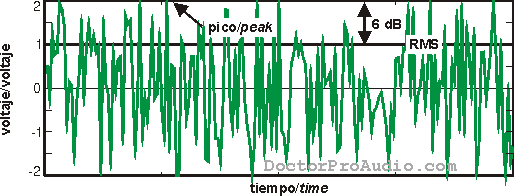
The test waveform has a 6dB crest factor. Definition: Crest factor is the decibel difference between the RMS value and the Peak value of the waveform.
aguante1.gif

RMS is basically a long term average rating. The power can go above the RMS rating, but only for a short time.

Program power is 3dB higher than the RMS value. Program is basically a short term max value measured in RMS Volts and Watts.

Peak is 2X an RMS value. Peak power is measured in peak Volts. With speaker testing, Peak is usually Related to the Program power rating...but this can vary, I.E. some companies relate the Peak power to the RMS rating. (Yes it's confusing).

400Wp = 200W RMS

400Wp at 8 ohms requires sq rt(400x8) = 56.57Vp

200W RMS at 8 ohms requires sq rt(200x8) = 40V RMS

But it's the same waveform
upload_2024-2-18_14-29-31.png

The difference between 56.57Vp and 40V RMS is how the measurement is taken...but again it's the same waveform. Understand that a constant sine wave has a 3dB crest factor: Covert from 200W RMS to 400Wp is a 3dbB crest factor...but again, it's the same waveform...no change.

The RMS value of a waveform is the DC equivalent. 1Vp produces the same amount of heat at 0.707V DC or 0.707V RMS. 56.57Vp produces the same amount of heat at 40V RMS.
upload_2024-2-18_14-36-18.png


To covert RMS Volts to Peak Volts, multiply the value by sq rt of 2
40V RMS x sq rt(2) = 56.57Vp​

To covert Peak Volts to RMS Volts, divide the value by sq rt of 2
56.57p/sq rt(2) = 40V RMS​
 
What is the mechanical power handling of the speakers in the cab? If you like strong lows, AFAIK this will be the limiting factor.

Mechanical power handling varies with the box design. Run the same driver in different tunings, and the mechanical power handling will change. Mechanical power handling may be significantly less than the RMS power rating.

The driver's RMS rating is essentially the thermal rating of the voice coil. I.E. how much power it can dissipate long term without overheating. The RMS rating is relevant in the mid range, where driver excursion remains relatively low. It's not necessarily relevant for low frequencies where driver excursion becomes large.

AFAIK, RMS, Program, and Peak come from the way drivers are tested. Keep in mind some driver tests only run for 2 hours, and the driver does not necessarily have to still meet spec to past the test. I.E. the driver can incur damage, but still pass.

The test waveform has a 6dB crest factor. Definition: Crest factor is the decibel difference between the RMS value and the Peak value of the waveform.
aguante1.gif

RMS is basically a long term average rating. The power can go above the RMS rating, but only for a short time.

Program power is 3dB higher than the RMS value. Program is basically a short term max value measured in RMS Volts and Watts.

Peak is 2X an RMS value. Peak power is measured in peak Volts. With speaker testing, Peak is usually Related to the Program power rating...but this can vary, I.E. some companies relate the Peak power to the RMS rating. (Yes it's confusing).

400Wp = 200W RMS

400Wp at 8 ohms requires sq rt(400x8) = 56.57Vp

200W RMS at 8 ohms requires sq rt(200x8) = 40V RMS

But it's the same waveform
View attachment 5356292
The difference between 56.57Vp and 40V RMS is how the measurement is taken...but again it's the same waveform. Understand that a constant sine wave has a 3dB crest factor: Covert from 200W RMS to 400Wp is a 3dbB crest factor...but again, it's the same waveform...no change.

The RMS value of a waveform is the DC equivalent. 1Vp produces the same amount of heat at 0.707V DC or 0.707V RMS. 56.57Vp produces the same amount of heat at 40V RMS.
View attachment 5356295

To covert RMS Volts to Peak Volts, multiply the value by sq rt of 2
40V RMS x sq rt(2) = 56.57Vp​

To covert Peak Volts to RMS Volts, divide the value by sq rt of 2
56.57p/sq rt(2) = 40V RMS​

That is thorough. Great stuff.

Yes my cab is ported with an Fb=Fs of 35, so very deep lows indeed. Until this post, I hadn't been paying attention to how the midband power breaches the AES power (2 hour test) per driver so that's good to know.

There was an article by peavey with many of the calcs you have here that I have saved somewhere, I'll have to dig it up. At one point, I was running a similar process using Ohm's Law as you have here but I got real unsure when factoring in frequency dependent impedances and the superposition of multiple frequencies. Combing through TB today I found someone referring to a Klippel post on how the output increases nonlinearly around the tuning frequency at higher signal levels. Another consideration for sure as it could induce chuffing at the port frequency or over-excursion. My takeaways here are that I should provide some buffer between the xmax and thermal max as there are anomalies at high levels. I know there is a limit to theory and simulation where bench testing takes over.

The other unknown is how the driver sounds at the reported linear xmax as the value provided is not 10%THD but a function of the gap. I'm hoping that it's either a nice soft clip but it'd suck if its intermodulation etc before it even reaches the published spec. Same with class d amps, their distortion is quite distasteful so I really have to operate under the 1% range.

Continuing with the ASX125, I'm wondering if I'm safer running it closer to ~400W pk since each driver is AES rated for 250W RMS. At 225W RMS per driver, I'm dangerously close to the AES rating and bass signals (and especially fuzzes) again are not sines so their RMS may be higher (granted the clean crest factors are more like 3-5 IMU).
 
  • Like
Reactions: Wasnex
Honestly knowing that mechanical Xmax is inflated is a huge save. I couldn't afford to buy a replacement.

A lot of the confusion comes from the ratings on power amps being unusual. They gives RMS but that doesn't guarantee they can hit the peaks because real signals have much greater crest factors than a pure sine wave and power supplies can limit the instantaneous peaks too.

While buying a cab is tempting fs, this is actually a design capstone that I got a grant for and hopefully could go commercial in time.

I'm gonna crack the sim open again but it seems like the 125ASX2 is the best bet with a compromise in power protecting the system.

Thanks for providing a second opinion.

Xmax is the mechanical linear axial displacement limit, it's not inflated. Xlim is the mechanical limit before (virtually) instantaneous catastrophic damage, but driving a speaker this hard for more than a few minutes will tear the suspension components up so you want to stay well away from this point.

The ratings on ICEPower amps are absolutely standard and easy to understand IF you really know what power amp specifications are and how they are derived. The crest factor above continuous power for most power amps is less than 1dB, so driving for less than 20msec above that value will simply clip the power amp. It's critical to understand the clipping behavior of any amp, and what goes along with this. There is a ton of information that's contained between the lines of power amp data sheets. That was the basis for one of my patents applied to ICEPower technology about 15 years ago. I have been working with their products since the beginning of the company.

If there is any ties to commercial applications, you need to declare yourself as a commercial user here, the commercial user policy is so that everybody is clearly identified.
 
I'm just a bass player, but thought to add since my "bass amp" consists of an Eden Module preamp and a Crown XLi 1500 power amp. The 2 channel Crown powers a Carvin 2×10 unported and separately a ported Carvin 15. Each cabinet is rated 400w @4 ohms, amp is 450w RMS @4 ohms per channel. Is sounds amazing and feel everything is paired up properly. Lastly my preference is still A/B over D.