• TalkBass has been independent since 1998. Add your voice.
    Create a free account to reply to discussions, view embedded media, and browse with fewer display ads.
    Join freeLog in
    Want zero display ads or expanded classifieds tools? Compare plans.

Practice bass....

How about I mix things up a little....

I have a small practice amp, but I'm not going to be able to use it all the time while I'm learning practicing.

I'm guessing that learning on an acoustic or semi-acoustic is as counter-productive as what has already been discussed.

So, is a headphone amp the best answer?
 
  • Like
Reactions: AudioTaper
How about I mix things up a little....

I have a small practice amp, but I'm not going to be able to use it all the time while I'm learning practicing.

I'm guessing that learning on an acoustic or semi-acoustic is as counter-productive as what has already been discussed.

So, is a headphone amp the best answer?
Buy and practice on what you want to play. (Get the bass you want)
A headphone amp is $40ish.

Does your little practice amp have a headphone jack?
 
Buy and practice on what you want to play. (Get the bass you want)
A headphone amp is $40ish.

Does your little practice amp have a headphone jack?
Good point. I have a Lowdown Studio 110 which has a headphone output. It also has a line input so I can play along to anything I like. I think that will work better than a battery power headphone amp, especially with the recessed/angled design of the jack out on most Ibanez models.

The reason I thought about an acoustic or semi-acoustic, is that I do have a potential use for it once I can play reasonably well.
 
Good point. I have a Lowdown Studio 110 which has a headphone output. It also has a line input so I can play along to anything I like. I think that will work better than a battery power headphone amp, especially with the recessed/angled design of the jack out on most Ibanez models.

The reason I thought about an acoustic or semi-acoustic, is that I do have a potential use for it once I can play reasonably well.

Worry about an acoustic bass after you get the one you want, which is that Ibanez unless things have changed.
 
After a few issues with getting a "new" bass, it's also given me time to think and I've slowly moved my focus from an entry level model to something a bit more substantial. I haven't yet pulled the trigger, but I'm extremely tempted.

So what I'm wondering is if people generally have a practice bass to learn and mess about with, rather than put their prized possession through daily torture.

Part of me is saying I should get something dirt cheap for practicing and messing about etc, but I don't know if I'm just being overly cautious.

Any thoughts?
"Quality is always better than quantity". I recommend you buy just one really nice bass to practice and gig with. And have it set up by a pro. The more you 'love it' the more you'll want to practice, and familiarity (muscle memory) will make playing much easier and enjoyable.
 
Weight is also something I've seen a lot of discussion about, that is one of the reasons I was put off the Squier Contemporary Active Jazz.
I have its predecessor, a Squier Deluxe Active Jazz and while I came to like it, it really is a big clumsy neck diving thing compared to my Ibanez SR. It is large and I have to take a particular sitting position to play it both because of the offset (can't really play that sitting on a flat surface like a couch, you need a chair or a stool) and for the need to push the body down with the plucking arm to counterbalance the neck dive.
It weighs 4.5 Kg in spite of having a basswood body against 3.6 for the all maple Ibanez SR370.

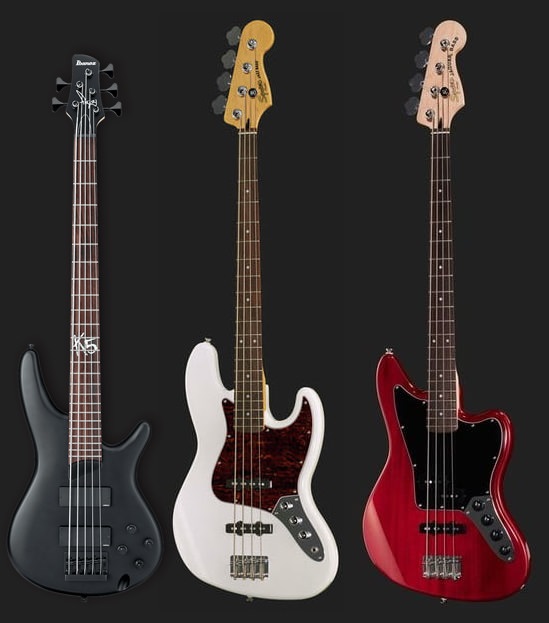
Fender basses are ridiculously large in comparison to the modern Ibanez:
lLhqLe5.jpg
 
Good point. I have a Lowdown Studio 110 which has a headphone output. It also has a line input so I can play along to anything I like. I think that will work better than a battery power headphone amp, especially with the recessed/angled design of the jack out on most Ibanez models.
The VOX Amplug 2 has a swivelling jack which will fit nicely into an Ibanez SR. The older model does not and will not fit. I know, I have one of each. They're great to play in the woods but the real issue is the headphones.
You want enough cable, yet not too much (for an Amplug) or a lot more (to reach your amp sitting somewhere in the room) and you want to keep it out of the way while playing so it's either running down your back or down the neck side of the head phones to avoid being caught between you and the body of the guitar. Small things that matter when choosing headphones.
 
I think I mentioned that I'm not really a fan of Precision basses. I've seen enough comments from people saying they've spent a lot of money on Fender basses and haven't been happy with them. Weight is also something I've seen a lot of discussion about, that is one of the reasons I was put off the Squier Contemporary Active Jazz.

You can’t go wrong with a Sire V7 or V7 Vintage (preferably Generation 2 but Generation 1 is also good). They compare very favourably with other top end basses I own or have owned such as Sadowsky, Xotic and US Fender and are 25% of the price.
 
  • Like
Reactions: Erik Asma
How about I mix things up a little....

I have a small practice amp, but I'm not going to be able to use it all the time while I'm learning practicing.

I'm guessing that learning on an acoustic or semi-acoustic is as counter-productive as what has already been discussed.

So, is a headphone amp the best answer?
I have a Warwick BC10 practice amp and most of the time I use it with itunes/ForeScore and headphones. But if I didn't own that, my TecAmp Puma (Eich) 500 has audio in and headphone out for practice so I'd use that.
 
I have a practise bass. I use a small cheap short scale. Why? Because a big long scale is uncomfortable when I'm lying on the coach watching TV. Which is the only place I do any practising (as in mindless noodling) by myself.

But I'm not using a cheap bass because I'm worried about wearing out my favourite. It's 100% only because I'm lazy and the most comfortable position on the coach will have my arms at painful angles with a long scale.:D
 
My opinion: Get a bass you love to play and don't mind taking to all the kinds of places you expect to play at. Use it everywhere. The "you love to play" part trumps the other parts, though.

For me, my Squier Classic Vibe 70's P bass with a bunch of mods is that bass. For someone else it could be a high end boutique custom, for another it's a cheap beater instrument. My recommendation would be for something mid-range, like an SR500, but only if it "talks to you" when you try it out. If the only one that speaks to you is a premium bass, then get that. It's harder to stay motivated if you're using a "compromise" or intermediate instrument and takes away from the joy of playing, IMHO. Then again, paranoid fear of damage or loss can also take away from enjoyment.

I use a Rumble 100 for practise most of the time (has a headphone out and aux in). It's usable for gigging, too, but I have a bigger rig I would use for that.
 
As others have said, buy the bass you love that you can afford. I mean, I'd love a Fodera...I just can't drop $8k on a bass...or even $5k for the standard models.

There is a law of diminishing return. I find that is right about $1000. You can buy a great bass for $1000, you can buy a slightly better bass for $1500, and you can buy a minutely better bass for $2000. Over that...it's all brand name, fancy wood, boutique builder, etc.

I am having a custom bass built by a local builder to my specifications. I have no idea if it's going to be as good as I imagine it will be, but it will be one of a kind. It will be playable art. I'll enjoy it a great deal and I'll practice with it, gig with it, hang it on my wall for display, etc. In 30 years when I hand it down to my child or grandchild...I hope there is some wear and "mojo" on the bass from the hours I spent playing it. That just makes it more mine.
 
After a few issues with getting a "new" bass, it's also given me time to think and I've slowly moved my focus from an entry level model to something a bit more substantial. I haven't yet pulled the trigger, but I'm extremely tempted.

So what I'm wondering is if people generally have a practice bass to learn and mess about with, rather than put their prized possession through daily torture.

Part of me is saying I should get something dirt cheap for practicing and messing about etc, but I don't know if I'm just being overly cautious.

Any thoughts?
Besides an '06 44-01 and a '16 Darryl Jones Lakland, I have a '75 Fender P-neck I've owned since '83 mated with a '66-'68 Jazz body since '96 that has gotten a LOT of playing. The neck has zero issues and the pots are still totally silent. Get something that plays and sounds right without any fear of it wearing out on you.