

Enjoy the benefits of a premium membership!
Upgrade Account
-
TalkBass has been independent since 1998. Add your voice.
Create a free account to reply to discussions, view embedded media, and browse with fewer display ads.
Join free Log in
Want zero display ads or expanded classifieds tools? Compare plans.
You are using an out of date browser. It may not display this or other websites correctly.
You should upgrade or use an alternative browser.
You should upgrade or use an alternative browser.
Practising fretless with non A440 tracks?
- Thread starter Maxra
- Start date
More options
Who Replied?

Legit good for your ear for practicing purposes. As a predominately double bass and fretless player, forcing yourself into alternate tuning systems (quartertones, various just or pythagorean tunings, non-12TET, etc) does crazy stuff for your intonation. Trying to actually perform with a 440-tuned bass alongside a, for example, 415-tuned keyboard, though? No thank you.
Also, for what it’s worth, I almost always tune to 442 in a 440 context. As the adage goes, better to be sharp than out of tune.
Also, for what it’s worth, I almost always tune to 442 in a 440 context. As the adage goes, better to be sharp than out of tune.

Playing along with a recording if I was really working on a song I’d adjust to the tune of the source.
if it’s a band I’d be an insufferable richard cranium until everyone else tuned properly unless someone had an instrument that was not possible to tune properly, some cool toy that was part of a song for example. And “properly” is the operative word. A440 Hz has been standardized by global organizations such as ISO for decades and some cases, centuries. So anyone who wants to play in 442 or 435 is just being difficult.
if it’s a band I’d be an insufferable richard cranium until everyone else tuned properly unless someone had an instrument that was not possible to tune properly, some cool toy that was part of a song for example. And “properly” is the operative word. A440 Hz has been standardized by global organizations such as ISO for decades and some cases, centuries. So anyone who wants to play in 442 or 435 is just being difficult.

This is not a "bad" idea - it's a good way to get you to start playing with your ears, not your eyes. That's a very good thing on fretless.
Actually this is a very, very bad idea.
The reason is that playing fretless relies as much on muscle memory as it does on your ears. Hitting the right spot in the first place, has nothing to do with your ears, you correct afterwards. But if your muscle memory is out of tune, every note you play will by out of tune, no matter how good your ears are.

While I try to not use open strings at all on fretless as they don't sound like a fretless, but I do need the hand positioning to stay the same relative to the side dots as a standard pitch tune. If all the songs are the same, but not in 440, then I'd retune the bass. But other than that, for learning, I tend to pitch shift songs when possible. It is super easy easy with downloaded files, but tougher for playing along with online stuff...

We haven't seen that here, at least in the southern US, which I'll admit, isn't exactly a cultural Mecca of any note. But they are pretty sophistcated, playing mostly standard/classical programs.Except that almost all (symphony) orchestras use 442 these days.
I base this on my experience providing sound reinforcement as some piano tuning for them.
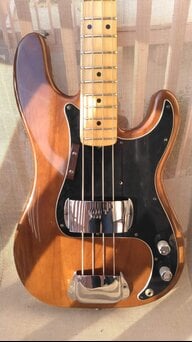

I'm new to fretless. If appreciate advice on whether it's good idea to practice by playing along to non A440 tracks. This seems like a bad idea for fretted basses, but on fretless only the open strings will be out of tune, and the fingerboard dots - well...
Not really, IME. Secure (=consistently and repeatably accurate) intonation is all about hand-shape and posture. That requires, amongst othe things, that the instrument be in tune and properly setup at all times. Chasing an out of tune note will just mess all of that up. It MIGHT help your ears a little, but the benefits are marginal compared to the harm you will do to your technique, IMHO. I would recommend always retuning to the reference or (preferrably) retune the reference to the standard tuning of your instrument.

Learn the melody/changes then play it in the closest key possible that is 440. I know some people don't mind retuning their instrument, but I will not do so. I have burned in the muscle memory/ear connection and do not wish to mess with it. If my ear hears a Db then I want my hands to go to that spot on my fingerboard and produce a Db. No one song (or act/gig for that matter) is sufficient to undo my muscle memory/ears.
We haven't seen that here, at least in the southern US, which I'll admit, isn't exactly a cultural Mecca of any note. But they are pretty sophistcated, playing mostly standard/classical programs.
I base this on my experience providing sound reinforcement as some piano tuning for them.
You haven't seen that because it's a myth. Some orchestras do it, some don't. (Often depends on who the conductor is).

I'm noodling along to a recording at home and don't retune for it. I've found it's been a good ear training exercise. Particularly for some albums I like to play along with, where every song is off A440 in different directions and different amounts.I'm new to fretless. If appreciate advice on whether it's good idea to practice by playing along to non A440 tracks. This seems like a bad idea for fretted basses, but on fretless only the open strings will be out of tune, and the fingerboard dots - well...
If I was practicing to a recording of a piece I intended to perform, I would want to develop proper muscle memory for it. In that case I would either retune or use pitch-adjustment software on the track.
You haven't seen that because it's a myth. Some orchestras do it, some don't. (Often depends on who the conductor is).
I'd like to be a fly on the wall when they are expressing their intent to the pianist, the harpist, the tuned percussion section and so on...
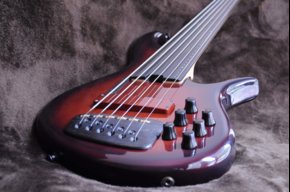
I re-tune my bass to practice something not tuned to A440.
Yup. Fellow fretless player here and while intonation is a fickle thing that sometimes requires on the fly adjustment of finger position, you want to train your left hand to hit the right spots on the board. I would tune as required so that I can continue to cement proper finger position on the board. My 2 cents.
This is all great, then the folks clamoring that all of the ills of the human race would be eradicated by tuning everything to A-432.Orchestras tune to 442 for a while now. German ands Austrian - I think go to 445 and the reason for that is that the orchestra will sound brighter (may not make sense for an electric instrument player). I play woodwinds also and I think 442 is where they resonate best.
Screw all that. At 65, and for as long as I’ll probably be around, it’s A-440 or bust…
Oh, yeah, to the OP, who started all of this….

 Stick with A-440 and try to practice without looking at the fingerboard….
Im not ashamed to admit, nay, proclaim that my fretless has lines (and gee, I still feel as manly as ever…), but I do try to practice without looking at the fingerboard.

So my gf/partner is a classical violinist. When I picked up a fretless this summer, a dual chambered Godin A4, she was thrilled at the sound it made acoustically.
I thought I was going to be able to use it in lieu of lugging around the whale upright. Turns out, yes and no as nothing has the woody mwah of the upright with rich overtones. I digress….
So as I started practicing on the fretless my partner would comment about my tuning, not A440. It was close and I was cool with it however I began to tune with a device and within a couple sessions I was hooked.
As far as fretless goes (OP), find the recorded pitch and learn it where it falls on the fingerboard. If the line uses open strings you may opt to play them open or cheat and plunk down a finger tip to match the pitch.
And finally my girl says that some orchestras tune to A444 per the Conductor’s preference.
BTW I love my fretless and play it all the time. I read/play the melody on my fretless after I get the bass line down. Best of luck on your journey.
I thought I was going to be able to use it in lieu of lugging around the whale upright. Turns out, yes and no as nothing has the woody mwah of the upright with rich overtones. I digress….
So as I started practicing on the fretless my partner would comment about my tuning, not A440. It was close and I was cool with it however I began to tune with a device and within a couple sessions I was hooked.
As far as fretless goes (OP), find the recorded pitch and learn it where it falls on the fingerboard. If the line uses open strings you may opt to play them open or cheat and plunk down a finger tip to match the pitch.
And finally my girl says that some orchestras tune to A444 per the Conductor’s preference.
BTW I love my fretless and play it all the time. I read/play the melody on my fretless after I get the bass line down. Best of luck on your journey.

Actually this is a very, very bad idea.
We disagree. Strongly.
Muscle memory is about relative shifts in position (not absolute placement) - playing with stuff that's a bit off 440 still helps you build that just fine. If you get yourself in pitch on one note, no matter where it is, muscle memory will get you to the right place for the next note.
Last edited:
I'd like to be a fly on the wall when they are expressing their intent to the pianist, the harpist, the tuned percussion section and so on...
Yeah, I would think this would have to be an established pre-requisite due to the logistics of retuning some of those instruments that simply cannot retune on the fly.
My experience is that any venue with a piano on site generally sets the tuning frequency...some are A440, some A442, and some between A443 and A445. In those situations, I tune to the piano since the piano cannot be adjusted on the day.
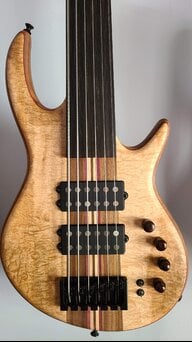
Fingerboard dots?Next, you'll be saying there's all these parallel lines running down the fingerboard that keep getting closer and closer together...

Clean slabs-O-ebony are fantastic. Only one of mine has speed bumps. Lol


