
Grazie!The B string sounds great. I prefer to stay in second position on a five string, so from frets 5 to 9, 10 maximum. I have never noticed any intonation issues.

Enjoy the benefits of a premium membership!
Upgrade Account
-
TalkBass has been independent since 1998. Add your voice.
Create a free account to reply to discussions, view embedded media, and browse with fewer display ads.
Join free Log in
Want zero display ads or expanded classifieds tools? Compare plans.
You are using an out of date browser. It may not display this or other websites correctly.
You should upgrade or use an alternative browser.
You should upgrade or use an alternative browser.
Praise Report: GHS Precision Flats
- Thread starter Linnin
- Start date
More options
Who Replied?
Hello
New to this thread. I actually have spent the last two night reading every comment on every page in this thread.
My name is Daniel and I’m from Sweden. Been playing bass for about 30 years and mostly have been using GHS Boomers which I like a lot. I do like them the most when they get older. I have also tried the Pressure wounds and liked them even more.
I just got myself a new to me Yamaha Attitude Standard 5-string bass which have Rotosound Steel round wounds strings on. I just hate the sound of round wounds steel strings. I was going to get me some Pressure wounds but didn’t find them anywhere.
So I just ordered a set of Precision flats instead. After reading this thread I can’t wait to get them home. I have tried some other flats before and do love the more old school flats sound. I listen a lot to Motown music.
I’m also auditioning to a new band soon. They are playing some kind of rock/folk rock/Americana music. So I guess these strings will be a good fit. Just hope I get the gig after the audition. They are trying out a few bass players.
Are there anyone here who has tried these flats on a Yamaha Attitude Standard bass? Maybe even a 5-string one? In that case, how did you like the sound?
Best regards, Daniel
New to this thread. I actually have spent the last two night reading every comment on every page in this thread.
My name is Daniel and I’m from Sweden. Been playing bass for about 30 years and mostly have been using GHS Boomers which I like a lot. I do like them the most when they get older. I have also tried the Pressure wounds and liked them even more.
I just got myself a new to me Yamaha Attitude Standard 5-string bass which have Rotosound Steel round wounds strings on. I just hate the sound of round wounds steel strings. I was going to get me some Pressure wounds but didn’t find them anywhere.
So I just ordered a set of Precision flats instead. After reading this thread I can’t wait to get them home. I have tried some other flats before and do love the more old school flats sound. I listen a lot to Motown music.
I’m also auditioning to a new band soon. They are playing some kind of rock/folk rock/Americana music. So I guess these strings will be a good fit. Just hope I get the gig after the audition. They are trying out a few bass players.
Are there anyone here who has tried these flats on a Yamaha Attitude Standard bass? Maybe even a 5-string one? In that case, how did you like the sound?
Best regards, Daniel

I live in Italy and no one sells pressurewounds so I had to find them online. The best place I found was Lord of the Strings from NL. Lord of the StringsI was going to get me some Pressure wounds but didn’t find them anywhere.
I have the Precion Flats on a Sire P7-5 and couldn't be happier. Best all round flats out there. I have the Pessurewounds on a Sire V7-5 and I like them much better than roundwounds, they have more bottom end and less clanky highs. GHS strings rule!
They are finally home and I just put them on. Unfortunately I won’t have the time to try them in the amp until Wednesday. Can’t wait. They feel good though.
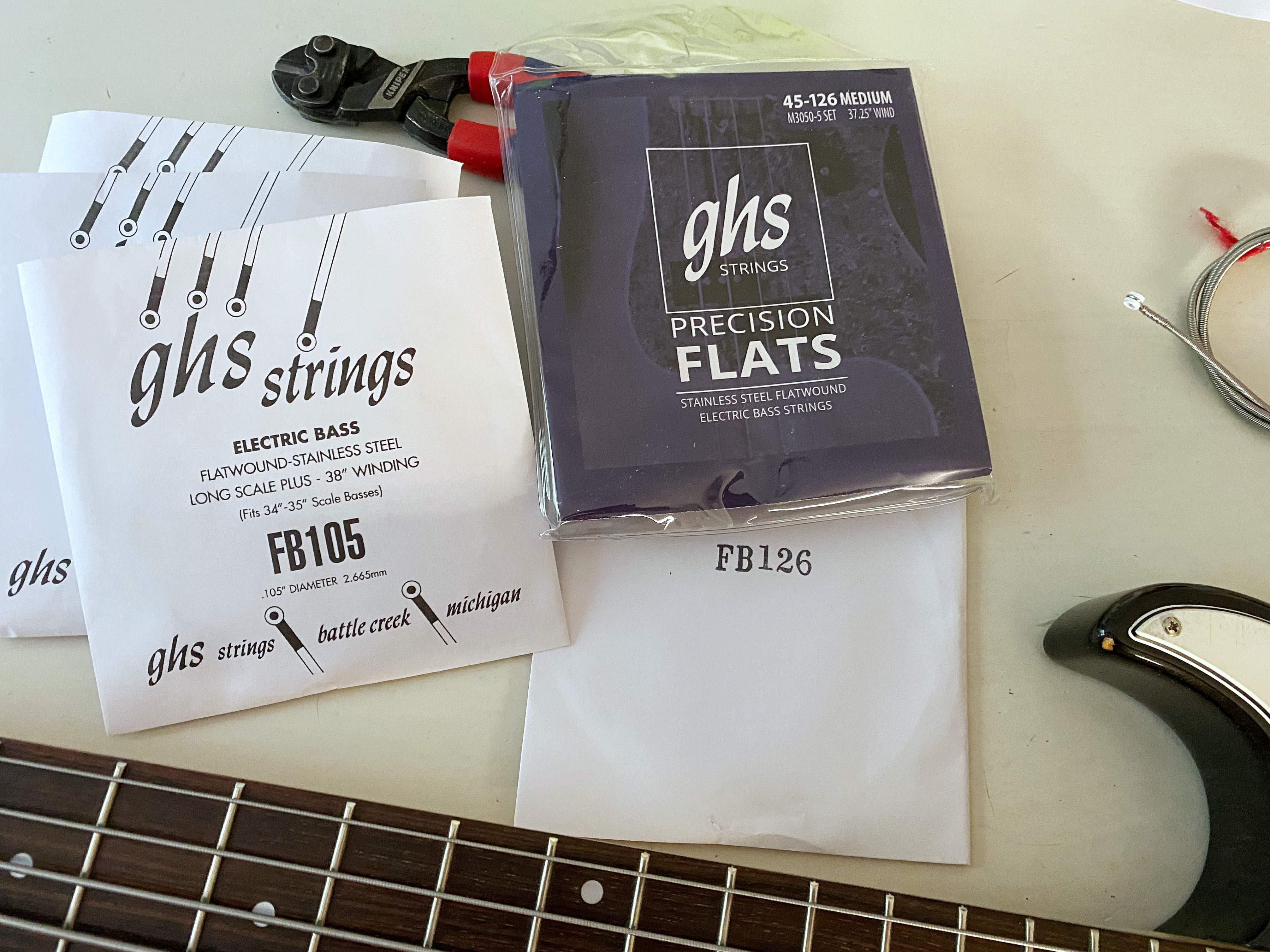


They are finally home and I just put them on. Unfortunately I won’t have the time to try them in the amp until Wednesday. Can’t wait. They feel good though.
View attachment 3964373
View attachment 3964374
Wow, a cool Yamaha Bass !!!
If i own one, sure i will go with Labella LTF5A rather than GHS flat.
~You would probably be best suited with our Light gauge set (45-60-75-95).
Or the Custom Mediums, which may or may not have been offered when this thread began.
I see them mentioned in your current PDF.
~

- Sep 9, 2007
- 5,309
- 4,977
- Disclosures
- Endorsing Artist: Eventide, GHS Strings, G&L Guitars, NS Design, Tsunami Cables
~
Or the Custom Mediums, which may or may not have been offered when this thread began.
They definitely weren't.
The thread started in Aug of 2013; I had only been here two months at that point. I introduced them partly because OF this thread.
~They definitely weren't.
The thread started in Aug of 2013; I had only been here two months at that point. I introduced them partly because OF this thread.
Jon, since I have your ear/eye, and you look to be in a position to influence the offerings, might I suggest that GHS begin to produce a short scale Precision Flats set (32.75" of winding like your other shorts), where the gauges are similar to those of the short scale Brite Flats.
For reasons which I do not understand, most string makers seem to tend to make most of their short and medium scale strings to favour the lighter gauges, when they really should if anything lean toward heavier, to maintain reasonable tension, which GHS already HAS done for the Brite Flats.
As you know, the info is within your PDF as to what the tension per string and per set is, and I can also feel/hear how much better the short scale Brite Flats respond on my USA Gibson SG bass.
So naturally I am curious about trying the Precision Flats on that and my Hofner, but the low tension numbers [of the only set offered] worry me.
Thanks.
BTW, I have not read the 100+ pages of posts of this thread yet, so if someone else has asked the same as I just did, I will see it at some point....
~
Last edited:
- Sep 9, 2007
- 5,309
- 4,977
- Disclosures
- Endorsing Artist: Eventide, GHS Strings, G&L Guitars, NS Design, Tsunami Cables
~
Jon, since I have your ear/eye, and you look to be in a position to influence the offerings, might I suggest that GHS begin to produce a short scale Precision Flats set (32.75" of winding like your others), where the gauges are similar to those of the short scale Brite Flats.
Is it possible? Sure.
Is it likely? Probably not.
Simply put, not a lot of people like/want the gauges of a set of short scale Brite Flats (.049-.062-.084-.108) as-is. I've had more requests to change those sets than praise.
IF anything were to change with the short scale Precision Flats set, it would be more based in playability and tone over numbers on a spreadsheet.
I have used these strings for almost a month now and they have a long way before they break in. But I really love these strings already. Can’t wait to try them with my new bassrig which consists of an Aguilar Tonehammer 500 and two Genz-Benz NeoX 112T cabs. And can’t wait til they’re fully broke in
~Would love to give these another try and order a custom set but no 50 for the G turns me away.
45 isnt enough and 55 is too much.
I too find this a bit odd, as GHS makes a .050 in almost if not all other of their bass string designations.
And BTW, I am looking at a May 2019 version of their master PDF.
http://www.ghsrep.net/uploads/2/2/2/5/22258814/ghs_bass_string_guide.pdf
That all said, I would see a 50 as being useful on a short scale [actual 30 inch playable] bass, but a 45 would be better suited to a long [34 inch playable] scale, tuned to G in both instances.
I was very pleased to see the introduction of the GHS Balanced Nickels, because while tension is not always equaling the apparent stiffness of a string, due to variances in number of wraps, core size, and other factors, I still regard the concept of equal tension among strings as a reasonable starting point in that quest, and have had very good luck choosing my own bass strings [of whatever brand over the years] on that basis.
- - - - -
[flashback]
During the early '70s, I worked in a music store where the owner was also a machinist, and was setting up and restringing guitars and basses for him, as well as fixing tube amps.
In his tool kit there was a micrometer, my first exposure to one of those, and I measured strings to see what was already on an instrument, when deciding what might next replace them.
I learned the math behind pitch vs tension very early on, before any of the string makers began to mention tension on their packages (D'Addario was the first which I noticed doing that), and when he got in the GHS individual guitar string assortment display for the first time, I was fascinated at being able to choose individual strings to make sets for customers, in 1 thou steps for plain, and 2 thou steps for wound.
Both the customers and I were very impressed with being able to choose the gauge of each string, and armed with the math, my setups, and Tony's micrometer [I bought my own before very long], many many customers ended up pleased beyond expectation.
[/flashback]
- - - - -
Fast FWD again to the GHS Balanced Nickels for bass, I can only wish that GHS [and many other string makers, for that matter] would expand that gauging strategy to sets of other types of bass strings which they already make [because some of us do not care for round wounds], some sets of which are closer to equal tension among their strings, than other sets are at the current time.
~
Last edited:
When will GHS come out with balanced tension sets like Circle K and D'Addario?
www.bassstringsonline.com
Order singles and make your own.
~I can certainly inquire about the availability of PACKAGED balanced tension sets, but with our Bass String Tension Guide and the bulk of TB users using online resources like BSO, you can make balanced tension sets out of our entire catalog at this point.

This is only of significant use to those playing long scale basses, because [correct me if I'm wrong] we must still choose from the strings which make up the various sets which GHS [or any other maker] currently offers, and there are considerably fewer choices in the shorter scale offerings than in long scale.
And as more electric bassists become geezers like me, we are looking increasingly to shorter scale basses [short and medium], for reasons of reducing weight and/or reach, and therefore the demand for further variety in strings for those basses is increasing each year.
~
Last edited:
- Sep 9, 2007
- 5,309
- 4,977
- Disclosures
- Endorsing Artist: Eventide, GHS Strings, G&L Guitars, NS Design, Tsunami Cables
~
This is only of significant use to those playing long scale instruments, because [correct me if I'm wrong] we must still choose from whatever strings make up the various sets which GHS currently offers, and there are considerably fewer choices in the shorter scale offerings.
~
There are fewer choices in short scale offerings, that's true. Simply put, the demand for balanced tension short scale sets, or more available gauges in short scale strings, is non-existent.
Even demand for balanced tension long scale sets (outside of online forums) isn't really there.
~There are fewer choices in short scale offerings, that's true. Simply put, the demand for balanced tension short scale sets, or more available gauges in short scale strings, is non-existent.
Even demand for balanced tension long scale sets (outside of online forums) isn't really there.
I added to my last post, possibly after you began to reply - you must have an alert set up for posts here.

Plus, three little words :
"Field of Dreams"
~
Interesting. Short scale instruments need higher gauges for good tension. Is it because of possible nut adjustment?Simply put, not a lot of people like/want the gauges of a set of short scale Brite Flats (.049-.062-.084-.108) as-is. I've had more requests to change those sets than praise.
.
Even demand for balanced tension long scale sets (outside of online forums) isn't really there.
I’m certainly in this camp. I have never ever felt a desire or need for balanced tension sets.
- Sep 9, 2007
- 5,309
- 4,977
- Disclosures
- Endorsing Artist: Eventide, GHS Strings, G&L Guitars, NS Design, Tsunami Cables
Interesting. Short scale instruments need higher gauges for good tension. Is it because of possible nut adjustment?
I'd base it more on familiarity and education over anything else.
How many people here, when having issues with a 45-65-85-105 set being too stiff, would rather change brands than (gasp!) go for a lighter gauge? We've got plenty of threads that spell this out; they stick with what they're familiar with.
In terms of education, many buy a short scale are aren't aware that heavier gauge strings will give comparable tension to a long scale with a lighter set. So, they look at a .049-.062-.084-.108 and see some really heavy gauges. And that also translates into stiffness; the aforementioned set is really stiff.
~Interesting. Short scale instruments need higher gauges for good tension. Is it because of possible nut adjustment?
It is strictly because of the difference in scale length, pure math - and also would involve [pun intended] the 'economics of scale' of manufacturing the less commonly purchased product.
If a 34" scale bass has a tension of 'x' when tuned to standard pitch, then a 30" scale bass with the same gauge and internal construction of strings would have a tension of 30/34 times 'x' at standard pitch.
Therefore, if you wanted the same tension on a 30" scale as you had on the 34", you would need in the neighbourhood of 34/30 times the string gauges which you liked on the 34" scale bass, give or take any internal differences in the construction of the shorter strings vs the longer ones.
I posted complete examples of these numbers somewhere on TB during the past few days, and forget in which thread, but suffice it to say that a .045" G string would become around .051", and so on....
Whether the tension is balanced among the strings would be a separate consideration on a short scale bass, just as it would be on the long scale bass.
~
- Sep 9, 2007
- 5,309
- 4,977
- Disclosures
- Endorsing Artist: Eventide, GHS Strings, G&L Guitars, NS Design, Tsunami Cables
If a 34" scale bass has a tension of 'x' when tuned to standard pitch, then a 30" scale bass with the same gauge and internal construction of strings would have a tension of 30/34 times 'x' at standard pitch.
I bolded that, because the latter part of that bears mentioning. While in the past, many companies just took a set of long scale strings and made them shorter (i.e. same internal construction).
The past five years have seen that change, as people are realizing that the short scale bass probably needs something other than just a "heavier gauge of strings" to be a true complement to the instrument.
~I bolded that, because the latter part of that bears mentioning. While in the past, many companies just took a set of long scale strings and made them shorter (i.e. same internal construction).
The past five years have seen that change, as people are realizing that the short scale bass probably needs something other than just a "heavier gauge of strings" to be a true complement to the instrument.
Yes, and I mentioned it because I had noticed in the GHS string database PDF, that short and medium scale bass strings sometimes were showing a different 'unit weight' than long scale strings of the same string type and gauge.
As a result, the gauge of the string is not the only variable when calculating the resultant tension of any given string, but I only commented in passing, so as to keep my last post mainly within one direction and purpose.
I do not know the fine details of what is different among the constructions of GHS strings in the shorter scale versions vs longer ones, but yes, I noticed that there is sometimes a difference.
For perspective, I looked at the equivalent database file from D'Addario, and they do NOT seem to be varying the construction of their bass strings when they change the length, as their unit weights remain constant when the length is changed.
I'm not sure what exactly is gained by changing the unit weight of a string or not changing it [when changing its length], and I'd have to buy a lot of strings and identical basses, and do a whole lot of plucking, in order to evaluate the differences.
~
Last edited:
Latest posts
-
I asked for feedback here a little while ago, and this is what it turned into
- Latest: 5stringedfrenzy
-

-
 Adding J pup to P bass, should I go 60’s or 70’s spacing?
- Latest: secondbestcody
-

-

