
Thanks for your personal sharing, i hope the replacement B string work like charm and sound like you describe .I’ve run almost the same custom set of GHS P Flats on one of my P Basses for a few years, except I use a .100 E string.
Lately I’ve shifted to a BEAD setup on my main P Bass and the .126 / .100 / .75 / .55 set is nicely balanced. The .126 GHS P Flat is my favorite B string I’ve tried so far… nice fundamental note definition but still very woody, dark, and deep without any “hollowness” in the low mids ( I like it better than the TI Jazz Flats B string for this reason )

Enjoy the benefits of a premium membership!
Upgrade Account
-
TalkBass has been independent since 1998. Add your voice.
Create a free account to reply to discussions, view embedded media, and browse with fewer display ads.
Join free Log in
Want zero display ads or expanded classifieds tools? Compare plans.
You are using an out of date browser. It may not display this or other websites correctly.
You should upgrade or use an alternative browser.
You should upgrade or use an alternative browser.
Praise Report: GHS Precision Flats
- Thread starter Linnin
- Start date
More options
Who Replied?


I'd like to add a fast comparison between Labella 760FL and GHS 3025 (45-95) on my '71 Precision.
this is a strange bass, that with rounds sounds a bit too "mellow", from steel to nickel, and I was afraid to try flats because I thought it would sound too "dampen" and dark.
I tried a set of Fender 9050L for a couple of days, and they just sounded like rounds with less "grind", so I decided to switch to GHS Precision flat I use on other basses (as mentioned in the last pages of this topic, I "discovered" them only last year, because I was afraid of the negative descriptions they have, as "too dark", "too muddy", until I tried and discovered that they have a powerful fundamental with the most precise projection and "mix center"), preferring the light set (I use them on a JMJ mustang, then two 55-105 sets on a CS1 Precision and Classic 50).
the first impression was so strange, they made the bass overall "brighter", not in terms of high frequencies, but definition and projection: every note was clear and defined, compared to every roundwound set I've used, and they sound livelier.
I've used them for a week, with two rehearsal in two different bands, loving the tone and woodiness, in particular when "finger-slapping" the strings against the frets, making them "bark".
however, I found an offer on a 760FL set of Labella and decided to try them and see how they would have worked on this particular bass. it's a set I know for using them on a Mustang (deep low end, less focused but thick. on the Mustang I preferred the GHS set, woodier and a bit clearer), and I've used the 0760M Jamerson many times on different basses.
despite the defective D string giving me the "mwaaaa" effect (I mailed Labella to see if they can send me a replacement), the overall sound was good, but... deader.
the notes were huge, full of basses, a bit of highs, but lacked the low-mids and clarity. the sound were "softer", and if I can say it, IMHO it's not the sound of "vintage flats" we usually have in mind.
doing researches, and as seen in many Talkbass topics, the stock Fender flats were actually the most used, except for some players like Carol Kaye, known to have switched from the heavy "Medium" Fender (55-105) to Labella (probably a lighter set available, and if I'm not wrong, the 43-104 set was one of them, as used by Jack Casady for a while), and James Jamerson, or the late Donald Dunn.
most bass players didn't change the strings on their basses, and so the stock Fender are mostly recorded in the 60's and 70's, and an example is John Paul Jones, who have used the same set on his Jazz Bass until he started using brighter sounds.
GHS P-flats are the most similar to the original Fender strings, and even the winding material is different from steel flats like Labella: the GHS are "silvery", the other flats are "grey".
here's a picture I found here on Talkbass, I'll add some pictures in the next days comparing Labella and GHS look:
in 20 years of playing I've always searched that sound I used to hear on records and couldn't get the right tone, always something "similar", but when I first tried a set of GHS, I just had an epiphany it was THAT sound in my head, and now I have them on all my "flatwounded basses", and can't go back to anything else, except for the Pyramid Gold on my three Hofners.
ah! mentioning the Pyramid, which are nickelwound, the GHS look more like the Pyramid/Thomastik than Labella/Fender/D'Addario flats, with the silver colour against the grey.
they also reflect light in a different way.
also, comparing the tension/flexibility, they are the most flexible flats (not considering the Thomastik) I've ever used, even in the 55-105 set. in this specific case, I switched from Fender 9050M (55-105) to GHS 3050R (55-105) on two basses, and I experienced the same exact thing:
the TENSION is a bit higher, but nothing more than 1/8 turn of the truss rod, but they are more FLEXIBLE, they are easier to fret and bend.
same for the 45-60 G and D compared to the Labella 43-60 from the 760FL set: Labella are less flexible, and it's easy to notice out of the package: GHS are easier to coil, Labella are difficult to coil back.
for me, the GHS flats are the best I really love them, and every time I try other flats, I can't find the same sound and feeling.
this is a strange bass, that with rounds sounds a bit too "mellow", from steel to nickel, and I was afraid to try flats because I thought it would sound too "dampen" and dark.
I tried a set of Fender 9050L for a couple of days, and they just sounded like rounds with less "grind", so I decided to switch to GHS Precision flat I use on other basses (as mentioned in the last pages of this topic, I "discovered" them only last year, because I was afraid of the negative descriptions they have, as "too dark", "too muddy", until I tried and discovered that they have a powerful fundamental with the most precise projection and "mix center"), preferring the light set (I use them on a JMJ mustang, then two 55-105 sets on a CS1 Precision and Classic 50).
the first impression was so strange, they made the bass overall "brighter", not in terms of high frequencies, but definition and projection: every note was clear and defined, compared to every roundwound set I've used, and they sound livelier.
I've used them for a week, with two rehearsal in two different bands, loving the tone and woodiness, in particular when "finger-slapping" the strings against the frets, making them "bark".
however, I found an offer on a 760FL set of Labella and decided to try them and see how they would have worked on this particular bass. it's a set I know for using them on a Mustang (deep low end, less focused but thick. on the Mustang I preferred the GHS set, woodier and a bit clearer), and I've used the 0760M Jamerson many times on different basses.
despite the defective D string giving me the "mwaaaa" effect (I mailed Labella to see if they can send me a replacement), the overall sound was good, but... deader.
the notes were huge, full of basses, a bit of highs, but lacked the low-mids and clarity. the sound were "softer", and if I can say it, IMHO it's not the sound of "vintage flats" we usually have in mind.
doing researches, and as seen in many Talkbass topics, the stock Fender flats were actually the most used, except for some players like Carol Kaye, known to have switched from the heavy "Medium" Fender (55-105) to Labella (probably a lighter set available, and if I'm not wrong, the 43-104 set was one of them, as used by Jack Casady for a while), and James Jamerson, or the late Donald Dunn.
most bass players didn't change the strings on their basses, and so the stock Fender are mostly recorded in the 60's and 70's, and an example is John Paul Jones, who have used the same set on his Jazz Bass until he started using brighter sounds.
GHS P-flats are the most similar to the original Fender strings, and even the winding material is different from steel flats like Labella: the GHS are "silvery", the other flats are "grey".
here's a picture I found here on Talkbass, I'll add some pictures in the next days comparing Labella and GHS look:
in 20 years of playing I've always searched that sound I used to hear on records and couldn't get the right tone, always something "similar", but when I first tried a set of GHS, I just had an epiphany
it was THAT sound in my head, and now I have them on all my "flatwounded basses", and can't go back to anything else, except for the Pyramid Gold on my three Hofners. ah! mentioning the Pyramid, which are nickelwound, the GHS look more like the Pyramid/Thomastik than Labella/Fender/D'Addario flats, with the silver colour against the grey.
they also reflect light in a different way.
also, comparing the tension/flexibility, they are the most flexible flats (not considering the Thomastik) I've ever used, even in the 55-105 set. in this specific case, I switched from Fender 9050M (55-105) to GHS 3050R (55-105) on two basses, and I experienced the same exact thing:
the TENSION is a bit higher, but nothing more than 1/8 turn of the truss rod, but they are more FLEXIBLE, they are easier to fret and bend.
same for the 45-60 G and D compared to the Labella 43-60 from the 760FL set: Labella are less flexible, and it's easy to notice out of the package: GHS are easier to coil, Labella are difficult to coil back.
for me, the GHS flats are the best
I really love them, and every time I try other flats, I can't find the same sound and feeling.

Carol Kaye using La Bella? Never heard that before...the stock Fender flats were actually the most used, except for some players like Carol Kaye, known to have switched from the heavy "Medium" Fender (55-105) to Labella (probably a lighter set available, and if I'm not wrong, the 43-104 set was one of them...
According to what I've read here and there, Carol Kaye was so busy with her session work she didn't even have time to change strings on her bass. So, every time her bass needed new strings, she would simply trade it in for another bass so she could carry on without any distractions. Wouldn't that mean she always used the stock Fender flats?
Carol Kaye using La Bella? Never heard that before...
probably I misunderstood something I red years ago, that she didn't like the stock "medium" Fender strings, being too heavy, and changed them. I probably got it wrong, and so even in this case, Fender stock strings are the sound

thanks!

As I recall, at leas through the 1960s, she did use the stock Fender strings. At some point in the 1970s she used Rotosound 77 for a while. Of course now she is known for using TI flats in more recent years.probably I misunderstood something I red years ago, that she didn't like the stock "medium" Fender strings, being too heavy, and changed them. I probably got it wrong, and so even in this case, Fender stock strings are the sound
thanks!
yes, I don't know where I red that she was one of those using the Original Labella 52-110, and that she used to change the stock Fender Medium strings, but probably it was some legend.
I see that in interviews and documentary she says that she didn't have time to change strings, and just bought a new bass (probably giving back the other to the shop).
also, strings back then were more expensive, and reading the late 50's Fender catalogue, a set of Mastersound was around what now would be 180$
however, this thing just adds to my idea that the "real vintage tone" we mostly hear in old records depends a lot on the stock Fender strings, and IMHO GHS P-flats are the nearest thing.
I've tried so many flats in my life, and these are the only ones that made me say "hey! this is the sound I was looking for!"
I see that in interviews and documentary she says that she didn't have time to change strings, and just bought a new bass (probably giving back the other to the shop).
also, strings back then were more expensive, and reading the late 50's Fender catalogue, a set of Mastersound was around what now would be 180$
however, this thing just adds to my idea that the "real vintage tone" we mostly hear in old records depends a lot on the stock Fender strings, and IMHO GHS P-flats are the nearest thing.
I've tried so many flats in my life, and these are the only ones that made me say "hey! this is the sound I was looking for!"
just to add, yesterday I had a gig with the blues band (doing the Stax/Blues Brothers/Aretha Franklin setlist): the club had a small Hartke Kickback 12" (the one with the graphic EQ) for the stage, going to the PA with it's DI.
I went with the Precision and GHS 45-95 flats, and wow... it's one of the few times I can clearly hear the bass from instagram videos! ahahhaha!
aside from jokes, the sound on stage was really focused and balanced, without booming basses but with all the "meat", and the light gauge helps when you want the "digging-in sound" against the frets.
I'd be curious to try the CM3050, the set that goes 45-60-80-105, because in some passages I find the lighter E and A a bit too light, but it's only a matter of feeling/tension, the sound is awesome, and I'd be afraid to change.
the 95 E, compared to the 105 on my 55-105 sets, has a bit more sustain and definition.
I went with the Precision and GHS 45-95 flats, and wow... it's one of the few times I can clearly hear the bass from instagram videos! ahahhaha!
aside from jokes, the sound on stage was really focused and balanced, without booming basses but with all the "meat", and the light gauge helps when you want the "digging-in sound" against the frets.
I'd be curious to try the CM3050, the set that goes 45-60-80-105, because in some passages I find the lighter E and A a bit too light, but it's only a matter of feeling/tension, the sound is awesome, and I'd be afraid to change.
the 95 E, compared to the 105 on my 55-105 sets, has a bit more sustain and definition.
here's a small video I got on whatsapp, low quality recorded with a phone, but...

I’ve had the Precision Flats on my MM jazz since 2016 (could not believe it’s been that long, but that’s what the order date says), absolutely love em.
When I got the AVII 1960 reissue Precision last year, thought to have alternative sound options between the two basses so I put the GHS Pressurewounds on it. They sound good, but all I keep thinking for the past year is “i wish i had those strings on THIS bass”…. so today I ordered me a set of the 3050’s and that’ll be that I think - flats on both. Can’t wait!
Older posts but how are/did you find them? I want the ghs for my AVii p bass and it can't decide between the gauges. I want the tension of the cm3050 but the 'not dead' e string of the 3025.So last night I finally A/B'd my Fender 60's AVII P bass (strung with LaBella 760FL's) against my 1963 Fender P bass with an older set of GHS Precision flats. Something about the GHS PF's piqued my interest so I found a lightly used set in my string drawer and installed them on the the 60's AVII. Although they sound new and not as thuddy as the LaBellas, the PFs seem to have a broader, richer and deeper sound than the LaBellas. They're not quite as polished feeling like the LaBellas, which I like. Think I'll gig these strings for awhile and see how they pan out.
Older posts but how are/did you find them? I want the ghs for my AVii p bass and it can't decide between the gauges. I want the tension of the cm3050 but the 'not dead' e string of the 3025.
The .095 E string still meet dull sounding earlier than the rest.
I have a set of custom gauge GHS flat order from string by mail ( 126. 095. 075. 055. 045 )on my ibanez SRMS 725 before move to NYXL MS set.
On first month, both B and E string sound quite balance tonal to the rest, after that both B and E notable sound getting dull and dry . After following month, both D and G string didn't change on their tonal, but both B and E string become like percussive kick bass drum characters, make the bass has 3 kind of different tonal between BE, A and DG.
Maybe this is the unique character make some bassist get love on GHS flat . But I am not.
From early years dissapointment with 3050 and 3025on Pbass, until same uneven tonal issue on Multi scale bass, I am totally learn and give up.
But will give a try on 3025 set again when I own reverse head stock Pbass......
Last edited:

Just popping in to say I’ve been a very happy user of the 3050 long scale on my string through USA J/P for several years now.
Acquired a new-to-me ‘23 USA P and after a few weeks of experimenting with some old favorites : Roto 77s, EB cobalt flats, Labellas, DR Legends, I’ve got the GHS on both now lol. So much for variety.
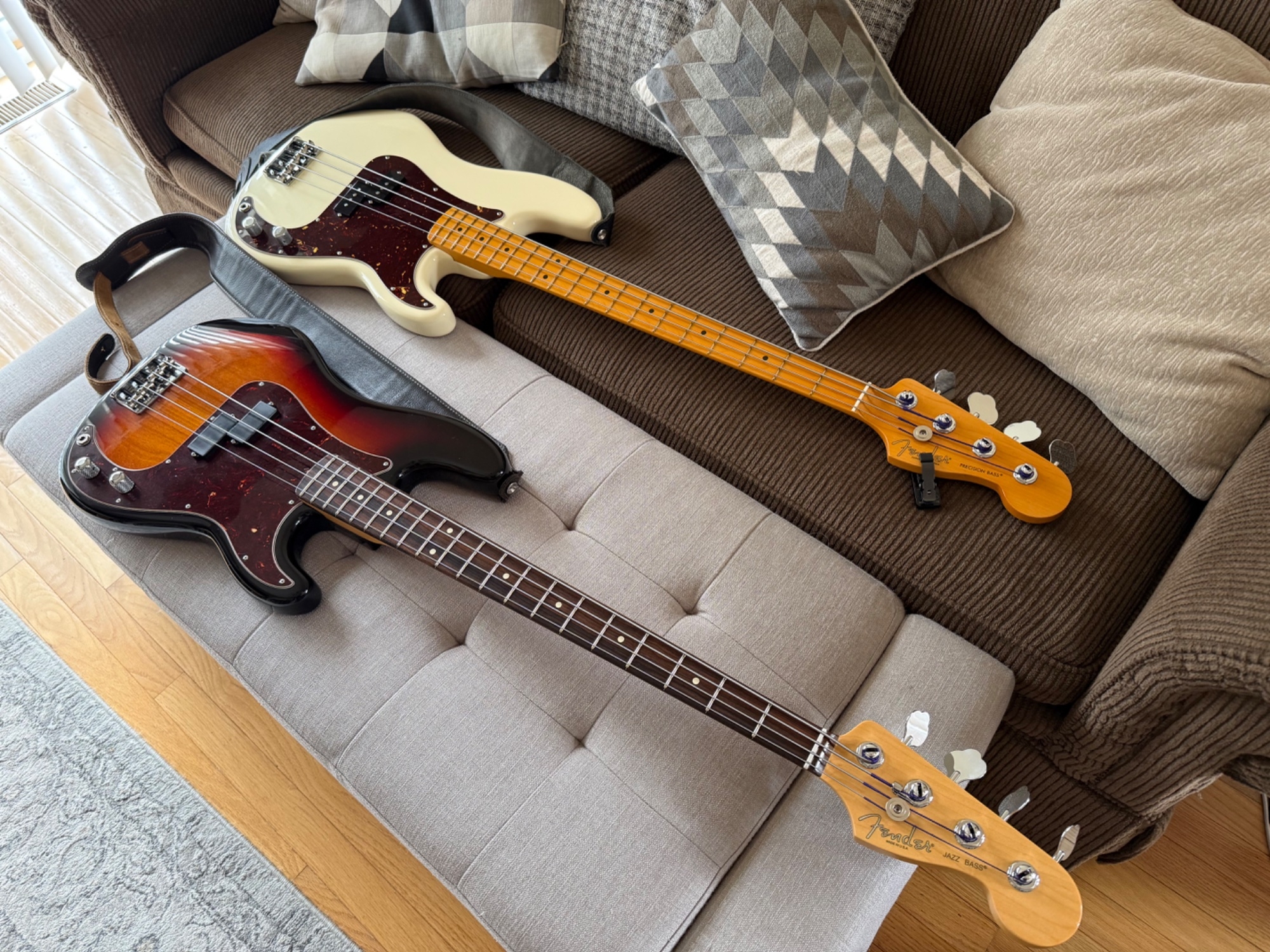
Acquired a new-to-me ‘23 USA P and after a few weeks of experimenting with some old favorites : Roto 77s, EB cobalt flats, Labellas, DR Legends, I’ve got the GHS on both now lol. So much for variety.
The .095 E string still meet dull sounding earlier than the rest.
that's interesting, because with all my 45-95 sets it didn't happen.
on the other hand, any Labella set I've ad got me a "thumping E" and zero mids from the rest of the set, so that after a while it all sounded "just bass and no definition".
GHS are still defined with a lot of mids, and I use them even in a punk band.


