
• TalkBass has been independent since 1998. Add your voice.
    Create a free account to reply to discussions, view embedded media, and browse with fewer display ads.
    Join freeLog in
    Want zero display ads or expanded classifieds tools? Compare plans.

Pre-amp to run 2 instruments?

Yeah, look at the tonebone bassbone. There is actually one in the classifieds right now for not too much. I used one, and it's a super nice pre for that purpose.

I sold it to a sound and light tech who works at the local university, and he used it for a double bass player for a campus production, and she liked it so well she went out and bought one.
 
Last edited:
  • Like
Reactions: okabass
The K&K Dual Channel Pro would do the trick if you're just looking for something simple, inexpensive, and effective. It has gain controls, but EQ adjustments would need to be done at your amp if you don't want to mess with the box's internal EQ.
 
  • Like
Reactions: KJMO
That's cool. I hadn't seen the K&K one. I needed a stomp switch, but most people probably wouldn't, I suppose. Plus, a new tonebone is spendy, but I had the v1 which is 100 or less. There's also the ebs microbass. A new version just came out, I think, so the older version is cheaper, but it's still expensive.
 
And then there is just your basic ab/y switch. I use one with 3 switches for a bass and two synths, but I can see wanting to have the separate eq for each channel that the bassbone has. It just depends what a person needs, I guess.
 
Last edited:
Like @KJMO , I have a passive A/B pedal that I sometimes use to switch between bass guitar and bass synth. Super easy. If you need separate tone shaping, you could put it before the passive A/B box.
 
  • Like
Reactions: KJMO
Switching between electric and upright is a special situation, different from switching between two electrics, or electric bass and synth, etc.

Your upright likely (almost certainly) uses a piezo pickup, and you need a preamp with with high impedance or it won't sound nearly as good as it should. You want 1 mega ohm or higher for the piezo.

If your amp input has high enough impedance, you can use a plain ABY type switch. Some do, but most electric bass amps do not have high impedance inputs.

I know Radial makes stuff just for this. Alternately, you can get another device for the upright signal path that'll provide high impedance, something like an fDeck high pass filter (highly recommended for upright). I've used an older Aphex Punch Factory compressor pedal with upright and it works really well, provides high impedance for nice full tone from a piezo and also provides very subtle, musical compression.

You can run an electric bass, synth, whatever, into a high impedance input with no problems. They just don't need the high impedance like piezos do, so the amps, preamps, etc. that are typically used for these don't have high impedance inputs.
 
  • Like
Reactions: KJMO
Like @KJMO , I have a passive A/B pedal that I sometimes use to switch between bass guitar and bass synth. Super easy. If you need separate tone shaping, you could put it before the passive A/B box.

That is what's nice about the radial solutions. They have the tone shaping and the a/b box in the same pedal. Along with a nice d/i and effects loop, tuner out, etc. For less than a 100.00 used. And I believe they say something about the inputs being made to handle high impedance, but I don't know about that for sure. I'm sure that part isn't as good as the pre's that are dedicated for use with piezos. From what I understand though, that should be handled as close to the piezo as possible (in the bass).
 
A simple passive AB box will work backwards as an instrument switcher.
My rig right now- Electric upright > Baggs para D.I.> AB box input
Electric BG> wireless receiver> Line6 M13 multieffects> AB box input.
One single line to amp input
Simply stomp the AB switch to change from UEB to wireless BG.
 
  • Like
Reactions: KJMO and ctmullins
A simple passive AB box will work backwards as an instrument switcher.
My rig right now- Electric upright > Baggs para D.I.> AB box input
Electric BG> wireless receiver> Line6 M13 multieffects> AB box input.
One single line to amp input
Simply stomp the AB switch to change from UEB to wireless BG.

This is fairly obvious when you look at them, but there are quite a few a/b switches that have active electronics of some sort, and they can't work in reverse (one guitar to two amps vs. two guitars to one amp). So, if a person goes this route, you have to pay attention and make sure there are no electronics. I worried about mine because it has a place for a battery, but I found that it only requires a battery to power little lights to show which channel is selected.
 
I recently got a LiveWire ABY to use for Upright/electric switching and it's causing a big tonal change in the instruments compared to direct into amp. I have a Realist pickup and my amp's manual says the input is at 1m ohm. The electric doesn't suffer the tone suck like the upright, just volume. Is there a passive element that could help my signal?

 
I recently got a LiveWire ABY to use for Upright/electric switching and it's causing a big tonal change in the instruments compared to direct into amp. I have a Realist pickup and my amp's manual says the input is at 1m ohm. The electric doesn't suffer the tone suck like the upright, just volume. Is there a passive element that could help my signal?

Do you have both on at the same time? Because I don't notice any loss of signal on my morley ABC unless I have more than one on at the same time. A big reason I think the radial is a better option though ;-) And it's not even that much more expensive (used anyway).
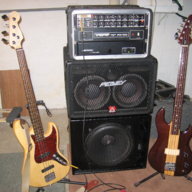
 
That's really weird because there shouldn't be anything to cause a loss of signal, as far as I know. Maybe there is more going on in these things than I think, but I thought they were pretty darned simple. I'll have to open mine up and see if there is anything other than switches.
 
I use a Pearce BC-1 for the acoustic / electric situation. It has the footswitch to turn on/off each channel, two channels so I can set the controls for each instrument. Although it's impedance is lower than optimal for the piezo on the upright. Biggest plus for me was being able to turn off the acoustic channel (the piezo has no controls) when the upright is not being used, without needing my hands to turn a control since they were full wrangling the upright into its stand.
 

Latest posts