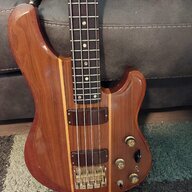
Forgive me if this is a stupid question... I recently got a bass that I want to replace the preamp on. It's late 80's/early 90's Aria. I'm putting an Audere Classic in it. The cavity is shielded with shielding paint, and the cover is shielded with foil. I'm going to have to use the existing jack as it's a barrel type unlike what Audere supplies. Anyway, in looking over the install instructions, several times it mentions "cavity ground" and then where to attach it to the jack. On the existing preamp, there's the bridge ground but I don't see any other ground in the cavity. I'm thinking that the existing shielding paint takes care of that, correct? I know in the old days there'd be a ground wire to the cavity, but I thought that was only if it isn't shielded. Hoping someone can provide some clarity... Thanks!

Enjoy the benefits of a premium membership!
Upgrade Account
-
TalkBass has been independent since 1998. Add your voice.
Create a free account to reply to discussions, view embedded media, and browse with fewer display ads.
Join free Log in
Want zero display ads or expanded classifieds tools? Compare plans.
You are using an out of date browser. It may not display this or other websites correctly.
You should upgrade or use an alternative browser.
You should upgrade or use an alternative browser.
Preamp Installation Wiring Question - Audere Classic
- Thread starter Bassguy61
- Start date
More options
Who Replied?
Instead of cavity ground you can use the jack ground, it is the same thing. Shielding paint is not necessarily conductive (you can poke a multimeter in it and see). When emi meets something like foil, it is in a way converts into electricity if the foil is grounded. This process reduces ElectriMagnetic Interference, (oversimplifying) interacting with "electro" part. Shielding paint however, instead of that, uses the emi energy to generate magnetic flux, hence (oversimplifying) interacts with "magnetic" part and that does not require connection to the ground. That said, there are conductive paints that would be based on copper usually, that would be using the same principle as foil and would need the connection to the ground. That connection can be the mechanical contact of the jack shell to the painted surface. Either way, you will need to connect to the jack ground via soldering, otherwise, you are risking poor contact or no contact at all.

I felt it more relevant and potentially conducive to finding information on this site to park this question here with regards to wiring up the classic module.
Are hot/common white pickup wires soldered to the striped black/white wire & striped blue/white wire with the ground going to the striped green/white wires coming from the end terminals of the module?
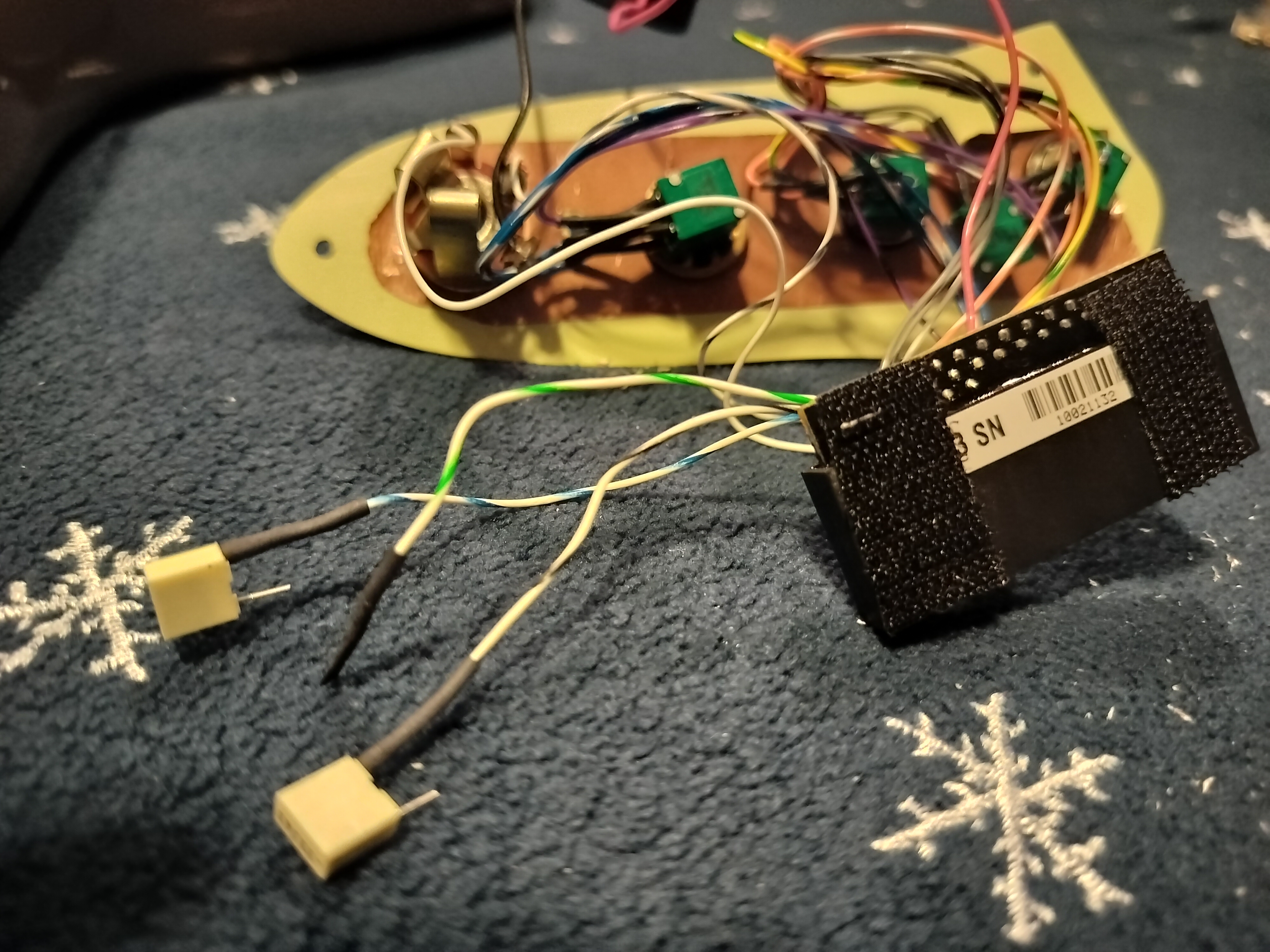
Are hot/common white pickup wires soldered to the striped black/white wire & striped blue/white wire with the ground going to the striped green/white wires coming from the end terminals of the module?



Using this with active pickups?I felt it more relevant and potentially conducive to finding information on this site to park this question here with regards to wiring up the classic module.
Are hot/common white pickup wires soldered to the striped black/white wire & striped blue/white wire with the ground going to the striped green/white wires coming from the end terminals of the module?
View attachment 7108647
Riis
Sure looks like it.Using this with active pickups?
Riis
Assume nothing. TBH, don’t think I’ve ever seen a trad classic module mounted on a J plate. Most folks opt for the “pre-loaded” plate.Sure looks like it.
Nope! Thomas Brantley pickups.Sure looks like it.
Originally I sent this off to David at Audere to troubleshoot because it had an overdriven buzzing tonality too it. I got it in a trade years back but didn't wire it up immediately. Some of the connections had loosened from the module block and that's when he added the capacitors.
Last edited:
The classic module sounds 100x better. Also it's less bulky so more easily fits inside the typical jazz route space.Assume nothing. TBH, don’t think I’ve ever seen a trad classic module mounted on a J plate. Most folks opt for the “pre-loaded” plate.
Last edited:
Okay…you have 2 capacitors wired-up to the pickup conductors. These are intended to be used with active pickups like EMG’s, Fernandes FGN’s, etc.
Riis
So, I asked David and he said "no matter" but then gave me instructions for hooking up to active pickups. I think I should cut the capacitors off and wire straight to the bare striped wires just like the wiring instructions indicate.Okay…you have 2 capacitors wired-up to the pickup conductors. These are intended to be used with active pickups like EMG’s, Fernandes FGN’s, etc.
Riis
This is the sole purpose of my seeking you all out.
Yeah, not sure of the rationale using caps on PASSIVE pickups or whether it would create any undesirable degradation. As you mentioned, I’d go wire-to-wire. I used caps on my two Fernandes basses but the pickups were fed 9v. Not truly my arena…just based on the install instructions and previous experience. You should see the ancient Pro Z module in my Soundgear w/ Nordstrand…has those insufferable micro trim pots.So, I asked David and he said "no matter" but then gave me instructions for hooking up to active pickups. I think I should cut the capacitors off and wire straight to the bare striped wires just like the wiring instructions indicate.
This is the sole purpose of my seeking you all out.
Riis
This is what David from Audere had to say:Caps like that in series with signal are not affecting the audio. Typically used to remove any DC voltage. This is why " he said, no matter". But if you remove them, do tell if you hear anything different.
"You want to separate the bridge ground and pot grounds from the green/white wire - the green/white wire is at ½ of the battery voltage
The bridge ground and pot grounds need to go to the grey/white (center pin of the output jack)
The green/white can go to the pickup commons
But since you have coupling caps on your preamp inputs - the pickups commons can also go to the grey/white
And insulate off the green/white (so it doesn't get grounded)
In the present wiring - if you touch the strings to a grounded object you will hear a super loud popping sound
And you are sending static discharges (aka touching the strings discharges your body especially in winter) through the power supply instead of taking them to ground - this can take out the preamp...
David"
The present wiring he is referring to, at first I hooked up everything to ground in one terminal point (bridge, black pickup wires, cavity and control plate.) So, upon his advice I separated the bridge and other grounds, soldered them to output ground (grey/white) and left pickup grounds (black) going to the green/white.
There was a definitive difference in tonal quality before and after. The first way I hooked it up was "punchier" and "hotter" but nothing off about it. Now it sounds more even I guess. This MX Mexican Fender fretless neck has flame running all through the maple grain and an excellent rosewood color. Super transparent with the Thomas Brantley pickups.
No knobs yet and that makeshift control plate is serving the purpose of wiring up to play it before I redrill the five hole line-up on a gold 3-hole plate.
Last edited:


