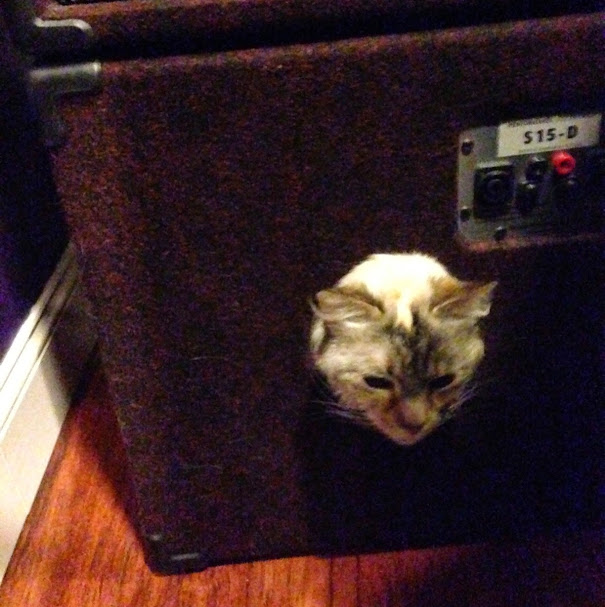
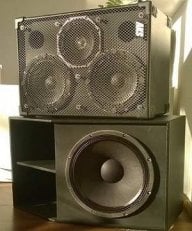
The real question here is tolex or ratfur?Stolen from Reiner Amplification's G+ page:

Enjoy the benefits of a premium membership!
Upgrade Account
-
TalkBass has been independent since 1998. Add your voice.
Create a free account to reply to discussions, view embedded media, and browse with fewer display ads.
Join free Log in
Want zero display ads or expanded classifieds tools? Compare plans.
You are using an out of date browser. It may not display this or other websites correctly.
You should upgrade or use an alternative browser.
You should upgrade or use an alternative browser.
Preference For Sealed Cabs? Why?
- Thread starter dukeorock
- Start date
More options
Who Replied?

- Feb 12, 2006
- 61,047
- 5
- 221,002
- Disclosures
- Development Engineer-Mesa Boogie, Development Engineer-Genzler (pedals), Product Support-Genz Benz
Unfortunately, the potential benefit this brings often includes the issue of stored energy in the form of a tank circuit that can interact with class d amps where the PWM carrier oscillates in damped within the zobel correction networks. I have encountered this on several poorly designed (though the designers felt otherwise of course!) speaker products.That can easily be fixed with an LCR on the 2nd spike.
But, most cab designers don't know about these kind of trix...
The result is amp shutdown in amps that contain appropriate protection, and magic smoke in those that don't.

...stored energy in the form of a tank circuit that can interact with class d amps where the PWM carrier oscillates in damped within the zobel correction networks.
That's almost sig worthy.

Stolen from Reiner Amplification's G+ page:
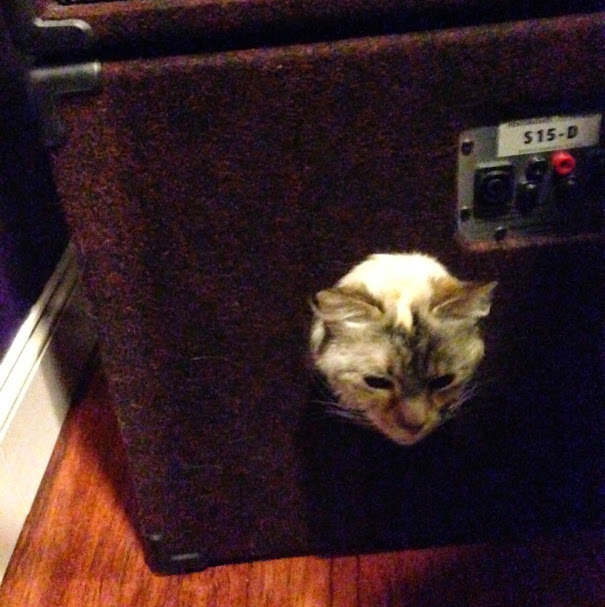
Looks like a Bag End!

Bottom ported behind the grill solves the critter issue.
I have to take apart my studio near field monitors and check them for stink bugs.
They hide in every place they can find.
Yet another benefit to sealed cabs: very best in critter protection, only gotta worry about the jack holes.
Yeah, I know: "Who you callin' a jackhole??"
Link Removed
Parallel notch filters
It's not a parallel notchfilter, the LCR I mean is a series notchfilter that is placed before the whole crossover. It'll only smooth out the impedance peak and will not change the frequency response (at least not for solid state). It will change the sound when combined with a tube amp because the tube amp will see a more linear impedance.
Does anyone think that part of the reason sealed "may" be preferred over ported is because many ported cabs have little or no reflection absorbing material inside the cab? I know when I was designing my own cabs they sounded absolutely horrid (no matter how they were EQ'd) without padding inside. I've seen many ported commercial cabs with nothing inside and at best, only very little, if there was any put in there.
Unfortunately, the potential benefit this brings often includes the issue of stored energy in the form of a tank circuit that can interact with class d amps where the PWM carrier oscillates in damped within the zobel correction networks. I have encountered this on several poorly designed (though the designers felt otherwise of course!) speaker products.
The result is amp shutdown in amps that contain appropriate protection, and magic smoke in those that don't.
Never encountered this problem. Maybe the zobel(LCR) was not dimensioned right resulting in a major impedance dip.
- Feb 12, 2006
- 61,047
- 5
- 221,002
- Disclosures
- Development Engineer-Mesa Boogie, Development Engineer-Genzler (pedals), Product Support-Genz Benz
Never encountered this problem. Maybe the zobel(LCR) was not dimensioned right resulting in a major impedance dip.
Sometimes in order to provide the perceived necessary correction, the design of the filter suffers from stored energy problems that were either not understood or simply ignored. With a tube amp, this would not be a problem but clearly it can be with other amp topologies.
It's not just minimum impedance, it's the storage of reactive energy. Filter responses contain both capacitive and inductive slopes (leading and lagging current responses), these factors plus stored energy can allow destructive oscillations to occur depending on amp topology and even specific design approaches. They can be especially troublesome on class ab amps using high global feedback and low stability margins, as well as class d topologies.
You can design a cab to cover a very broad range of frequencies and high power, but if the amp you plug into that cab has no soul, no warmth, no character, then you're trying to make the speaker cabinet compensate for the amp's lack of tone.
I think that is why so many cabs have a baked in sound (ported or sealed). If you dig that sound, most amps will work. If you don't, you look for other cabs. I personally prefer cabs that allow me to do my own "baking".
Does anyone think that part of the reason sealed "may" be preferred over ported is because many ported cabs have little or no reflection absorbing material inside the cab? I know when I was designing my own cabs they sounded absolutely horrid (no matter how they were EQ'd) without padding inside. I've seen many ported commercial cabs with nothing inside and at best, only very little, if there was any put in there.
Some commercial cab manufacturers skimp on the amount of damping material, but I have never seen a sealed or ported cab with none.
Guitar cabs get away with none as many are open back, plus those guys thrive on distortion and other weird sound artifacts and defects. But there is a trend towards FRFR guitar cabs, so damping material is a part of those designs. Boutique builders use, and the major DIY plans always specify, adequate damping material.
Last edited:
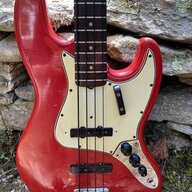
I want my '64 Jazz Bass and my '66 Hofner to shine through with their own natural voice.
Warm woody musical.
That really starts with the amp.
Still you can shape the sound differently if you wish going through a variety of cabs and speakers.
My SVT 8X10 is an old reliable friend.
That does not mean I would not be open minded to trying newer designs if... I was looking.
I'm still thinking about a Reeves 1X15 ported bass cab, since I have 10's covered.
Warm woody musical.
That really starts with the amp.
Still you can shape the sound differently if you wish going through a variety of cabs and speakers.
My SVT 8X10 is an old reliable friend.
That does not mean I would not be open minded to trying newer designs if... I was looking.
I'm still thinking about a Reeves 1X15 ported bass cab, since I have 10's covered.
Some commercial cab manufacturers skimp on the amount of damping material, but I have never seen a sealed or ported cab with none.
Guitar cabs get away with none as many are open back, plus those guys thrive on distortion and other weird sound artifacts and defects. But there is a trend towards FRFR guitar cabs, so damping material is a part of those designs. Boutique builders use, and the major DIY plans always specify, adequate damping material.
I think it is a cost cutting measure for some...bean counter wants to save a few pennies on hundreds of units...though my old Carvins, which were considered sort of budget gear, were pretty well damped inside, didn't skimp on box size or port area either. Though that was before having everything as compact as possible became all the rage. We just figured carrying around big boxes and blocks of iron was just part of playing the bass.



I'm not too concerned with Doppler/phase modulation, it's more of a audiophile spec. It can be measured, and designs created to compensated for it. It's impossible to hear with normal music.
Headphones also work and it's nearly impossible for a bell curve human to hear doppler with them.
As it turns out my ear drums are a single cone like membrane. There's only a single point of contact that sends vibrations to the inner ear. The same doppler would happen there. Apparently my brain takes care of the phase modulation.
Seems that most people want louder, smaller, lower, transparent, reliable, cheaper - ported cabs fit the bill.
Headphones also work and it's nearly impossible for a bell curve human to hear doppler with them.
As it turns out my ear drums are a single cone like membrane. There's only a single point of contact that sends vibrations to the inner ear. The same doppler would happen there. Apparently my brain takes care of the phase modulation.
Seems that most people want louder, smaller, lower, transparent, reliable, cheaper - ported cabs fit the bill.

You can design a cab to cover a very broad range of frequencies and high power, but if the amp you plug into that cab has no soul, no warmth, no character, then you're trying to make the speaker cabinet compensate for the amp's lack of tone.
So that's why you play the old alnico cab.

- Nov 24, 2008
- 4,343
- 7,163
- Disclosures
- Owner & designer, AudioKinesis; Auth. mfg, Big E (Home Audio only)
Sometimes in order to provide the perceived necessary correction, the design of the filter suffers from stored energy problems that were either not understood or simply ignored. With a tube amp, this would not be a problem but clearly it can be with other amp topologies.
It's not just minimum impedance, it's the storage of reactive energy. Filter responses contain both capacitive and inductive slopes (leading and lagging current responses), these factors plus stored energy can allow destructive oscillations to occur depending on amp topology and even specific design approaches. They can be especially troublesome on class ab amps using high global feedback and low stability margins, as well as class d topologies.
I don't have a formal background in electronics, so am at risk of being "that guy". I try to keep my impedance curves fairly benign (above as well as within the passband) in both magnitude and phase angle, and use damping resistors on the parallel legs of my filters so they don't show a dead short if a driver blows, but I don't know what specific steps to take to avoid the stored energy oscillations you describe. What should I be looking at? What are the symptoms that might show up in measurements (before the magic smoke escapes)?
If this is beyond the scope of what you're comfortable discussing here, no problem. But I really don't want to be the speaker guy who accidentally kills someone's amp.
Last edited:
Now THAT ^ is funny! Thanks for going to all the trouble.

- Mar 8, 2011
- 12,232
- 51,187
- Disclosures
- Authorized greenboy designs builder/Owner of BNA Audio
A few years back I toured with an AudioKinesis TC115. I really loved it, but I had about 15 different amps blow up on that tour


