• TalkBass has been independent since 1998. Add your voice.
    Create a free account to reply to discussions, view embedded media, and browse with fewer display ads.
    Join freeLog in
    Want zero display ads or expanded classifieds tools? Compare plans.

Pretty sure I messed up.. help with misplaced volute and too thin headstock.

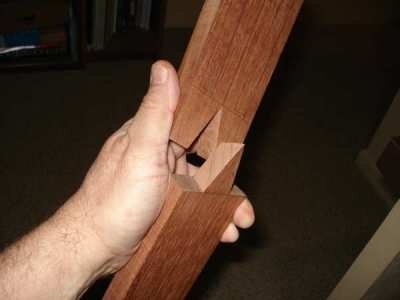
I was up too late last night and misplaced my volute location - too far up the headstock. As a result the remaining wood is too thin. See pics.

This is for a 5 string NT multi-scale bass so tensions are high.

I'm looking for some opinions on a fix before I go with my nuclear option - converting to headless ( also here to see if this idea is viable).

For my headless conversion I'm thinking of chopping the headstock off at the rear of the nut shelf and epoxy-ing a pair of 4"-6" long 1/4" steel rods 2-3" into the cross section of the neck and affixing a new piece of wood onto the other side of the rods to mount my headless anchors.

Some things of note- the break angle as it currently sits is pretty bad and I had other plans to fix that, going headless would get me a fresh start on that.

Any thoughts or concerns?

 
  • Wow
Reactions: Hurricane Jimmie
You can glue veneer or veneers on the back of the headstock like Alembic does.
 

Attachments

  • IMG_6207.jpeg
    IMG_6207.jpeg
    421.6 KB · Views: 7
I was up too late last night and misplaced my volute location - too far up the headstock. As a result the remaining wood is too thin. See pics.

This is for a 5 string NT multi-scale bass so tensions are high.

I'm looking for some opinions on a fix before I go with my nuclear option - converting to headless ( also here to see if this idea is viable).

For my headless conversion I'm thinking of chopping the headstock off at the rear of the nut shelf and epoxy-ing a pair of 4"-6" long 1/4" steel rods 2-3" into the cross section of the neck and affixing a new piece of wood onto the other side of the rods to mount my headless anchors.

Some things of note- the break angle as it currently sits is pretty bad and I had other plans to fix that, going headless would get me a fresh start on that.

Any thoughts or concerns?


Oof! Yes, that needs to be reinforced. You cut it too thin, right at the most highly stressed point. The scoop on the front side is too deep and close to the nut, and the volute on the back is too far outboard.

To fix it, you need to solidly glue a block of wood on the front side, to mostly fill in that scoop. Turn it into a gentle slope from the nut down to the first tuners. Make it from some nice contrasting color wood and trim it neatly so it looks like it belongs there.

Similar thing on the back. File a flat strip down the curve of the volute and glue on a block of wood to fit. Then shape it to bring the peak of the volute back to where it should be, about even with the nut. Use a contrasting wood, and shape it like it's part of the design.

The point is, you need to increase the thickness significantly right at that spot. The thickness will make it stronger.
 
If you are willing to risk it a bit, maybe inserting a couple of carbon fiber bars diagonally from the back of the headstock and into the neck could make it strong enough.

If you go the headless route, I wouldn' trust an end grain glue joint. Even reinforced with with steel dowels, the glue joint is going to be a weak point.

To m the best solution would be removing the fretboard and doing a new scarf jointed headstock. Or, going headless, you could also do some kind of reverse diamond joint like an old Martin guitar, with the V cut into the neck back. That way you get a.decent glue surface without having to remove the fretboard.
 
  • Like
Reactions: aston47
If you are willing to risk it a bit, maybe inserting a couple of carbon fiber bars diagonally from the back of the headstock and into the neck could make it strong enough.

If you go the headless route, I wouldn' trust an end grain glue joint. Even reinforced with with steel dowels, the glue joint is going to be a weak point.

To m the best solution would be removing the fretboard and doing a new scarf jointed headstock. Or, going headless, you could also do some kind of reverse diamond joint like an old Martin guitar, with the V cut into the neck back. That way you get a.decent glue surface without having to remove the fretboard.
Something along these lines, but reversed?
 

Attachments

  • Vjoint1.jpg
    Vjoint1.jpg
    26.1 KB · Views: 9
  • Like
Reactions: KidAmnesia
The block on the front would be an excellent place for an inlaid logo..........
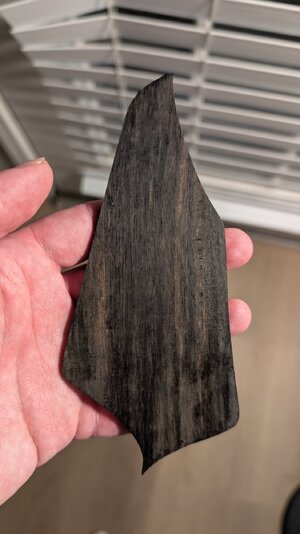
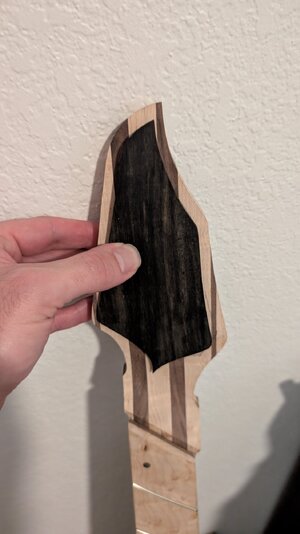
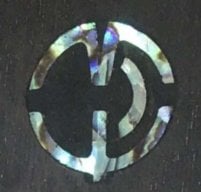
I did have this piece planned for the front face. I'll likely still use it.. I have yet to put a logo on any of my instruments but this one is screaming for a gold or black pearl inlay.
 

Attachments

  • PXL_20260302_012220803.MP.jpg
    PXL_20260302_012220803.MP.jpg
    616 KB · Views: 7
  • PXL_20260302_012605357.MP.jpg
    PXL_20260302_012605357.MP.jpg
    493.7 KB · Views: 5
  • Like
Reactions: Matt Liebenau
I did have this piece planned for the front face. I'll likely still use it.. I have yet to put a logo on any of my instruments but this one is screaming for a gold or black pearl inlay.

Sure, that would look nice. But you still need to fix the structural weakness. You need to build up up the thickness of that offset part by adding blocks on the front and back.

I recommend a block of walnut fitted and epoxied into that scoop on the top. Trim the front edge at an angle, to meet up with that ebony cap.
 

Latest posts