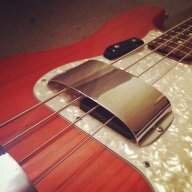
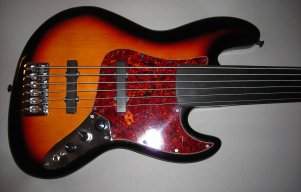
I have an American Standard Pbass that I am planning to do this on. I love the tone I get and would prefer not to change out the pups. Glad to know how much it helped!
Look.
There are some facts that all bass players need to get right.
1. There are TWO kinds of hum. Electric and Magnetic.
2. Copper foil (or any conductive coating) only blocks the electric hum.
3. Usually Electric hum tends to change or go away when the player touches ground (jack, strings, metal knobs etc.)
4. Magnetic hum (single coil hum) will change level with the orientation of the bass. Often a "null" position can be found but not necessarily in a playable position.
5. Hum can be 60 Hz but also (and often) includes a bunch of higher harmonics making it more like a "buzz" or Sizzle or any other of the myriad words musicians like to use to describe the sound. This can happen with either electric or magnetic hum. A "hiss" sound (like escaping steam) is usually due to active electronics. Turning off the cab tweeter can help hiss.
6. For copper (or paint) to work as shielding it must be grounded which means connected to the jack body or control plate. Ungrounded copper shields do nothing. Conductive glue works, but a little "insurance" by solder-tacking copper pieces together and to ground makes sure you don't lose contact if glue dries out over the years.
7. P-bass pickups are HUMBUCKER pickups! So are "noiseless" jazz pickups and so are my SCN Jazz pickups.
8. Single coil pickups tend to sound much better than hum canceling pickups which is why people are willing to put up with the hum. How much better they sound is YOUR opinion.
9. The ideal for shielding is to enclose ALL wiring in a water-tight grounded conductive box. This is not possible because tops of pickups must stick out. Putting copper shielding inside pickup covers adds capacitance that can change the tone. Usually I stop at just coating pickup routs with copper foil. The more wiring you leave uncovered with no conductive material the more hum the whole thing will pick up.
10. Most players are surprised to learn that by shielding the bass electronics and blocking all electric hum, the remaining single coil hum is MUCH less objectionable. However, in a bad venue (lots of nearby light power supplies etc) single coil hum WILL still be present in spite of all the stories about how shielding made it go away.
11. RF pickup (picking up radio stations) is another problem and is difficult to solve. Often it's an amp and not a bass problem.
Personally I tend to prefer copper foil to conductive paint even though it's harder to install. For unknown reasons sometimes paint just doesn't work. This is even true of Fender factory conductive paint (as I mentioned earlier on my Deluxe Jazz V). Just remember to solder-connect all pieces and connect it all to the jack body. To ground conductive paint you put a screw through the paint into the body with a lockwasher that "bites" into the paint. Ground the screw.
Also the Audere dummy coil jazz bass preamp seems to have lots of possibilities in keeping killer single coil tone while still bucking single coil hum. We need some reports here on how this new product worked out.
Good luck!