• TalkBass has been independent since 1998. Add your voice.
    Create a free account to reply to discussions, view embedded media, and browse with fewer display ads.
    Join freeLog in
    Want zero display ads or expanded classifieds tools? Compare plans.

Pros and cons of stacking...

What's my best bet from these choices??

  • stacked on the floor

    Votes: 30 61.2%
  • stacked on a box

    Votes: 14 28.6%
  • Stack split by stand

    Votes: 0 0.0%
  • something else

    Votes: 4 8.2%
  • something else involving crates of organic carrots

    Votes: 1 2.0%

  • Total voters
    49

mikewalker

Supporting Member
Jul 30, 2017
8,881
21,793
Canada, Eh!
I'm not an acoustical engineer (although I do play one on TV) ;) and I was wondering if anyone can educate me about the "boundary effect", and how substantial that really is.

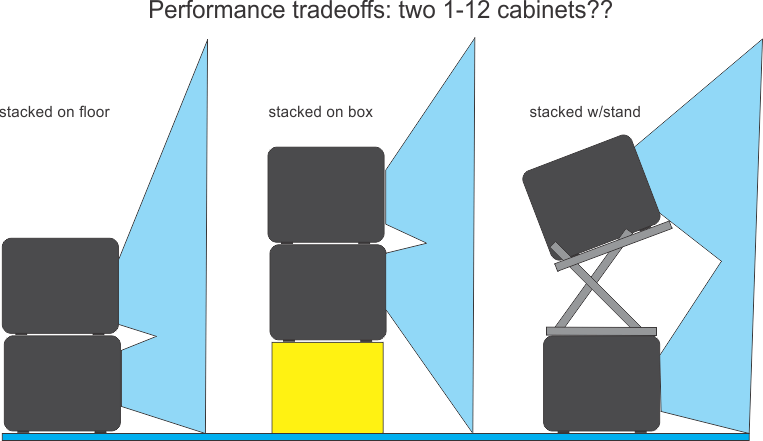
I have two identical 1-12 cabs, and would like to stack them for optimal performance and efficiency - but also keeping in mind I'd like to hear my articulation very well.

These are my three options I have been considering :
stand.gif


The "stacked on the floor" potentially offers "floor boundary coupling" plus "the line array effect" - but it's not pointed anywhere near my ears... (I'd typically be positioned no more than 5 or 6 feet in front of it)

The "stacked on box" potentially offers LESS (zero?) "floor boundary coupling" plus "the line array effect" - and it's pointed somewhat closer to my ears...

The "stacked w/stand" potentially offers "floor boundary coupling" but (probably?) loses the "the line array effect" - however the top cab is pointed more towards near my ears...

All things being equal, which would be considered optimal? Are the "boundary" and "line array" effects really considerable? I'd be running about 400 WRMS through this rig. This application is for small but loud rooms, with no PA support for the bass. I've been leaning towards buying a tilt stand, but would love some opinions on this first...
 
Last edited:
  • Like
Reactions: Spidey2112
My own personal choice would be to stack 'em on the floor, as this is less likely to produce acoustic anomalies, but, as you have observed, this doesn't put the speakers up near your ears, and results in less HF content being audible at the playing position. If that is a problem for you, the second option, putting the stack on a box, is probably the better of the remaining two choices. You might find that there's a place out in front of the stack where there is an audible cancellation of the direct sound and the waveform reflected off the boundary (the floor), but at least there will be more HF content audible to you. Separating the two speakers with a stand is inviting even more audible cancellations at the playing/monitoring position, IMO.

And I have no doubt that at least one TB-er is going to weigh in with a suggestion of IEMs. Also not a choice I would consider, but everyone has their own thing.
 
Hmmm... it never occurred to me that IEM could be used to supplement/replace the exiting stage mix. (I have used them lots in completely amp-less stage setups). Food for thought, though it complicates what I hoped would be a minimalist setup...
 
I have mine stacked on a specially built honeycombed box full of foam. I've found that sometimes direct to floor coupling creates boom in some wooden floored and hollow stage situations .. even with castors .. it gets the top stack up to my ear level as well ..good luck ( this just happens to work for me , others may have a better solution)
 
I'm not an acoustical engineer (although I do play one on TV) ;) and I was wondering if anyone can educate me about the "boundary effect", and how substantial that really is.
each nearby boundary that is fully reflective contributes +6dB to the original sound until it is far enough away that it is not well enough in phase , further out it cancels out the original sound quite effectively when it is 1/4 of the wavelength distant from the woofer.

Mostly we are concerned that our bottom end doesn't vanish unless our bottom end is booming violently under the stage.

At 2ft off the stage you only cancel mids that are directional enough not to matter.

Mostly you don't want to be 4ft from a brick wall corner. That gives you a double dose of no 80hz.
 
Stacked on a box is probably best. You want to have your ears within the midrange and high frequency radiation pattern of the upper cab, so with 112s you probably want to have them on a box 18 to 24 inches high. You won't lose boundary reinforcement from the floor in the bass with that high of a box. Option 3 is the worst, it puts the drivers too far apart.
 
  • Like
Reactions: fig and mikewalker
How about put the bottom one on the floor and the top one of top of the box, that way you get the floor coupling which I always like plus you get to hear it at ear level, not sure how that would effect double cab coupling though or whatever you call it.
Cab coupling is more important to mitigate midgrange acoustic interference. Keep 'em stacked tight!
 
The box with "the beer effect" gets my vote!
Reminds of back in the '70's, when I happened to witness a fairly large country-swing band setting up in one of their favorite, regular honky-tonk venues. Their roadie made a beeline to the behind-the-bar storage area with a hand truck and brought out a couple of loads of cases of 'long-neck' empties...this was when beer could still be purchased in returnable bottles, so thriving bars always had a bunch of empties waiting to be returned. So every one of the band's Twin Reverbs (I think they had about 4 or 5) got set on a stack of beer cases. This particular bar always had plenty of that band's favorite brand, so the cases could all be the same and all turned to show the same logo..."Lone Star", or course. I thought it made a pretty good statement about who the band was and what their music was about.

That act still plays a monthly engagement at that old honky-tonk dance hall, but it's been a generation or more since beer was sold in returnable long-neck bottles around here.
 
i've never tried stacked on a box. but there is definitely something to be said for having the speaker near ear level for hearing your articulation / treble-end-of-things. The split with stand seems... weird. i would first try two stacked on the floor (this is what i do now wth 2 gk neo 112s and how i plan to run my 2 fEARful 12/6s when i finish the second one). If that's not cutting it, try them up on a (sturdy) box and see if you get a sense of the pros and cons to either approach.
 
  • Like
Reactions: mikewalker
I'm not an acoustical engineer (although I do play one on TV) ;) and I was wondering if anyone can educate me about the "boundary effect", and how substantial that really is.

I have two identical 1-12 cabs, and would like to stack them for optimal performance and efficiency - but also keeping in mind I'd like to hear my articulation very well.

These are my three options I have been considering :

View attachment 3408304

The "stacked on the floor" potentially offers "floor boundary coupling" plus "the line array effect" - but it's not pointed anywhere near my ears... (I'd typically be positioned no more than 5 or 6 feet in front of it)

The "stacked on box" potentially offers LESS (zero?) "floor boundary coupling" plus "the line array effect" - and it's pointed somewhat closer to my ears...

The "stacked w/stand" potentially offers "floor boundary coupling" but (probably?) loses the "the line array effect" - however the top cab is pointed more towards near my ears...

All things being equal, which would be considered optimal? Are the "boundary" and "line array" effects really considerable? I'd be running about 400 WRMS through this rig. This application is for small but loud rooms, with no PA support for the bass. I've been leaning towards buying a tilt stand, but would love some opinions on this first...
There is still a fair amount of art vs science in the way folks look at this issue. Your post seems to be primarily concerned with the floor as a boundary? Of course, walls and ceilings can have similar concerns.

Coupling to the stage plate is one particular concern. The mechanism for transfer is not from mechanical contact with the cab itself, but rather from the projected pressure waves from the drivers. Bass frequencies have wavelengths in air around a meter +/-. Transfer from the drivers to the stage plate actually increases as the cab is elevated above the stage plate for the first 1/4 wavelength and starts to fall off. So, putting the cab on a box of uncontrolled height may actually increase the transfer to the stage plate. But, since that height depends on frequency, I’ve given up trying to control it, and just put my cabs stacked directly on the stage.

The most effective way I have found to reduce transfer to the stage is to put absorbing materials IN FRONT of the drivers on the stage, to soak up the pressure waves.

Some players prefer to tilt one cab for better monitoring. I have personally never had a problem hearing my bass with even a single 112 on the ground; but, YMMV.
 

Latest posts