• TalkBass has been independent since 1998. Add your voice.
    Create a free account to reply to discussions, view embedded media, and browse with fewer display ads.
    Join freeLog in
    Want zero display ads or expanded classifieds tools? Compare plans.

Pros and 'Unusual' Basses.

Woah woah woah wait a minute "that we all love" talk about yourself. I don't like mainstream music that much, rock neither. Ya know that Geddy played Steinberger headless basses, Rickenbacker and Wal before taking the Fender which I'm sure it is all because of the money and ya know the tone he gets is part is technique and part all the effects/preamp/amp combination, it's far from natural. Marcus's bass is heavily modded by Sadowsky.

No geddys bass which he bought in a pawnshop was used on early albums and tours along with the stienbrger.
If adding a preamp is heavily modified ok. Stock pickups in Marcus"s original bass.
And we aren't discussing teqnique or effects. Marcus normally recorded straight to the board though.

I know a large portion of mainstream music was recorded with Fender but you have to also remember that for a very long periode Fender was the only choice, everything else was very bad to the point that bass guitar was named Fender. Also just like I already said, go outside of that mainstream pop/rock/punk stuff that we hear on radio and you'll see the world doesn't gravitated toward Fender at all.
 
Woah woah woah wait a minute "that we all love" talk about yourself. I don't like mainstream music that much, rock neither. Ya know that Geddy played Steinberger headless basses, Rickenbacker and Wal before taking the Fender which I'm sure it is all because of the money and ya know the tone he gets is part is technique and part all the effects/preamp/amp combination, it's far from natural. Marcus's bass is heavily modded by Sadowsky.

I know a large portion of mainstream music was recorded with Fender but you have to also remember that for a very long periode Fender was the only choice, everything else was very bad to the point that bass guitar was named Fender. Also just like I already said, go outside of that mainstream pop/rock/punk stuff that we hear on radio and you'll see the world doesn't gravitated toward Fender at all.
I think most of us love some music by rush Marcus( miles,luther etc.) Bob marley Motown the police
Etc I can think of Fender artists in every genre for the last 60 years
 
Of course most of geddy and Marcus"s tone comes mostly from their teqnique but were discussing their choice of insturments which is start of their signal chain. As far as I know the only mod to Marcus"s original bass was a two band preamp and setup.
Geddys stock and he used it along with th Ric to record the early albums.
 
[...]For what I do they work in every single situation studio or live, theater pits, or bar gigs. I know even in a tough room I can take out my P-Bass and get great sound without having a million knobs to tweak.
Getting a great tone in a tough room, is why AMJ's comment is very important. It's the one HUGE advantage of a passive Precision or Jazz Bass. Some of the best places to play can still be at times, be the worst rooms for sound.
 
  • Like
Reactions: Handz Solow
"Nothing is an improvement on a J-bass" with the moving goal posts of body shape, pickups, bolt on necks, 4 strings, 34" scale etc.

The bass guitar wasn't Leo Fender's crazy brain child that came out of a vacuum. The body shape looks pretty much like a guitar, which isn't too much of a stretch from viol/violin family instruments, which have been around for hundreds of years. Bigger lower bout, a waist/"c" bout, smaller upper bout. On the viol/violin family, that shape was decided upon to provide an acoustic resonating chamber, and to allow clearance for the bow so it didn't stab the body of the instrument. On acoustic guitars (which were around long before electrics came around) it made it so you could play the instrument sitting down over your leg. Ever try to sit with a flying V without a strap? doesn't work so well. The upper horn on electric guitars was extended to balance the instrument and prevent neck dive, because of the solid headstock and heavy metal tuners. The reason that you don't see too many radical shaped instruments that deviate from "generally guitar shaped" is because ergonomically they work. You don't see too many cars with 7 wheels either, because 4 makes sense. That doesn't mean there haven't been improvements since the Ford Model T.

The same can be said about pickups. The two pickups on the J bass have significantly different sounds because of the distances they sit from the bridge. You can get a huge range of tones out of an instrument by soloing either one or blending them, which is nothing new. Archtop guitars had two pickups on them before Fender came into the game. The P bass pickup being where it is gets a particular tone, same with the Music Man/Stingray and its distinctive sound. And there is only so much real estate between the bridge and the fretboard, so it comes as no surprise that other manufactures are going to put pickups somewhere in there.

Bolt on necks: Ease of construction/mass production. Cheaper material/labour costs than neck through or set neck. It works.

4 strings: 95% of the double basses out there have 4 strings. They happen to be (usually) tuned the same, which also happen to be the bottom 4 (bass) strings of a guitar.

34" scale: Compromise. The double bass has a string length of around 42" which most guitar players would find insane and no one has an arm long enough to play that seated. The typical 25.5" guitar neck wouldn't work because the strings would be way too floppy. This has been "improved" upon countless times with 35" 5/6 strings, 30" short scale, fanned fretted basses that have a longer scale for the lower strings that need it and shorter scale for the higher strings.

"Rich musical history"

The P bass hit the market in '51. The J bass in '60. That is 64 years, (55 for the J bass) when music has existed for millennia. Yes, in the west the farthest we tend to go back seems to be Baroque music that started around 1600 because that is when musical notation started to resemble what we are familiar with today, but there are plenty of people alive today that precede the electric bass and it's "rich history". I have nothing against the music that has been made with the electric bass, but it is one of the youngest mainstream instruments around today and people are still coming up with new things to do with it all the time. Suggesting that Fender has some sort of lineage, tradition, or history beyond when other players came on the scene is pretty narrow minded when the Hofner 500/1 ("Beatle bass) came out in '56, Rickenbacker 4000 series started in '57 and the Gibson EB-0 was '59 (before the J bass) and the Music Man StingRay hit the market in '76, and G&L came around in the late 70's. Sure they might have had more popularity initially, but they weren't the only bass in the game.

That turned into a novel. Long story short: Fender P and J basses are considered "standards" much the same way that a four door sedan is the standard automobile. Most other basses look/function similar because the Fenders themselves weren't crazy deviations to begin with, and their "history" is as old as Mr. Potato Head.
 
This is a "chicken or the egg" thing- why Fenders sit so well in the mix/ work for so many things. There's an upper midrange funk to a P bass that gives you presence that sits well no matter how you EQ it. Nothing else can really do that. I don't always like the way a P sounds on its own, but in the mix it's a magical thing. With one tone knob, one pickup, and the choice of fingers or pick, a good player can make a P work on almost anything. That being said, I'd rather slap or pretend to be Jaco on a J bass or something like it.


Don't you think they sound good in the mix because it is a Fender or because they are so used to Fender sound that they mix it in a way it will work so another brand may ask more work on all the other instrument as well ...
 
Do you think those 50 bassists
Chose the p for its tone or look
Or perhaps a perfect combination of both for thier music?

I don't know. That was my question. I have a P bass, and I love it to death. Granted, it's not a typical 'Murica sunburst white pickguard maple fretboard kind of P bass. It's black, no pickguard, and has a matching headstock (SCORE). And it has EMGs! :D And I think it's great. I fully expect someone like Pino Palladino to honestly love his P bass. There's nothing else quite as groovy. And I can't say Mike Dirnt having a P bass surprises me either. He plays punk. All he needs to do is keep up on his strings, and everything sounds great. But there are people who do use P basses that I question. Peter Baltes from Accept uses one. Why? He could EASILY afford a German Warwick. He's German himself! What's not to love? And, he plays metal! Why would he use a P bass? Why aren't bassists more like Chris Wolstenholme, from Muse. He's used tons of stuff. Pedullas, Zons, Status, and Fenders. On Panic Station, I'm 99% that's just a Fender Jazz. He has multiple different basses for the multiple different occasions his band calls for. For bands like Green Day, I see why you would only ever need a P bass. That's all Green Day calls for. Pino is Pino. Take away his P, and you're just left with -ino. Puns aside, his Precision is part of his tone. Baltes could use a Warwick and he could probably cop a better metal tone from it than a P bass (my opinion, of course.) So there's the question- Is the Precision that much better? Does he like the Precision that much better? Or does his sound guy? Or does the rest of Accept? Or does the world at large? Who is ultimately responsible for Fender use when there are other substitutes? And that's what I meant by pros. People who play for a living, and can afford at least one of most any bass they want.
 
Pino still plays his fretless Musicman with an octave pedal... saw him using just that with Nine Inch Nails. If you're not hip to the stuff he did with Paul Young and Pete Townshend (and Don Henley and and and....) you're missing out. Pino uses a J for lots of stuff as well. On D'angelo's Voodoo I believe he used a detuned instrument by Moon, the company Larry Graham endorses. The P is just one of his voices. Dude has a BIG career.


I don't know. That was my question. I have a P bass, and I love it to death. Granted, it's not a typical 'Murica sunburst white pickguard maple fretboard kind of P bass. It's black, no pickguard, and has a matching headstock (SCORE). And it has EMGs! :D And I think it's great. I fully expect someone like Pino Palladino to honestly love his P bass. There's nothing else quite as groovy. And I can't say Mike Dirnt having a P bass surprises me either. He plays punk. All he needs to do is keep up on his strings, and everything sounds great. But there are people who do use P basses that I question. Peter Baltes from Accept uses one. Why? He could EASILY afford a German Warwick. He's German himself! What's not to love? And, he plays metal! Why would he use a P bass? Why aren't bassists more like Chris Wolstenholme, from Muse. He's used tons of stuff. Pedullas, Zons, Status, and Fenders. On Panic Station, I'm 99% that's just a Fender Jazz. He has multiple different basses for the multiple different occasions his band calls for. For bands like Green Day, I see why you would only ever need a P bass. That's all Green Day calls for. Pino is Pino. Take away his P, and you're just left with -ino. Puns aside, his Precision is part of his tone. Baltes could use a Warwick and he could probably cop a better metal tone from it than a P bass (my opinion, of course.) So there's the question- Is the Precision that much better? Does he like the Precision that much better? Or does his sound guy? Or does the rest of Accept? Or does the world at large? Who is ultimately responsible for Fender use when there are other substitutes? And that's what I meant by pros. People who play for a living, and can afford at least one of most any bass they want.
 
  • Like
Reactions: wvbass
If you want to compare basses to cars, the Fender P and J are like classic American muscle. Mustangs, Challengers, Chargers, Corvettes, take your pick. Classic design, classic looks, solid technology, but by no means perfect. However people grew up idolising these cars, and have learned to work around and love their flaws, and will defend them until the end of time - "they don't make them like they used to...." "the 427 big block was the greatest engine ever made..." etc. People still love them today, and are still buying, modding and loving them.

The boutique P and J are like the more modern versions of the classic muscle - Corvette ZR1/ZO6, Challenger SRT Hellcat, Camaro Z28. It's a modern take on a classic design, or as some people like to say, 'on steroids'. Better quality, more power, better handling. Some people love the improvements and changes that have been made to the original design. Other people don't even think that the newer versions are worthy to share the same model name. Are either group of people wrong?

The high-end boutique instruments are like European supercars - Ferrari, Lamborghini, Pagani, Aston Martin, etc. They are (generally) technically superior to the American muscle in almost every way - more power from smaller engines, more efficient, newer technology, better handling, faster off the line, faster round the track, the list goes on. But then not everyone can afford that kind of vehicle, and not everyone would want that kind of vehicle - some people prefer a more classic look, or know that they would never use that amount of HP, or just want something more practical.


At the end of the day, it doesn't matter what everyone else drives. Decide what you want/need from a vehicle, factor in what you can afford, and then look at what options are open to you and test drive your shortlist. Buy the one that suits you best. If someone else has different taste, why does that matter? It's not like we're living in North Korea.
 
  • Like
Reactions: JLY and Handz Solow
"Nothing is an improvement on a J-bass" with the moving goal posts of body shape, pickups, bolt on necks, 4 strings, 34" scale etc.

The bass guitar wasn't Leo Fender's crazy brain child that came out of a vacuum. The body shape looks pretty much like a guitar, which isn't too much of a stretch from viol/violin family instruments, which have been around for hundreds of years. Bigger lower bout, a waist/"c" bout, smaller upper bout. On the viol/violin family, that shape was decided upon to provide an acoustic I am fully aware of the. resonating chamber, and to allow clearance for the bow so it didn't stab the body of the instrument. On acoustic guitars (which were around long before electrics came around) it made it so you could play the instrument sitting down over your leg. Ever try to sit with a flying V without a strap? doesn't work so well. The upper horn on electric guitars was extended to balance the instrument and prevent neck dive, because of the solid headstock and heavy metal tuners. The reason that you don't see too many radical shaped instruments that deviate from "generally guitar shaped" is because ergonomically they work. You don't see too many cars with 7 wheels either, because 4 makes sense. That doesn't mean there haven't been improvements since the Ford Model T.

The same can be said about pickups. The two pickups on the J bass have significantly different sounds because of the distances they sit from the bridge. You can get a huge range of tones out of an instrument by soloing either one or blending them, which is nothing new. Archtop guitars had two pickups on them before Fender came into the game. The P bass pickup being where it is gets a particular tone, same with the Music Man/Stingray and its distinctive sound. And there is only so much real estate between the bridge and the fretboard, so it comes as no surprise that other manufactures are going to put pickups somewhere in there.

Bolt on necks: Ease of construction/mass production. Cheaper material/labour costs than neck through or set neck. It works.

4 strings: 95% of the double basses out there have 4 strings. They happen to be (usually) tuned the same, which also happen to be the bottom 4 (bass) strings of a guitar.

34" scale: Compromise. The double bass has a string length of around 42" which most guitar players would find insane and no one has an arm long enough to play that seated. The typical 25.5" guitar neck wouldn't work because the strings would be way too floppy. This has been "improved" upon countless times with 35" 5/6 strings, 30" short scale, fanned fretted basses that have a longer scale for the lower strings that need it and shorter scale for the higher strings.

"Rich musical history"

The P bass hit the market in '51. The J bass in '60. That is 64 years, (55 for the J bass) when music has existed for millennia. Yes, in the west the farthest we tend to go back seems to be Baroque music that started around 1600 because that is when musical notation started to resemble what we are familiar with today, but there are plenty of people alive today that precede the electric bass and it's "rich history". I have nothing against the music that has been made with the electric bass, but it is one of the youngest mainstream instruments around today and people are still coming up with new things to do with it all the time. Suggesting that Fender has some sort of lineage, tradition, or history beyond when other players came on the scene is pretty narrow minded when the Hofner 500/1 ("Beatle bass) came out in '56, Rickenbacker 4000 series started in '57 and the Gibson EB-0 was '59 (before the J bass) and the Music Man StingRay hit the market in '76, and G&L came around in the late 70's. Sure they might have had more popularity initially, but they weren't the only bass in the game.

That turned into a novel. Long story short: Fender P and J basses are considered "standards" much the same way that a four door sedan is the standard automobile. Most other basses look/function similar because the Fenders themselves weren't crazy deviations to begin with, and their "history" is as old as Mr. Potato Head.
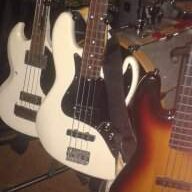
In the history of electrified music Fender has been there al along.
Hendrix, Clapton., Jamerson giddy, Marcus all play big roles in modern music history,
Sure it's simple design made by a non artist, non musician over 60 years ago.
Do you see builders building eb-3 or Ric clones regularly?
The jazz bass , the p, the strat are beautiful instruments to me. Classic lines and legendary tone.
 
In the history of electrified music Fender has been there al along.
Hendrix, Clapton., Jamerson giddy, Marcus all play big roles in modern music history,
Sure it's simple design made by a non artist, non musician over 60 years ago.
Do you see builders building eb-3 or Ric clones regularly?
The jazz bass , the p, the strat are beautiful instruments to me. Classic lines and legendary tone.
But thanks for your beautifully written thesis.
 
The Fender Bass is a lot the colt 45 pistol. A classic industrial design, function and form. Still in production today.
Most auto pistols use the same mechanisms and look quite similar. Sure you could get a glock ( kinda like a stienberger )
Or a gas operated desert eagle but many still Cary the 1911 Colt 45 .
 
I certainly don't believe that. In fact, I don't ever recall seeing Victor with one. ;)

I don't know about a Boss multi effects unit, but he does use a Boss Looper which may look similar from a distance. I saw him at Guitar Center. He did a session and explained, verbally and hands on, how he uses it. The next week I bought myself the Boss RC 300 Looper (although he uses the smaller unit. I think it's the 30 or something)
 
I don't know about a Boss multi effects unit, but he does use a Boss Looper which may look similar from a distance. I saw him at Guitar Center. He did a session and explained, verbally and hands on, how he uses it. The next week I bought myself the Boss RC 300 Looper (although he uses the smaller unit. I think it's the 30 or something)
He uses a boss multiple effects unit. I've seen him discuss it. It is fact. Did you not see it in the photo?
 
"Nothing is an improvement on a J-bass" with the moving goal posts of body shape, pickups, bolt on necks, 4 strings, 34" scale etc.

The bass guitar wasn't Leo Fender's crazy brain child that came out of a vacuum. The body shape looks pretty much like a guitar, which isn't too much of a stretch from viol/violin family instruments, which have been around for hundreds of years. Bigger lower bout, a waist/"c" bout, smaller upper bout. On the viol/violin family, that shape was decided upon to provide an acoustic resonating chamber, and to allow clearance for the bow so it didn't stab the body of the instrument. On acoustic guitars (which were around long before electrics came around) it made it so you could play the instrument sitting down over your leg. Ever try to sit with a flying V without a strap? doesn't work so well. The upper horn on electric guitars was extended to balance the instrument and prevent neck dive, because of the solid headstock and heavy metal tuners. The reason that you don't see too many radical shaped instruments that deviate from "generally guitar shaped" is because ergonomically they work. You don't see too many cars with 7 wheels either, because 4 makes sense. That doesn't mean there haven't been improvements since the Ford Model T.

The same can be said about pickups. The two pickups on the J bass have significantly different sounds because of the distances they sit from the bridge. You can get a huge range of tones out of an instrument by soloing either one or blending them, which is nothing new. Archtop guitars had two pickups on them before Fender came into the game. The P bass pickup being where it is gets a particular tone, same with the Music Man/Stingray and its distinctive sound. And there is only so much real estate between the bridge and the fretboard, so it comes as no surprise that other manufactures are going to put pickups somewhere in there.

Bolt on necks: Ease of construction/mass production. Cheaper material/labour costs than neck through or set neck. It works.

4 strings: 95% of the double basses out there have 4 strings. They happen to be (usually) tuned the same, which also happen to be the bottom 4 (bass) strings of a guitar.

34" scale: Compromise. The double bass has a string length of around 42" which most guitar players would find insane and no one has an arm long enough to play that seated. The typical 25.5" guitar neck wouldn't work because the strings would be way too floppy. This has been "improved" upon countless times with 35" 5/6 strings, 30" short scale, fanned fretted basses that have a longer scale for the lower strings that need it and shorter scale for the higher strings.

"Rich musical history"

The P bass hit the market in '51. The J bass in '60. That is 64 years, (55 for the J bass) when music has existed for millennia. Yes, in the west the farthest we tend to go back seems to be Baroque music that started around 1600 because that is when musical notation started to resemble what we are familiar with today, but there are plenty of people alive today that precede the electric bass and it's "rich history". I have nothing against the music that has been made with the electric bass, but it is one of the youngest mainstream instruments around today and people are still coming up with new things to do with it all the time. Suggesting that Fender has some sort of lineage, tradition, or history beyond when other players came on the scene is pretty narrow minded when the Hofner 500/1 ("Beatle bass) came out in '56, Rickenbacker 4000 series started in '57 and the Gibson EB-0 was '59 (before the J bass) and the Music Man StingRay hit the market in '76, and G&L came around in the late 70's. Sure they might have had more popularity initially, but they weren't the only bass in the game.

That turned into a novel. Long story short: Fender P and J basses are considered "standards" much the same way that a four door sedan is the standard automobile. Most other basses look/function similar because the Fenders themselves weren't crazy deviations to begin with, and their "history" is as old as Mr. Potato Head.
Thanks.