• TalkBass has been independent since 1998. Add your voice.
    Create a free account to reply to discussions, view embedded media, and browse with fewer display ads.
    Join freeLog in
    Want zero display ads or expanded classifieds tools? Compare plans.

PSA, If you're looking for an EASY painted finish... ;)

I've been doing a few of these Kanso-influenced guitars over the last few years and thought I'd post a photo of my daily player and relate how pleased I am with this painted finish.

This particular guitar features a CHEAP big box store pine body finished with General Finishes "milk paint". While they call it "milk paint" it is actually a tough water based Acrylic mineral solids paint. It's easy to apply and has an attractive matt finish when dry.

I have used a couple different colors, but I really like this "plum" which resulted when combining red and blue until I liked the result. I mostly want to relate that I really like how tough this finish is, and there's absolutely no discernable wear in the year (or two?) since I finished this one.

The neck got two coats of Osmo Poly-X European hard oil. I LOVE the feel!
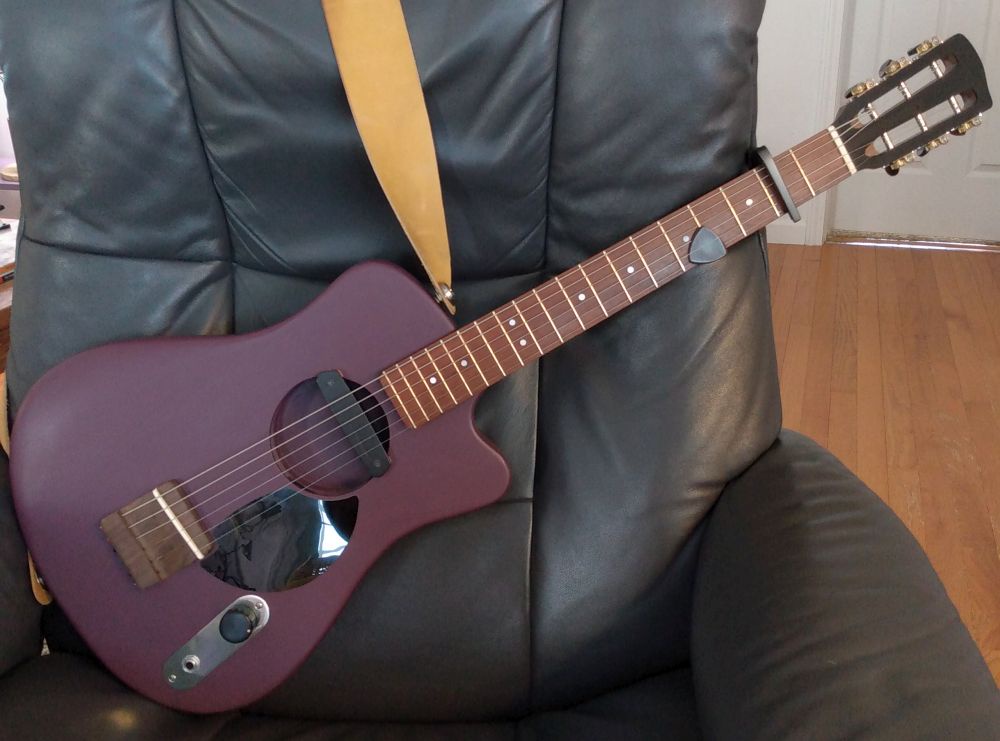

yWwOjPr.jpg
 
Last edited:
Nice! I like the colour too. I'm also really digging the same stuff, general milk paint. It's really good stuff and you can also wax it using the 'furniture wax' products meant for milk paint or chalk paint to good effect. I've also covered it in UV-cure resin for a bit more protection on the surface, but I don't think that's actually needed either.
 
@Bruce Johnson 's mentions of milk paint in the Target Coatings/Varathane Ultimate megathread is what got me interested. I've mixed it with VU for some laundry room stuff and it still looks the same after a couple years spent under a stacked washer and dryer, so I'd expect it to do OK on a guitar :smug:
 
  • Like
Reactions: Beej
I have been planning a finish with the General Finished paint as well. How did you apply it? Brush, roller, sprayer? How many coats? Sanding between coats? Sanding in the end?
 
@Bruce Johnson 's mentions of milk paint in the Target Coatings/Varathane Ultimate megathread is what got me interested. I've mixed it with VU for some laundry room stuff and it still looks the same after a couple years spent under a stacked washer and dryer, so I'd expect it to do OK on a guitar :smug:

Yes, I experimented some with General's Milk Paint a few years back. I was using it as a colorant, to get a dark opaque black in various WB polyurethenes (Pro Finisher and Varathane). It worked fairly well, in small percentages of the mix. Like 5%-10%. But if I mixed in too much, then the chemistry of the milk paint would mess with the chemistry of the poly, and it wouldn't cure properly.

Used by itself, the Milk Paint is definitely an easy, fast way to cover something with a basic solid opaque color. Like Rudy said, it's a water-base acrylic that's loaded up with a high percentage of mineral-base pigment. It's completely opaque on the first coat, which is very satisfying. The finish is quite soft when cured, and it's very difficult to polish it up to a gloss. That and the high pigment load means it's always going to be a dull satin sheen, and the colors are kind of dull. Basic and fully opaque, but not real exciting or vibrant. If that's what you need, it's an easy way to get there.

The Milk Paint is soft, but it's surprisingly tough, in impact and wear resistance. Things tend to bounce and slide off of it, and fine abrasion scratches don't really show. And if it does get scratched, just slap on another coat. That's why it's so popular for household use, like your lawn furniture. It's simple and practical.
 
  • Like
Reactions: 60bass and TyBo
I have been planning a finish with the General Finished paint as well. How did you apply it? Brush, roller, sprayer? How many coats? Sanding between coats? Sanding in the end?

General Finishes makes a wide variety of types of finishing products. Here, we're talking specifically about their Milk Paint. In the can, it's quite thick, and is intended to be brushed on. It can be sprayed, but you have to thin it, which can be tricky.

Usually it's brushed on in one coat, and it moderately flows out to its dull satin sheen. That's it. No sanding between coats, no sanding or buffing at the end. It is what it is.
 
Last edited:
  • Like
Reactions: LowWay
I have been planning a finish with the General Finished paint as well. How did you apply it? Brush, roller, sprayer? How many coats? Sanding between coats? Sanding in the end?
Here's a copy/paste from a complete build topics posted at the Telecaster forum:

"The instrument detailed here is designed with simplicity in mind, and I’d recommend a finish regime that matches the aesthetic. SIMPLE, but hugely comfortable as well as durable.
Osmo Poly-X Satin hard oil is a great solution for neck finishing. It feels like a bare “speed neck” but also offers a degree of protection. There’s nothing simpler to apply, and I’ve been using it exclusively as a neck finish for the last 3 or 4 years and can’t think of anything I’d rather use. The body is finished with three coats of General Finishes “Milk paint”. Don’t be deceived by the name, this is actually a very easy to apply but durable finish. I think it’s a most cool alternative to the fussy and difficult “status quo” finishes."

To expand on that, I sanded to 220 and applied a coat of General Finishes Milk Paint with a foam brush (as per their recommendation for best way to use their product), and lightly knocked off any dust nibs with a 3M white pad when dry.
I repeated the process for a second coat and then did a final coat but skipped the 3M white pad knock down as it didn't need it.

By2Wuzy.jpg
 
No clear coat for me. It adds complexity and work that runs against the concept of simplicity.

If you want a gloss finish it's probably better to go with conventional paint.
I see. I was more asking about durability of the finish as is. If a clear coat isn't necessary, so much the better.

ETA - I have some house paint samples that I've been using for bass bodies for a bit now, and finding a suitable clear coat to keep the color coat intact has been challenging. That's why I was asking.
 
I like the look of that finish, good stuff. Millimetric Instruments also does a lot of their finishes using milk paint, and I think it suits their designs really well, as well as being pretty environmentally friendly.
Thanks for the Millimetric link, I had not seen their stuff before.

I think there may be quite a few small shop builders who are using the General Finishes milk paint. Another builder who features unique minimalist 6 string and bass guitars is Weir Guitars. Many of his instruments feature relicing, which would be another good option for a milk paint finish.
 
  • Like
Reactions: Beej
Thanks for the Millimetric link, I had not seen their stuff before.

I think there may be quite a few small shop builders who are using the General Finishes milk paint. Another builder who features unique minimalist 6 string and bass guitars is Weir Guitars. Many of his instruments feature relicing, which would be another good option for a milk paint finish.
I like that kind of relicing better than the "road worn" look a lot of builders do.
 
I see. I was more asking about durability of the finish as is. If a clear coat isn't necessary, so much the better.

ETA - I have some house paint samples that I've been using for bass bodies for a bit now, and finding a suitable clear coat to keep the color coat intact has been challenging. That's why I was asking.
The one pictured here has been my daily player for a couple years and part of the reason I posted was to relate how robust this finish has been. I figured it would scratch and wear easily, but it shows no signs of any change during that time.

This also lets you know that if a reliced finish is something that appeals to you then it's going to be necessary to do it quite intentionally.

I suspect that standard house paints wouldn't be as durable as the General Finishes Acrylic milk paint. They say on their website that it's formulated for durability, suggesting it is good to use for heavy wear areas such as kitchen cabinets.

I'm not sure as to the timetable for full curing of the finish, but it does seem like it toughens up if you give it a month to really "cure". I tried to be careful not to bump it hard during that first month and then resumed my normal degree of not being overly cautious. ;)

One of the things I love about the idea behind these instruments is that they designed to be part of everyday life. They live it with you, and don't consider themselves to be fine art that needs to be protected from the rigors of the world.
 
Last edited:
The one pictured here has been my daily player for a couple years and part of the reason I posted was to relate how robust this finish has been. I figured it would scratch and wear easily, but it shows no signs of any change during that time.

This also lets you know that if a reliced finish is something that appeals to you then it's going to be necessary to do it quite intentionally.

I suspect that standard house paints wouldn't be as durable as the General Finishes Acrylic milk paint. They say on their website that it's formulated for durability, suggesting it is good to use for heavy wear areas such as kitchen cabinets.
Awesome, I'll definitely be looking into their paint going forward. Thanks for posting!
 
I like that kind of relicing better than the "road worn" look a lot of builders do.
Oh man, I hear you. Some of the Fender Custom Shop relics are just over the top. A properly reliced guitar shouldn't look like it was tied to the bumper of a car before a cross-country road trip. What were they thinking?

I think that Novo Guitars is probably leading the field for properly done and tasteful relicing.
 
  • Like
Reactions: definenredefine
I like the color and look of that guitar!

I am planning to use milk paint on my two WBO projects so I'm glad to see that you used it and had good results!

I was thinking I would seal it with shellac, though, to get a little more durability. Not sure if that's necessary...
 
Oh man, I hear you. Some of the Fender Custom Shop relics are just over the top. A properly reliced guitar shouldn't look like it was tied to the bumper of a car before a cross-country road trip. What were they thinking?

I think that Novo Guitars is probably leading the field for properly done and tasteful relicing.
Those are gorgeous...
 
Thanks for the Millimetric link, I had not seen their stuff before.

I think there may be quite a few small shop builders who are using the General Finishes milk paint. Another builder who features unique minimalist 6 string and bass guitars is Weir Guitars. Many of his instruments feature relicing, which would be another good option for a milk paint finish.
Schorr Guitars / Schorr Guitars Nicolai Schorr is another, and he provides some links to a few other builders he likes. :)