• TalkBass has been independent since 1998. Add your voice.
    Create a free account to reply to discussions, view embedded media, and browse with fewer display ads.
    Join freeLog in
    Want zero display ads or expanded classifieds tools? Compare plans.

Public Service Announcement: Using EB Cobalt Flatwound strings on Fender basses

mcontour

Supporting Member
Apr 27, 2008
677
644
Happy Valley, Oregon
Hi Folks,

I've been meaning to send this out for a while now, and today is the day.

A few years back I switched from D'Addario Chrome flatwound (50-105) to Ernie Ball cobalt flatwound (50-105) strings.

When I put them on my fender Jazz and Precision basses, things went well until I tried to bring the G string up to pitch. I would get it to ~ an F note and the string would snap. I went through this multiple times. Ernie Ball was nice enough and sent me additional string sets. Same thing happened. I purchased multiple 50 gauge single strings....just for security.

While the problem is simple and obvious to me now, it took a while to dawn on me. The core on the Cobalts is very very thin. The windings on the strings were snagging on the string retainer, and at some pitch the string would no longer slide past the retainer. The last crank on the tuner would snap the string right at the tuner....

To solve the problem, I added spacers under the string retainer, along with a longer screw to compensate for the spacers. The string still has a good break angle over the nut but is now able to slide past the retainer under full tension.

I wish I could find a string retainer with a taller bass. In the mean time, the spacers do the trick.

Hopefully this solution to my G-String pain (ha ha) will help someone else out there.

Cheers...

Michael
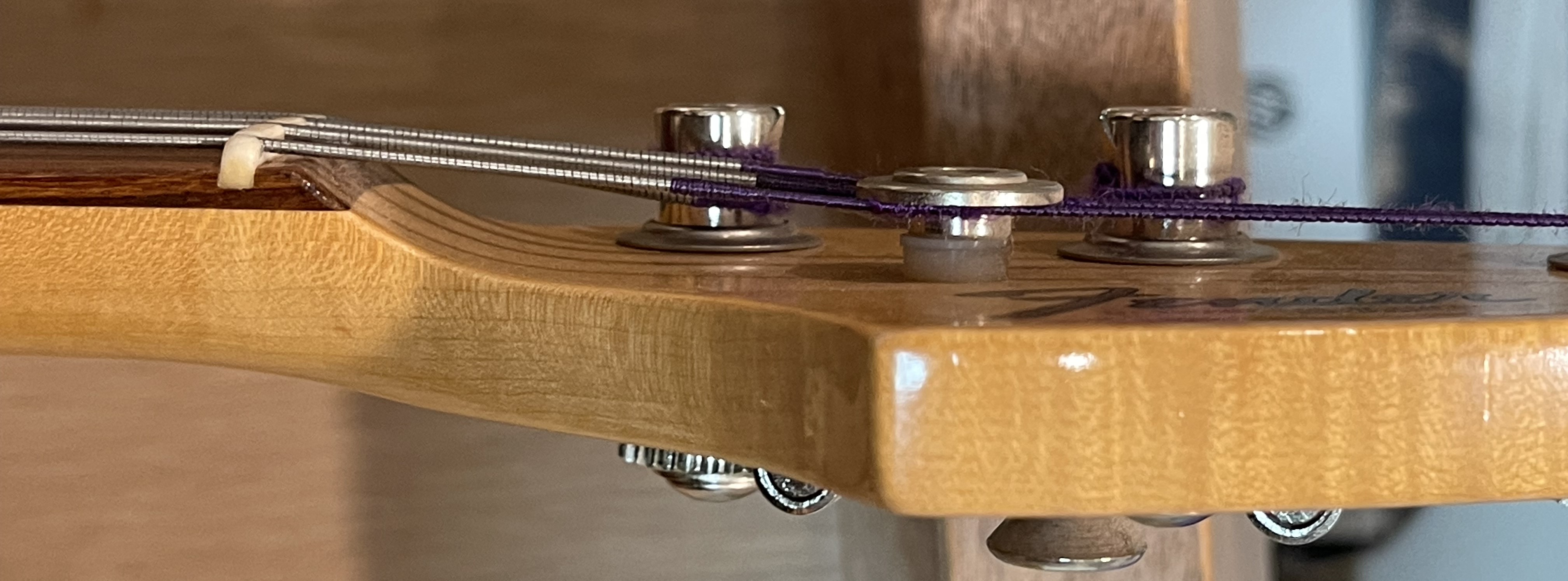
jazz1.jpg

jazz2.jpg
 
Cool spacer idea. Hope that solution works for you.

No problem using these on J basses the past 5 years or so.

I’ve had all kinds of strings & silks catch on different types of string retainers, from Squire to Sadowsky. Not enough to snap, but to cause frustration tuning.

I’ve developed a habit of tuning near pitch then pushing the string down, between nut & retainer, while tightening to pitch so it doesn’t catch under the retainer.

Before getting to pitch, I push down on the string at the tuning post to make sure it’s wrapped tight at the bottom of the post and I barely trim string ends, if at all, when starting so there’s a lot of wraps in the post to keep the string tightened down as near the headstock as possible. This results in more downforce on the nut for strings that don’t have a retainer, and less upforce to snag under a retainer where there is one.

Again, for all strings on all basses. And for for all strings I’ve adopted the method of wrapping strings at the post suggested in the Cobalt Flats packaging.

So far, so good. So what? Might also work for someone reading.

If not, at least EB has quick, responsive service.
 
Last edited:
installed lots and lots and lots of cobalt flats on fenders (they're some of my favorite flats, they're so bright and flexible they almost sound like old rounds) and have never once encountered this

maybe the string tree in question needs to be taken off and have its bottom edge rounded over a little so as not to catch on the string
 
installed lots and lots and lots of cobalt flats on fenders (they're some of my favorite flats, they're so bright and flexible they almost sound like old rounds) and have never once encountered this

maybe the string tree in question needs to be taken off and have its bottom edge rounded over a little so as not to catch on the string

I agree, that string retainer looks like it has sharp edges. For esthetic reasons apply thin CA to the full length of the silks if they contact anything, it helps prevent fuzz.
 
Hi Folks,

I've been meaning to send this out for a while now, and today is the day.

A few years back I switched from D'Addario Chrome flatwound (50-105) to Ernie Ball cobalt flatwound (50-105) strings.

When I put them on my fender Jazz and Precision basses, things went well until I tried to bring the G string up to pitch. I would get it to ~ an F note and the string would snap. I went through this multiple times. Ernie Ball was nice enough and sent me additional string sets. Same thing happened. I purchased multiple 50 gauge single strings....just for security.

While the problem is simple and obvious to me now, it took a while to dawn on me. The core on the Cobalts is very very thin. The windings on the strings were snagging on the string retainer, and at some pitch the string would no longer slide past the retainer. The last crank on the tuner would snap the string right at the tuner....

To solve the problem, I added spacers under the string retainer, along with a longer screw to compensate for the spacers. The string still has a good break angle over the nut but is now able to slide past the retainer under full tension.

I wish I could find a string retainer with a taller bass. In the mean time, the spacers do the trick.

Hopefully this solution to my G-String pain (ha ha) will help someone else out there.

Cheers...

Michael
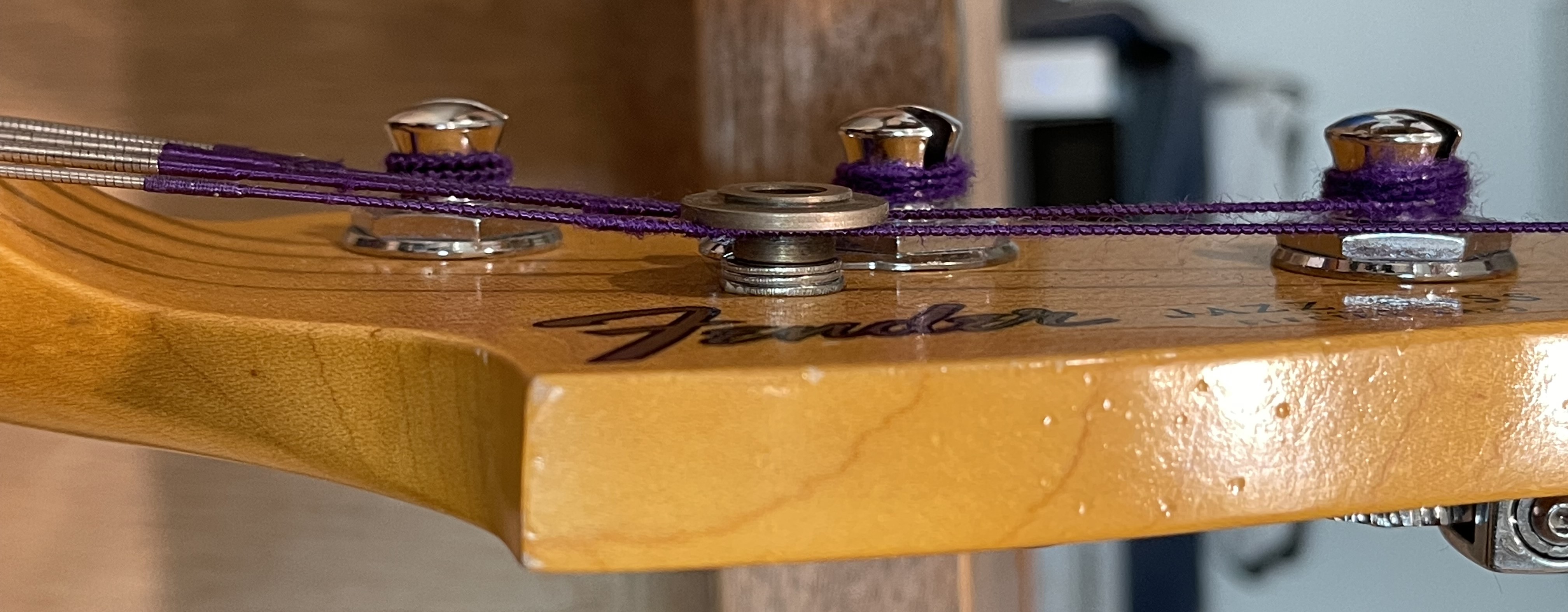
jazz1.jpg

jazz2.jpg

Plenty of tall retainers on Ebay. I just searched for tall string retainers & a variety of options came up.

Or as @walterw mentioned above "wind your D and G strings up somewhere close to tension and then put them under the string tree, so they're not getting dragged along under the tree in the first place". AND, it keeps the silks in good shape. That's what I've always done with no problems.
 
That's what I do. Never had a problem doing it that way.
Yeah, me too. After all, the wraps on the post should be correctly descending from how one initially winds the string. The tree is really there to keep the string angle behind the nut sharp enough to not buzz. I like either a Fender stealth A tree or a 3-string tree if possible.
 
  • Like
Reactions: HowieD72
Yeah, me too. After all, the wraps on the post should be correctly descending from how one initially winds the string. The tree is really there to keep the string angle behind the nut sharp enough to not buzz. I like either a Fender stealth A tree or a 3-string tree if possible.
Agree 100%. I always try to fit a 3-string aluminum tree on my basses.

20250327_220011.jpg
20250213_193745.jpg
20241102_161129.jpg
 
…i tend to wind my D and G strings up somewhere close to tension and then put them under the string tree, so they're not getting dragged along under the tree in the first place…
I kinda thought I was probably alone here
just being overly cautious. I broke a string decades ago on a sharp retainer and have done it ever since, if a retainer has grooves I hit it with a file on the first string change. :thumbsup:
 
  • Like
Reactions: /\/\3phist0
I had that happen when installing DR strings on my G&L M-2500 Tribute. I resolved the issue by using a Dremel tool with a grinder tip to widen the slot of the string retainer. That was several years ago and I haven’t experienced any more issues with the string hanging up in the retainer slot.
 
Over the past almost fifty years of playing bass I have used just about all of these solutions. I have burnished the underside of the string tree, used a Fender A-string adaptor to make sure the A string has enough break over the nut, burnished the back side of the nut, keeping a sharp front edge to assure good intonation, the 3-fer multiple string tree, and the washers under the string tree to lessen the angle for the G & D strings.

I agree: cobalts are strange critters. Cobalt is inherently brittle. The windings can snap with no warning. They grind and clank with the desired edgy tone as they are supposed to until one day they just go dead, thump, thump, thump, seemingly overnight. They also rust. Cobalt is also harder, so you get the dreaded fret wear issues faster, as used to be discussed about stainless steel rounds. If a player wants to continue using Cobalts, whether rounds or flats, here is what I advise:

1) Make sure the installation instructions on the package are followed exactly.
2) Burnish the string tree and bridge saddles to make sure that there are no burrs or sharp edges that could cause the string to snag.
3) Adjust the string tree to make sure, as suggested above, to assure that there is that happy medium between enough downforce angle to secure the string in the nut slots, but not so much the strings are overstressed.
4) Have your frets checked periodically for wear.