• TalkBass has been independent since 1998. Add your voice.
    Create a free account to reply to discussions, view embedded media, and browse with fewer display ads.
    Join freeLog in
    Want zero display ads or expanded classifieds tools? Compare plans.

'Pure Sound'

It's amazing how much gear is marketed to bassists promising better tone, and yet how few bass players manage to achieve a truly distinctive and effective sound.

Bass may be one of the easiest instruments on which to get an adequate tone, but developing really outstanding bass tone is deceptively difficult I've found. I've always believed that we each have an "ideal bass sound" in our head, which varies from person to person, and probably has a lot to do with early influences we were exposed to. Some of my early influences were actually analog keyboard bass and bass pedal sounds in bands like Genesis and Stevie Wonder, and lately I'm finding myself a bit frustrated with the inability to reproduce that kind of sound on bass guitar! Does anyone else get frustrated by the general lack of articulation of bass guitars? Modern basses are much better in this regard, but still never have the same kind of attack as a good key bass sound, in my opinion.
 
I too am one of those players that believe tone is something more between the player and the instrument than anything else downstream.

I began to improve as a player in my own eyes when I realized how many sounds were available to me from my largely unmodified P-bass. So many subtle ways to set a string into motion.

JKT
 
Good points and thanks. I have, like many of us, several basses here. My jazz bass is a 1985 model produced when the Japanese were reproducing early 60s models better than the US factory could (or so the legend has it). It's great and it was a song. What you say JKT regarding technique is bang on - the equaliser of the gods (right hand) does allow some lovely tones to be produced from the instrument. I think the thing with a good Fender is that they sound they produce are the sounds you have grown up hearing - they have to sound right.

However, the sound I want is a fretless tone that I can hear (in my head) but can not produce. Saying that, my fretless is a Westone Thunder (remember them?) and acoustically the timbre is wonderful. Plug her in and she just can't cut it, the sound just isn't right.
 
What you say JKT regarding technique is bang on - the equaliser of the gods (right hand) does allow some lovely tones to be produced from the instrument. I think the thing with a good Fender is that they sound they produce are the sounds you have grown up hearing - they have to sound right.

However, the sound I want is a fretless tone that I can hear (in my head) but can not produce. Saying that, my fretless is a Westone Thunder (remember them?) and acoustically the timbre is wonderful. Plug her in and she just can't cut it, the sound just isn't right.

Makes you wonder what is standing in the way of that sound getting to the speaker? What have you tried?

JKT
 
Strangely enough - one of my favourite-sounding basses ever - was a fretless Westone Thunder 3 I had in the 1980s - I used to get comments on how wonderful it sounded from studio engineers etc. etc.

But it was damaged in a transit van - some knobs got broken - and it never sounded as good again - despite taking it back to the shop and having it worked on by a guitar tech who I trusted!!

That was always a mystery to me...:confused:
 
Hey steve

Interesting discussion about tone - I've always believed that within reason the tone comes from the player - I suspect you and I would always sound like ourselves whatever instrument we played. When talking of double bass players we tend to talk about 'their sound' and that's got nothing to do with the instrument or amplification, it's to do with attack, articulation, muting, the type of skin on your fingers, left hand pressure, note choice and all that. For beginners, it's question of practice and experience, to develop an effective technique I've seen so many young players trying bass after bass, amp after amp and never getting a sound they like.

The sound you'll get is only as good as the sound you hear in your head.

On the subject of attack, in relation to synth basses etc, these days I find myself playing with a pick quite often, just for that really clean attack and sometimes with a really thin pick for the 'click' - remember the great tic-tac bass sound on 50's and 60's C&W and American pop records. There's a tendency among bass guitar players to suggest that if you're not playing fingerstyle, you're not playing properly - the proper sound is the right sound for the music, and if that's with a pick or one of your ebows so be it.

Keep the faith Steve
 
Bruce - the Westone Thunder Fretless I have has had a modification. A very early senior moment took the brigde pick-up out and replaced with a Rick' pick-up. I took it to Joe the tech in Birmingham a few years back and he reckoned that due to the value it wasn't worth spending the money on. I really need to get the flat wounds off and put something else on again. As I've mentioned, acoustically it sounds great, especially with those stethoscope headphones from the US. Through an amp it just can't get it out. If however I ever eBay it and someone runs a search on here and finds this thread - it stillis the greatest fretless bass in value for money and quality terms ever :)
 
Yes - same experience - it's strange that an instrument that sounds great unplugged can't be made to sound good amplified - despite the best efforts of experts in the field!!??

I think it may be to do with the fact that bass guitar is really a "happy accident" and shouldn't sound as good as it does for its size.....?

After it was damaged - mine just sounded hollow and nasal - whereas before it was rich and full!
 
I think it goes without saying that perception of a "pure" or even simply "good" tone is subjective- what intrests me greatly is how that tone is perceived by the human ear.

every ear is unique or in other words, the way in which we as individuals process frequencies is unique. take for example, Les Claypool who is partially deaf in one ear - I forget which one, but I would suspect that his reliance on one ear over the other has altered the way his brain processes audio signals (i.e. left brain/right brain differences) and thusly affected the sound he strives for.

Im playing with a singer/songwriter right now with a similar situation where her ear favors certain frequencies over others. the result being totally wacked out compositions that are incredibly enjoyable to listen to. she plays all by ear and has no training in theory but the chords and changes she comes up with are very cool.

I was born with auditory processing disorder, which to avoid a lengthy explanation meant that I was kind of a space case all through my childhood- primarily because my brain wasn't processing higher frequencies (apd is much more complex than I give it credit for- my parents thought I might have been autistic before taking me in for tests). most of my childhood teachers were female and as a result I got in trouble for always day dreaming in class- not because I was lazy but because it was exhausting trying to understand what they were lecturing on (btw, I became an awesome student when I started having male teachers). It makes sense then why I would gravitate toward a lower frequency instrument as opposed to something like a guitar or violin.

however, (and i'm still unsure as to why) since having played bass for almost 10 years my ear has grown fond of those higher frequencies I used to be deaf to.

So I guess what I'm trying to posit here is that our "ideal tone" is not only unique but also something that grows and changes with us.
 
Hey steve

Interesting discussion about tone - I've always believed that within reason the tone comes from the player..

Indeed - though it seems that the key to good gear is that it stays out of the way of the tone that the player has in mind and fingers getting out to the audience... if a bass is incapable of reproducing certain frequencies, the player's 'vibe' will still be there, just muffled... like listening to a great album on laptop speakers. It's still a great album, you just can't always tell why ;)

There's a tendency among bass guitar players to suggest that if you're not playing fingerstyle, you're not playing properly - the proper sound is the right sound for the music, and if that's with a pick or one of your ebows so be it.

Those kind of discussions used to get my riled and I'd answer them, and now there aren't enough hours in the day to bother with people who put those kind of limits on creativity. :)

I guess the key to this is that your 'sound' is not what you play music with, it IS the music. The music is a complete synthesis of the notes, the sounds, the feel, the intention and the environment in which its listened to... Ignore any one of those, and you'll struggle to connect...

(I guess it's worth noting here that Pete was my bass teacher at college many moons ago, and probably did more than just about anyone to encourage me to think outside the box, and also to teach, and HOW to teach... definitely up there alongside Michael Manring, Todd Johnson, Doug Wimbish and Jonas Hellborg in the list of people who have influenced the bassness of my musical world the most!)

Steve
 
Back to the "nuts and bolts" of the tone discussion, I know Mr Manring uses some piezo mixed in with the regular magnetic pickup ( that AMAZING tone makes me absolutely cry :crying: BTW), What techniques do you guys use to minimize "artifact" or stray noise when you use a lot of piezos in your sound? For example, I can hear some of the de-tuners "clicking" or fingers sliding down the string.
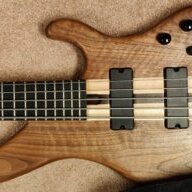
 
Purity of sound is all in the eyes(well, ears) of the beholder. A players sound and his instruments tone have involve so many variables in them, one could spend their entire life trying to get the "pure bass sound" they once heard, and never even get close.

It has to do with what the bass was made out of, how it was made, where it was made, where you are now, what is doing the vibrating, what is reading those vibrations, the tension on the strings, the tone shaping, how the strings are being struck, what is striking them, what the signal is passing through, what is reproducing the sounds, where the sounds are being reproduced, and on and on into infinty.

Pure sound would be a beautiful thing to have, but when players spend to much time thinking about things as minute as these, they tend to forget about what its all really about; The music. Personally, i'd rather just have a good sound and spend my time enjoying what i'm doing, rather than worry about "purity".
 
Hi, Steve,

Amongst "pure sounds" I've been enjoying this week Ron Carter stands out for his sound behind Tommy Flanagan on the Duke's "It Don't Mean a Thing". It's #1 on the Master Trio album. See http://tinyurl.com/6564bx There's a wonderful thick buzz to Carter's sound, combined with luscious glissandos. It does no harm that he swings like a jackhammer. Lovely, lovely sound.

Some years back I discovered David Barard, the New Orleans bassist, through his work on Dr John's "Duke Elegant" album. Again, the sound is simply gorgeous. I'm still wondering how he achieved it. I think there must be some multi-layer recording there, so there's a really smooth bottom pulse, with more piano twang layered on top. I'd be interested to know your thoughts, if you have the album.

I got to see Barard play in London a couple of years back, and he swung and slapped so hard live too. It was thrilling.

All the best from Austin!
Dominik
 
That's kind of ironically funny - as if you do search of these forums and particularly the Double Bass side - Ron Carter is the one Jazz "great", who (while nobody can deny his musicianship) comes in for most criticism in terms of his sound, which often lets him down as poorly amplified and "electric". :eyebrow: