• TalkBass has been independent since 1998. Add your voice.
    Create a free account to reply to discussions, view embedded media, and browse with fewer display ads.
    Join freeLog in
    Want zero display ads or expanded classifieds tools? Compare plans.

Put My First Set Of Straplocks On Last Night.....

Am I missing something here?
Reading these posts, it sounds as if fitting a certain type of strap lock involves major surgery to one's bass.

What's wrong with the little plastic strap locks that I use, which are cheap, simple to use and most importantly, do the job perfectly?

I think I paid 50 cents each for mine about 10 years ago & have been all over the world with them. I throw my bass around and I am all over the stage playing live. I used to have Dunlop straplocks, but I didnt like the way they stuck out from the pegs & I didnt want to use the flushmounts & drill into my bass. The Dunlop Lok-straps are my choice for sure

http://www.jimdunlop.com/index.php?page=products/pip&id=142&pmh=products/accessories

As far as working on my bass- I have routed under pickguards to install EMGs, filed frets, built up worn down nuts, done basic setups & hated every second of it! I dont even like changing my strings :D
 
Whatever happened to good old ducttape?
anthony_tremors_2.jpg
 
I found that my straplock pins were often coming loose on certain basses. The threads on the provided straplock screws are just not aggressive enough for wood. The toothpick trick works temporarily, but what I ended to doing is getting drywall screws (very aggressive screw thread pitch), grinding the head so it will fit through the pins, adding a little bit of wood glue on the threads and added rubber washers. These pins are like a rock now and won't move. So far, no problems.

By the way, my straplocks are Schallers.

The problem with drywall screws, is that they are rather brittle. They do not tolerate deflection and side-loads well AT ALL, and will snap easily. The "normal" screws or not so hardened, and will bend before they snap.
 
I think I paid 50 cents each for mine about 10 years ago & have been all over the world with them. I throw my bass around and I am all over the stage playing live. I used to have Dunlop straplocks, but I didnt like the way they stuck out from the pegs & I didnt want to use the flushmounts & drill into my bass. The Dunlop Lok-straps are my choice for sure

http://www.jimdunlop.com/index.php?page=products/pip&id=142&pmh=products/accessories

Thanks for the link. I had a couple sets of those....great for the basses I have that don't have regular locks installed.

Lost the ones I had...didn't know if they still made them. Need to keep a few sets around...those thing are great.
 
Am I the only one that seriously had nó problems with putting the straplocks on or off? :hmm:
I agree with you, this thread is surprising. In ten years I've never had any trouble installing or removing strap locks, and I've put them on at least a half-dozen different instruments.

I've always used the Schaller brand, and they've never required me to do any drilling or use wood putty, glue, etc. I just screw them into the original holes, and they work.
Invalid Link Removed
 
I got Dunlop straploks with one of my basses, they're pretty old but still do the job. I'm putting them on all my basses so that if I ever need to switch straps for any reason I can in abut 5 seconds. Just press the buttons and change round. Safer too, I had a scare with one of my basses the other night. Nearly fell on the floor only I caught it.
 
For installing straplocks onto a thick leather strap, with either Schaller or Dunlop straplocks, it's handy to have two sets of needle nose pliers. For Dunlop, one set of pliers to push down the washer, the other to force the C-clip onto the post. For Schaller, one to hold the cup, the other to tighten the nut.

Also, for Schaller, a dab of loc-tite or clear nail polish will keep the nut from coming undone. Clear nail polish is great because: a) it's clear. b) it's strong enough to hold the nut on, but brittle enough to break and clean up when you want it to.

As far as the screw is concerned- the toothpick and wood glue is the best method. The reason for the glue is so that the screw is biting into material that's bound to the body, not just relying on the pressure of the screw against the wood. The "best" method is to fill the hole with glue, insert the toothpick(s), break them off to length, wipe up excess glue and screw the screw in. What you're doing is binding the toothpick to the sides of the hole. The glue will not bind to the metal screw- only the wood. The screw is biting into the wood that is bound to the sides of the hole.

Although they're both "good" units, I feel the Schaller is "better."

I used Dunlops for over 10 years. I'd had a few failures of the Dunlops, but I always attributed it to "user error," that I hadn't seated the unit properly. However, after I had nearly dropped a 45 year old Les Paul when I KNEW the locks were seated well and proper- I looked back into it. The Dunlops are held on with either 2 or 4 ball bearings held in with spring tension. The bearings fit into a trough on the female end. If a bearing fails, the spring fails or there's junk in the trough, or if the shaft wears, the unit can fall out.
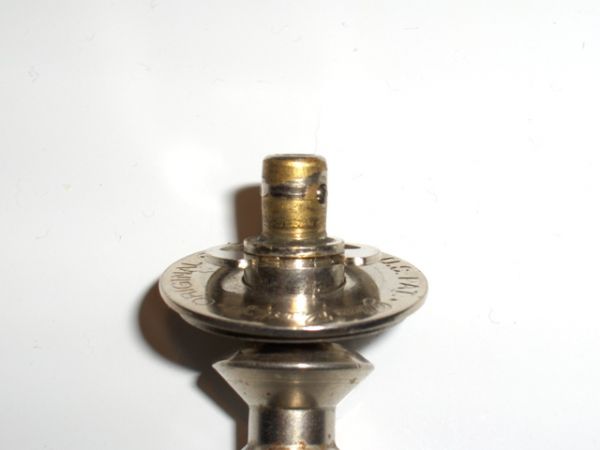
normal_lock2.jpg


The Schaller is a cup bearing the weight of the guitar. It is also redundantly held into the cup by the spring loaded plunger. If the spring loaded plunger fails, the cup is still supporting the instrument. The cup is not going to fail. I've actually smacked a Schaller with a hammer to see what it takes to break the cup. The only ways for the Schaller to fail is if the nut comes undone- if you check the nut and/or secure the nut to the unit with loc-tite or nail polish, it's not coming off, and if the button itself wears down too far. That's when the guitar end starts looking like a rounded off nub instead of the way it looks.


normal_Schaller2.jpg


I've been using Schaller straplocks since 2002 and have not had one single "failure" yet. When I was using Dunlops I had at least 3 failures in the first 5 years of using them.