• TalkBass has been independent since 1998. Add your voice.
    Create a free account to reply to discussions, view embedded media, and browse with fewer display ads.
    Join freeLog in
    Want zero display ads or expanded classifieds tools? Compare plans.

Qs: 6 strings, B strings (DR 130 vs. 125) and recommendations?

Mar 30, 2023
1,449
2,317
Hello all,

I've recently purchased a six-string bass after playing four-string basses exclusively and was hoping to get recommendations.

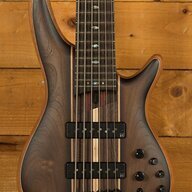
The bass in question is active and has a mahogany body, an anchico burl top and a flamed maple fretboard. I would like to use nickel round wounds.

-

My favourite nickels for my '60s Jazz (alder body/rosewood fingerboard) were the DR Sunbeams.

Q1: Is this a good place to start or are the basses too dissimilar?

-

While my favourite Sunbeams were light, DR only offers their medium gauges in its six-string sets. There are two, the only difference being the B string: 125 vs. 130.

Q2: What's the difference between the two? How does it affect balance in terms of sound and tension?

-

Q3: Any over all recommendations, nickel or otherwise?


Thanks!
 
B strings can be touchy, depending on the bass and the player’s touch. I used to prefer the feel and solidness of a 130. But I’ve learned that a 125 matches the sound of the other strings better, and is a bit more articulate. I’ve lightened my touch so it doesn’t flop or bottom out, and I’m very happy with the results.

And personally I hate tapered strings. The harmonics are a bit sour.
 
When I got my first sixer, DR Pure Blues string sets were all packaged like the below.

30, 45, 65, 85, 105, 125.

At the time, I was surprised that DR offered no 130 option like their fiver sets had.

However, after putting them on, the feel and tone seemed so perfectly balanced that I never looked back.
 
I agree wiith the B 130.
If it's a tapered ball end, put a measured spacer between the ball and the bridge when stringing. This brings the full winding close to the saddle and makes the string more stable to play and produces the fundamental faster. Better to thumb too.
I use a small brass tube.

I wondered what size strings would produce the most even change from string to string, It was down to the amount of metal vibrating over the PU., so I looked for a progression.
I now use 130-100-75-55-40-30

The differences between strings, C to B, all increase by 5.
Graphed, it's an exponenriol curve, but it's more unform to the pickup, and so is my sound across the fingerboard.

The same relationship works for my 4 string
105-80-60-45

This is a slightly heavier set and may explain why many claim 4 string basses sound heavier. There is a compromise made to fit the range of a 6 string over an already difficult scale.

Different scale basses, fat/ground/tape wounds may change the sizes but I feel the same progression will give more evenness over the bass.
 
What's the difference between the [.125 and .130]? How does it affect balance in terms of sound and tension?

fwiw when I first started playing 6-string bass ~35 years ago I used .125 low B strings. I did not have any specific complaints...but after a couple years I changed my low B to a .130 and I was pleasantly surprised at how much more uniform they sounded when playing passages that crossed strings; the .130 low B sounded more consistent timbrally with the E and A strings than the .125 did. Haven't looked back since, I'm using .130 all the time now on all my basses with a low B.
 
I use a 125 DR strings on my Wal 5 strings. It sounds like a piano, very rich.

I dont care for taper strings.... Back in the 90's B's weren't fantastic, but string construction has tightened up greatly. I remember hating Ernie Ball Slinky B's, and I like those now because they're really tight. So, I no longer see any need for taper strings in todays world.
 
  • Like
Reactions: BWorm