The shuttle 3 and 6 heads have attenuated (reduced) low end because the shuttle cabs that they are designed to go with don't handle low end very well. The shuttle 9 and the new streamliner amps do not have that attenuation.
I would like to correct some mis-information that seems to rear it's head from time to time here.
First of all, over the last 10 years or so as the power levels of amps have increased (a lot), most of the higher quality amps have incorporated high pass filtering to reduce the potential for damage to all cabinets as well ast to improve the clarity of the midrange by eliminating the sub-sonic modulation of the mid frequencies (the reproduction of mid frequencies by a cone moving large amounts at very low frequencies) which results in NON-MUSICAL sum and difference frequencies being added to the acoustic signal. This wasn't much of a problem with smaller amps but it certainly is with bigger ones.
Secondly, with the entire industry shifting to supporting a class of cabinet called compact and sub-compact cabinets, an additional issue comes into play, that of driver unloading where the box, air mass and driver no longer operate as a "linear spring" at very low frequencies. This increases the potential for damage to the drivers as well as wasting valuable power that could be better used reproducing frequencies that the smaller cabinets can handle.
The HPF's are in the 28-35Hz range depending on the models and are low enough that when played on larger cabinets will not be an issue. When played on smaller cabinets (by any manufacturer) the cabinet will be the limiting factor in low end reproduction, not the amp.
There are also differences in perceived low end due to the available power (higher powered amps when driven hard will feel more solid on the low end in general) and comparing a 900 watt amp to a 300 watt amp will, of course, certainly feel different.
We were one of the first companies to understand (and incorporate) the need for proper high pass filtering and we developed some unique filter applications (4th order asymmetrical types) that are particularly suited to bass amp applications. Now, almost all quality manufacturers use some form of high pass filtering though I do not know of anybody using the particular types of filters we designed.
Another note, to clarify another misperception, the low frequency "boost" function of the Shuttles is actually a low frequency extend, meaning that when the switch is pressed in, the HPF's corner frequency shifts down increasing the low frequency bandwidth. It is not a "boost" per se, and it's the same basic circuit that's in the GBE's that's marked LF Extend just that we got a lot of question as to what extend ment and players suggested that we just call it a "boost". Can't win on this one

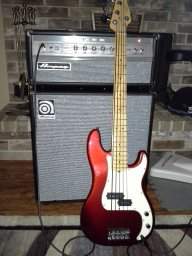
If you are playing the Shuttles on a larger cabinet and want the full extension of the low end, push the LF "boost" (EXTEND) switch in. If you are playing with any manufacturer's compact or sub-compact cabinet at lower volumes the LF Extend can be in but if playing the small cabinets really hard, it's advisable to keep it out to help prevent possible damage to the cabinet. Compact cabinets (all cabinets actually) power handling capabilities decrease as frequency goes down, usually quite significantly.
Hope this helps.




 Peace, ernie.


