• TalkBass has been independent since 1998. Add your voice.
    Create a free account to reply to discussions, view embedded media, and browse with fewer display ads.
    Join freeLog in
    Want zero display ads or expanded classifieds tools? Compare plans.

Double Bass Quality Chinese Basses

Is there really that much demand for UBs that the concept of "volume" comes into play? I just can't imagine a giant warehouse pumping them out like they were cell-phones. It would be interesting to know just how many double basses are sold world-wide each day or week. - j

That would be interesting to know. I'd think a "sweat shop" situation would involve a wide variety of instruments being built though.
 
jayscheuerle said:
Is there really that much demand for UBs that the concept of "volume" comes into play? I just can't imagine a giant warehouse pumping them out like they were cell-phones. It would be interesting to know just how many double basses are sold world-wide each day or week. - j

Good point. I only assume. All I know is that my bass was not acquired through a wholesaler, and that the string shop has a relationship with the builder.
 
Steve Swan said:
I used to see a lot of top cracks and even some back cracks on the Romanian basses with many brand names that came out of the Reghin factory. Sometimes I've even seen those cracks develope during the course of the four day NAMM show. I'm not seeing those "green wood" cracks coming from the very best chinese makers. Any new bass can develope cracks if you torture it enough with dry heat and neglect.

I think not just the wood and it's age, but how it it is cut makes a big difference. A quarter-sawn piece of wood having more integrity than other cuts. I wonder if some of these cracks developed because of age, sudden change in humidity along with just the wrong cut. The few guitars I built, the cut of wood made a huge difference, wondering (with my limited knowledge) if the same could be for the db?
 
That was and still is the goal. The shops and companies on the first post still meet the criteria. What I think others our trying to point out is that the wood could be an issue and I think that does have to be taken into consideration, especially if buying new vs. used.

If you are buying a bass from a reputable shop or luthier you should be just fine.
 
I bought an Eastman VB-95. I'm a beginner so I got something in between amateur and pro (I hope). Not a bad bass for an entry level. I've played some fully pro basses and there's no comparison as far as that goes but for a beginner, it's a pretty good bass. I've seen basses online for like $600 but that makes me balk. How good could a $600 bass be when pro models are up in the $4000 range and higher? As it was, the VB-95 was $2100. If you're serious about learning, you have to shell out even for an entry-level bass. You can't learn with a cheap piece of crap. Now maybe this $600 job was a good bass--I don't know--but I'm not buying online only to find out otherwise. I'd have to be able to play it first.

The biggest problem I have with the Eastmans is that the adjuster wheels on the bridge are stiff as crap. I had to use pliers to make them turn and it was still a struggle. Eastman really needs to improve on that. Someday, I'll take that bridge apart and work some graphite into those adjuster threads so the wheels will turn smoothly. Definitely improved the sound and handling to raise that string action.
 
If you're serious about learning, you have to shell out even for an entry-level bass. You can't learn with a cheap piece of crap.

I'm sure plenty of people have not only learned, but rock the house on sub-grand pieces of crap. Props to them!

What spending more than the minimal amount of cash can afford you is piece of mind. You KNOW your bass is built well. You KNOW it's not going to fall apart. And if in the offhand chance it does, you KNOW you have someone to turn to. It's relaxing to know you don't have to worry about being saddled with a lemon.

And if you stick with it, you'll also find out that it has resale value if you want to trade up to the next level. With a POC, the best you can hope for is to shuffle it off to some unsuspecting mark via Craigslist... - j
 
I might be persuaded to buy a $600 bass but ONLY if I get to play it first. But to buy it online? Absolutely not. But even if it plays well there's other issues: how well does it handle humidity and temperature changes, was the wood adequate (and for $600--probably not) and not crack like Bonomo Turkish taffee (boy, I think I'm showing my age here), will it stay in tune, is it put together right--and so on. It could look and play ok when you decide to buy and still end up a big piece of junk in 6 months.
 
The Archer bass looks very interesting, just from what I've read online. I agree that playing a bass before you buy it would be best but there are also alot of posts in this site about people with CCBs that are/were quite happy with them. Me included. It seems that there is more variety of quality from Chinese basses than anywhere else?
 
The Archer bass looks very interesting, just from what I've read online. I agree that playing a bass before you buy it would be best but there are also alot of posts in this site about people with CCBs that are/were quite happy with them. Me included. It seems that there is more variety of quality from Chinese basses than anywhere else?

Everything I've managed to find online about the Archer screams to me, "Stay away!" A "fully-carved" DB for about $1000.
 
Good point Drub

I'll elaborate a bit. I looked at the reviews of the Archer online. There was no way to really tell what experience and knowledge the reviewers had. I took a look at whatever pics I could find of the Archer. Pretty wood to be sure but, based on what I could see, the build seemed similar to the Carlo Robelli basses. For those, what they call a "fully-carved" top is actually a cardboard-thin piece of wood (albeit pretty) pressed into a shape. Carved? Well, uh... not really. If one had a budget of around $1000, I think it would be better to strectch it a bit further and get a solidly built and reliable ply such as the Shen.

Rebop has what I think is one of the most informed and realistic approaches to CCBs around here. They can be of service to some in certain circumstances and with the proper caveats. I think he'd agree that they're not for newbies who aren't willing to do the tweaks/modifications and who need to rely on them as their sole instrument for learning, practice, and performance.
 
Agree with that too, I lucked up, did the set up myself etc and have a quite playable upright that I love, and for those in my situation, the only choice, but for sure if you can play the bass you want before purchasing, that's the way to go as well as getting the best instrument you can and the one that feels sounds best to you. Didn't mean to mess up this thread, hope more people post about Shen etc. basses here. Very interesting reading.
 
The biggest problem I have with the Eastmans is that the adjuster wheels on the bridge are stiff as crap. I had to use pliers to make them turn and it was still a struggle. Eastman really needs to improve on that.

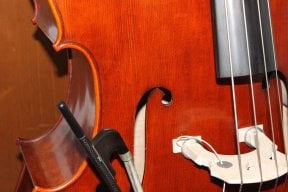
Did Eastman the manufacturer install these bridge adjusters or did the local bass shop install them? The adjusters usually are more of a local setup issue rather than a manufacturer build issue. Adjuster wheels should be easy to turn with your fingers to either lower or raise the bridge at proper tuning. A good bass luthier can fix this for you.
 
Hi¡ i need your help. do any body Knows anmorlly? im looking for a duble bass and i think they have good options, the one im interested is the Gaetano Rossi model. i just want to be sure, if somebody Knows something about it, i´ll apreciate your coments.
thank you.
this is the web site Invalid Link Removed
 
Did Eastman the manufacturer install these bridge adjusters or did the local bass shop install them? The adjusters usually are more of a local setup issue rather than a manufacturer build issue. Adjuster wheels should be easy to turn with your fingers to either lower or raise the bridge at proper tuning. A good bass luthier can fix this for you.

In some cases, adjusters are factory installed at higher-end laminated basses.
You can make them easier to turn with some soap.
 
Did Eastman the manufacturer install these bridge adjusters or did the local bass shop install them? The adjusters usually are more of a local setup issue rather than a manufacturer build issue. Adjuster wheels should be easy to turn with your fingers to either lower or raise the bridge at proper tuning. A good bass luthier can fix this for you.

It came this way. Definitely wasn't a local install. I have the height adjusted okay right now. Maybe a bit higher but I'm not in a big hurry about it. My instructor says he knows someone who can fix it and he'll be in town soon and I can bring my bass over and he'll fix it. Until then, the string height is tolerable now. Before it was like a strat. And that may be fine for a strat but it doesn't work for bass.
 
I would like to add West Coast Strings. I tried several models and found them to be of high quality and with a great sound and playability. I purchased a Paolo Lorenzo (I know, fake italian name). Even though the bass was smashed on the second day I had it (see previous post), I am very pleased with the purchase.

[Invalid or Expired Link Removed]
 

Latest posts