• TalkBass has been independent since 1998. Add your voice.
    Create a free account to reply to discussions, view embedded media, and browse with fewer display ads.
    Join freeLog in
    Want zero display ads or expanded classifieds tools? Compare plans.

Quartersawn maple

From what I understand, it's more of an aesthetic thing... with the quarter sawn having nicer and more extreme 'graining'.... I dont' think there are any tonal or 'stability' differences.

Since quarter sawing gets less wood out of a given tree, it tends to be more expensive. The Lakland USA's use quarter sawn one piece necks and the Sadowsky NYC and Metro's and the Lakland Skylines use flat sawn (with the NYC's have graphite reinforcement bars like the Lakland USA's). I haven't noticed any differences among the stiffness of stability of the necks on those four great lines of basses... so it seems a minor issue.

K
 
When you quartersaw, the growth rings are front to back of the neck, halfsawn means they are across the neck. The theory is that this is why a quartersawn neck has less flex in the direction of the sting tension.
 
When you quartersaw, the growth rings are front to back of the neck, halfsawn means they are across the neck. The theory is that this is why a quartersawn neck has less flex in the direction of the sting tension.



+1.. that's the theory.. just never noticed a systematic difference in the 'real world'. Those Sadowsky flat sawn maple necks are the stiffest I've ever experienced. I do like the look of the quarter sawn better though!

That being said, I do notice, in general, slightly less consistency in the Sadowsky necks regarding even string response (usually a few minor peaks and valleys in the tone and volume throughout the range of the neck, along with the classic, if minor, dead spot issue on the G string around that 5th to 7th fret region... again, nothing major, but it's sure there). Roger attributes this to the 34" scale vs. the Lakland 35" scale, versus flat versus quarter sawn, so I'm not sure.
 
I hear some people say that quarter sawn necks sound brighter and possibly more even, where as flat sawn necks are a little mellow , warmer sounding and more dynamic.
THIS IS NOT MY OPINION, JUST WHAT I READ SOMEWHERE
I'd be very interested to hear some luthiers opinions on this one.
I personaly don't care as to how a neck looks.
 
This is an interesting one, and a lot of builders debate on
this with great enthusiasm.

I have built basses both ways, and have not
determined one or the other to be consistently stiffer or more
stable.

I've also read at least 2 descriptions of 'partially-scientific'
testing on this.
Roger Siminoff, who is a *very* accomplished builder and
technician, describes in his "Luthier's Handbook" a test on a
single sample, of maple IIRC, indicating no difference in
deflection from a controlled load in flatsawn vs. quartersawn.

Furthermore, David Hurd's excellent "Left-Brain Lutherie"
actually suggests that flatsawn may be slightly stiffer.
His book, as I read it, suggests that the two are,
at best, equivalent.

SO: Why do it?

Well, the above cases all relate to hardwoods.
Softwoods, such as spruce and cedar, are a different beast,
and probably are stiffer in a quartersawn section.

These softwoods are also vastly more difficult to sand flat
and work consistently on a flatsawn face. Try to hand-sand
a piece of flatsawn pine, and you will very soon see this.
The rings are much denser, and don't sand as quickly.

I think much of the habit of using quartersawn wood
is inherited from the acoustic tradition, from the use
of softwood tops and bracing. It also looks really nice...
the ray figure in quartered maple, mahogany, etc.
can be incredibly attractive.

Mostly, I think it's important not to get too bogged down in
this stuff. Some of the most sought-after basses out there
(L-series 60's Jazz Basses, for example), have simple flatsawn
necks. So do many modern classics, like most MTDs.
Others have quartersawn necks, and they can be great too.

So, in a way, you can't lose.

Peace,
Martin Keith
 
:cool:
I have basses with both type necks.

It all comes down to how good the wood is, to begin with.
Some wood is just better for tone.

It does vary from piece to piece.
Not all wood is suitable for tone wood.
Hopefully, the builder, get good wood to begin with?
 
Curious. So is the maple neck on my MTD 635 flat sawn by this description then?
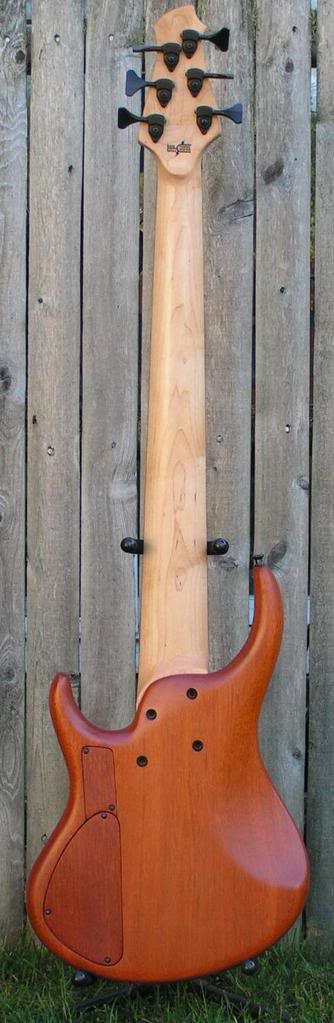
MTDback1a.jpg


If so, I've not noticed any stability problems at all. In fact, it needs little to no adjustment at all.
 
Since the luthier probably went back to work, Xgabriele, I will hazard a guess yours is not quartersawn. I just went out and looked at a wine barrel I cut in half. Looking down on the cut the oak grain is clearly going inside to outside, and you can see the lines going up and down the barrel on the outside surface. (quartersawn I believe). Look at the top of your headstock. This is the only similar view to the above unless you detach the neck, or it's neckthrough. If the lines.(grain) go front to back it would be 1/4. Your grain pattern suggests otherwise. Hey Cheese, my G&L JB-2 US doesn't look 1/4 either.
 
I am no scientist, I simply play what I think sounds and feels the best to me.

I am a huge fan of the USA Lakland JO, the biggest diffence in the feel of it vs. a Fender or Sadowsky is the neck IMO. Not only the quarter sawn but the finish as well. The skyline basses are flat sawn I always attributed that to why they feel and sound more like a new Fender.

All that being said given the choice I'd pay the extra money for quartersawn if given the option but it might just be in my head.

Pete
 
I am no scientist, I simply play what I think sounds and feels the best to me.

I am a huge fan of the USA Lakland JO, the biggest diffence in the feel of it vs. a Fender or Sadowsky is the neck IMO. Not only the quarter sawn but the finish as well. The skyline basses are flat sawn I always attributed that to why they feel and sound more like a new Fender.

All that being said given the choice I'd pay the extra money for quartersawn if given the option but it might just be in my head.

Pete


The neck on my L2000 is the smaller #8 (jazz sized) but it's quarter-sawn and feels like it's made of stone as far as flex goes. :D Stiffest neck I own.
 
Any more luthiers care to comment?


Also, how is it with Bodies?
Quarter or flat sawn, one piece, more than one, etc ?

A piece of quarter sawn lumber large enough to make a one-piece body would be VERY expensive and available in limited quantities. It would take a log nearly 3' in diameter to produce such a billet.

I can't imagine the tonal character of a solid body instrument to be impacted enough to justify the expense. Although, I suspect some builders select quarter sawn for natural finishes if for no other reason than aesthetics.

The ash body of my Skyline JO5 is slab cut. The alder body of my Q5 is the same.

I imagine the figured top of any bass is cut to best reveal the quilt or flame with less concern for tone.
 
Honestly, if I felt quartersawn was superior, I would use it. I recall Rick Turner citing a Dept. of Agriculture report from over 20 years ago that said that with maple, flat sawn was actually stiffer and more stable. But regardless, I think it is a non issue. I prefer the esthetics of a flat sawn neck and a quartersawn maple fingerboard.

Roger
 

Latest posts