

Enjoy the benefits of a premium membership!
Upgrade Account
-
TalkBass has been independent since 1998. Add your voice.
Create a free account to reply to discussions, view embedded media, and browse with fewer display ads.
Join free Log in
Want zero display ads or expanded classifieds tools? Compare plans.
You are using an out of date browser. It may not display this or other websites correctly.
You should upgrade or use an alternative browser.
You should upgrade or use an alternative browser.
Quartersawn Neck vs. Plain Cut Neck
- Thread starter ChadPaulJones
- Start date
More options
Who Replied?


I good neck is a good neck no matter the cut. In my experience the good quartersawn ones are in fact stiffer and never move; the good flatsawn ones allow perfect relief adjustment in tiny increments (and need it with weather changes). A bad neck is a bad neck, no matter the cut.
I agree a good neck is a good neck. My US Master's bass has a beautiful quarter sawn neck, but i think it is mostly for looks and very little room for adjustment as quarter sawn is very stiff ( not that it needed to be adjusted, just wanted to try it). I dont mind a little flexablity in my necks as i make sure they are good and straight before buying a bass. Only would need a slight adjustment if going to say realy heavy or light guage string....just.my opinion.
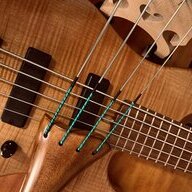
Wood changes dimensionally across the rings, not along them, which means a quarter sawn neck will become narrower, rather than thinner.
Unfortunately, this information is not correct. Wood does change dimension in three directions in relation to the growth rings. The greatest change is tangental, then radial (across), and a very small amount is longitudinal (length of board).
A few sources:
Forest Products Laboratory (1999) Wood Handbook
Understanding Wood- Bruce Hoadley
Left Brain Lutherie- David Hurd
The link below shows the average movement from green to kiln dry for many species. This source indicates 4.8% radial to 9.9% tangental for hard maple.
Invalid Link Removed

is it bad that I don't know, or really care about this issue? Not meaning to sound like a jerk, but until joining TB, I would not have ever known there was a difference, or that it mattered...it is cool to find out about this stuff, but it doesn't seem that important to me
is it bad that I don't know, or really care about this issue? Not meaning to sound like a jerk, but until joining TB, I would not have ever known there was a difference, or that it mattered...it is cool to find out about this stuff, but it doesn't seem that important to me
As a player, I think it is probably better not to over-think this. The luthier simply needs to understand what is going to happen with the blank as the environment changes and to evaluate the properties of the individual piece, rather than making broad assumptions. Unfortunately, this topic regularly rears its ugly head on every guitar/bass/luthier forum and it generally takes a few weeks to die down.

svtb15
Inactive
- Mar 22, 2004
- 13,004
- 4,741
- Disclosures
- I play it all. Whatever works for the gig. Q+
I like the look of Flatsawn.. And i i like the feel..
I think they are both fine..
But what you need to look out for is RUN-OUT in the grain.. I think that would cause more issues some time down the road than anything
I think they are both fine..
But what you need to look out for is RUN-OUT in the grain.. I think that would cause more issues some time down the road than anything

This is the most sane discussion about this subject that I have seen.
Yeah - a good neck is a good neck.
I find myself in love with two (almost perfectly) flatsawns:


Nice lumber SolarMan.
Mike Lull does not use quarter sawn maple in his well- built, high-end instruments, so IMO quarter sawn is not worth the added expense unless you like the appearance of the wood grain. Have any Lull owners out there had any issues with Mike's necks?
IME flat sawn necks are extremely touchy and tent to bow forward more and more over time until the truss rod maxes out
Quarter sawn is very stable. I have an ibanez sr506 with quarter sawn wenge and i can set it and leave it for months without worrying about movement. My first build has a 5 piece quarter sawn maple and purple heart neck and it hasnt moved a bit since i built the neck a year or two ago
Quarter sawn is very stable. I have an ibanez sr506 with quarter sawn wenge and i can set it and leave it for months without worrying about movement. My first build has a 5 piece quarter sawn maple and purple heart neck and it hasnt moved a bit since i built the neck a year or two ago
svtb15
Inactive
- Mar 22, 2004
- 13,004
- 4,741
- Disclosures
- I play it all. Whatever works for the gig. Q+
My Alleva Coppolo kbp4 and 5 only need a Truss adjustment maybe once or twice a year.. I like my action fairly low too.. They are flat sawn.. My sadowsky too.. Flat sawn. only needs a tweak a couple times a year ...
I had two identical pedullas. Each with Quarter sawn neck i believe.. One needed weekly adjustment while the other never moved.. It seems to be the wood and not the cut in my opinion..
I believe i read roger sadowsky once said that he believed that flat sawn in maple was more stable... IIRC.. Somewhere on his old site.
My 1980s Yamaha bb3000s its 5 piece quatersawn maple and mahogany and it needs tweaks much more than any of my flat sawn 50 and 40 year old fender basses// Go figure
I had two identical pedullas. Each with Quarter sawn neck i believe.. One needed weekly adjustment while the other never moved.. It seems to be the wood and not the cut in my opinion..
I believe i read roger sadowsky once said that he believed that flat sawn in maple was more stable... IIRC.. Somewhere on his old site.
My 1980s Yamaha bb3000s its 5 piece quatersawn maple and mahogany and it needs tweaks much more than any of my flat sawn 50 and 40 year old fender basses// Go figure
svtb15
Inactive
- Mar 22, 2004
- 13,004
- 4,741
- Disclosures
- I play it all. Whatever works for the gig. Q+
This show a little about RUN OUT which i think makes a bigger difference than quarter or flat sawn
http://www.lutherie.net/frankford.runout.html
http://www.lutherie.net/frankford.runout.html
Unfortunately, this information is not correct. Wood does change dimension in three directions in relation to the growth rings. The greatest change is tangental, then radial (across), and a very small amount is longitudinal (length of board).
A few sources:
Forest Products Laboratory (1999) Wood Handbook
Understanding Wood- Bruce Hoadley
Left Brain Lutherie- David Hurd
The link below shows the average movement from green to kiln dry for many species. This source indicates 4.8% radial to 9.9% tangental for hard maple.
Invalid Link Removed
Right, and it is exactly this difference between radial and tangential shrinkage that makes plain-sawn boards twist and cup with moisture changes, while quarter-sawn boards remain straighter because those radial and tangential lines are virtually parallel to the sides of the cut board. This is also where the quality of wood has changed from the old days. The further you get from the center of the tree, the straighter the grain lines are, the close to the center, the more they are bent and the more cupping forces there are as moisture content changes. Old days = bigger trees = better quality plain-sawn boards.
You'll notice that tangential number is around 8% shrinkage for Maple - that's a HUGE number: about 1/4" for a 3" piece of wood. Luckily, that's from green just cut wood (maybe 30% - 50% water, sometimes more) to kiln dried (usually around 6% - 12%, varies with locale). In the real world of furniture and guitar necks, it's rare to get changes more than a percent or two, but that's still enough to make fret ends stick out.
The more stable the humidity where you live, the less it matters. The more the humidity changes with the seasons, the more it may affect your neck. So, the question "does it make any difference?" may be best answered with the question: "where do you live?"
If you live in Florida and fly to Arizona to play gigs, graphite starts to look pretty good.

That's a problem of nomenclature, in german it's called "standing growth rings" (==quartersawn) vs. "lying growth rings" (==flatsawn). So we name after what it is in the application, while in english it's named after how it's made which adds a level of semantic indirection, therefore less clear and easier to confuse.
The German language is rich in description. My friend Jens lectures me constantly on the fault of English language. (Especially on past and present participles).
~ Back on topic ~
Here is - (almost perfectly) quartersawn neck that needs adjusting at least once a month:
[Invalid or Expired Link Removed]
☼
And to follow up: This neck is "standing growth rings" - but in USA it is flatsawn -
Semantic Indirection.
There is also a difference in where the maple came from. Southern softer maples are more prone to move than the northern harder maples

The German language is rich in description. My friend Jens lectures me constantly on the fault of English language. (Especially on past and present participles).
~ Back on topic ~
Here is - (almost perfectly) quartersawn neck that needs adjusting at least once a month:
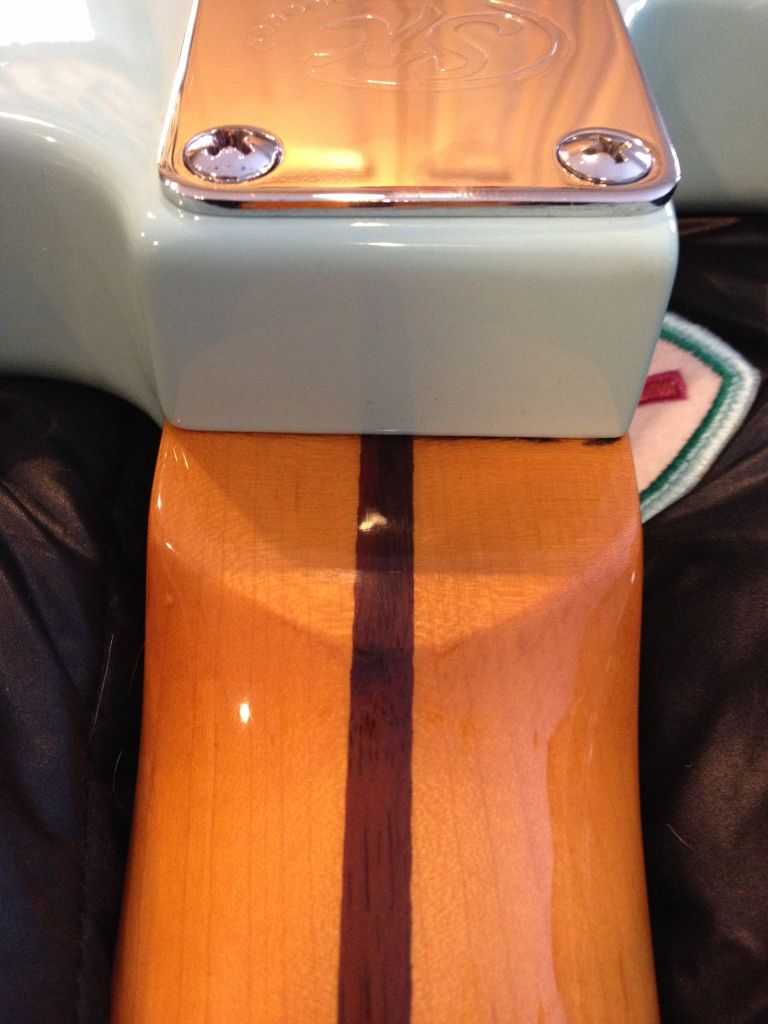
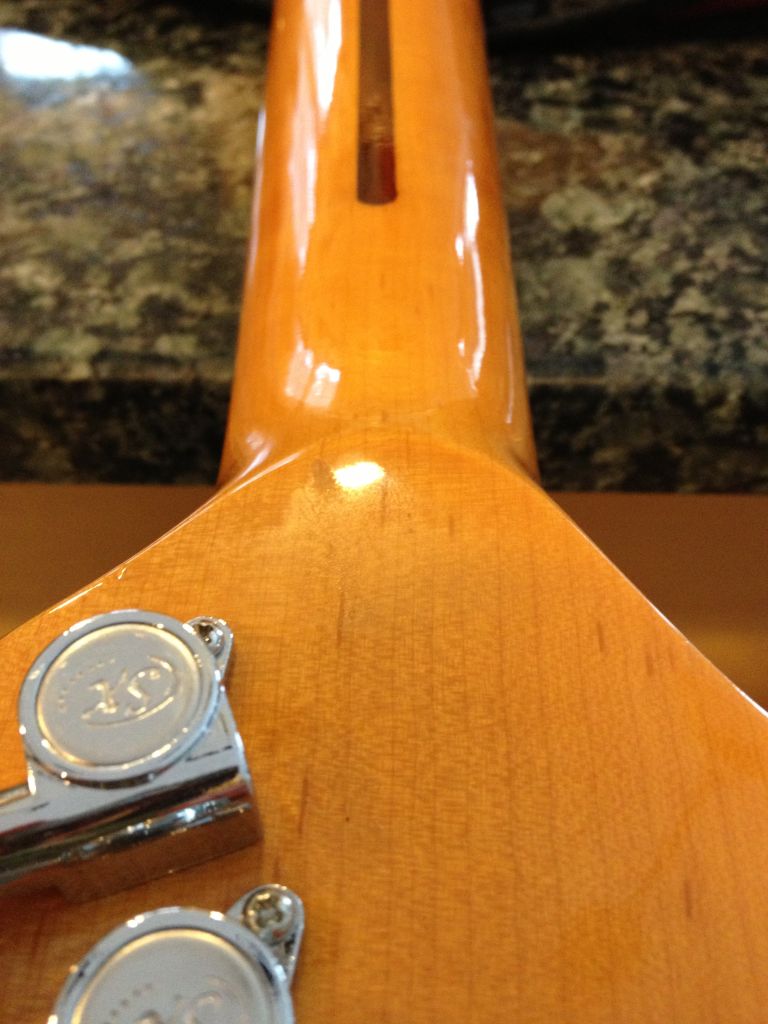
[Invalid or Expired Link Removed]
☼
And to follow up: This neck is "standing growth rings" - but in USA it is flatsawn -
Semantic Indirection.
That neck looks quartersawn to me, not flatsawn. I wouldn't expect that to need adjustments any more than at the change of seasons...
...or any neck to need it more than that, in all honestly.
That neck looks quartersawn to me, not flatsawn.
Correct. That is a quartersawn neck.
By the way, if anyone else brought this up, I missed it: a quartersawn neck should be MUCH stronger in the transition from neck to head.
IME, I owned a few Lakland US basses (quartersawn), a few MIJ Lakland Shoreline Series basses (flatsawn) and a MII Lakland Skyline bass (flatsawn). I never had an issue with a quartersawn neck but I did have an issue with one MIJ Shoreline bass. Namely, when I got the bass, the bass-side of the fretboard above the 15th fret was raised a bit. Probably the climate in Japan, - I hear people get rusty parts and such from time to time (I got the bass used). Those who played a Lakland know how ridiculously low you can set the string action - well, it didn't work on the lowest E and B of that bass.
I adressed Lakland and although they made a remark that they didn't support Shorelines (produced by ESP for Japan inner market and fully covered by ESP warranty) but they were great as always. They asked for every aspect and then recommended to wait for a few months (IIRC, until winter), and they proved right. The fretboard levelled, no issues, happy end, great bass, great consumer relations.
That said, I recently changed my US 55-94 for a MIJ SL55-94 and some cash, because they both are great basses soundwise and make-wise, and I don't at all expect problem with ANY flatsawn neck, no sir.
I adressed Lakland and although they made a remark that they didn't support Shorelines (produced by ESP for Japan inner market and fully covered by ESP warranty) but they were great as always. They asked for every aspect and then recommended to wait for a few months (IIRC, until winter), and they proved right. The fretboard levelled, no issues, happy end, great bass, great consumer relations.
That said, I recently changed my US 55-94 for a MIJ SL55-94 and some cash, because they both are great basses soundwise and make-wise, and I don't at all expect problem with ANY flatsawn neck, no sir.
I agree. I played Pedullas for years with quartersawn necks. Great basses, but required more adjustments than a chiropractors patient. I was constantly cranking on those things!Some say the oposite.
I personally like flat sawn.
Same experience here as a Pedulla player for 20 years.My Alleva Coppolo kbp4 and 5 only need a Truss adjustment maybe once or twice a year.. I like my action fairly low too.. They are flat sawn.. My sadowsky too.. Flat sawn. only needs a tweak a couple times a year ...
I had two identical pedullas. Each with Quarter sawn neck i believe.. One needed weekly adjustment while the other never moved.. It seems to be the wood and not the cut in my opinion..
I believe i read roger sadowsky once said that he believed that flat sawn in maple was more stable... IIRC.. Somewhere on his old site.
My 1980s Yamaha bb3000s its 5 piece quatersawn maple and mahogany and it needs tweaks much more than any of my flat sawn 50 and 40 year old fender basses// Go figure
I have a quad-cut (Flamed) G&L neck. I think I adjusted it a few times when it was sort of new (‘97–‘00 or so) but have t touched the truss rod in about 15 years…Actually, a guy named Leo Fender came up with a neck design that helped combat this problem of neck warping, called the "bi-cut" neck. It was used for a while at his company G&L, though it was later abandoned for reasons unknown....
I have a bi-cut #6 neck on my L2K which has never warped in the last 14 years or so I've owned it. Mine looks almost quarter-sawn but not quite, but it's never twisted on me....
But again, even G&L abandoned it for some reason. Too bad, because they were the best necks ever made on a Fender design....
LS


