
Quick question for the cab experts out there. I recently modified an Avatar SB112 to replace the horn tweeter with an Eminence ALPHA-6CBMRA sealed-back midrange. I also replaced the Avatar crossover with an Eminence PXB:1K6 (crossed at 1.6KHz). And while at it I replaced the L-pad, which was fairly low wattage, with a 100W, 8ohm unit. I got most of my info from this thread:
https://www.talkbass.com/threads/need-help-wiring-replacement-high-pass-filter-for-avatar-cabinet-mod.924361/
The wiring I used looks like this:
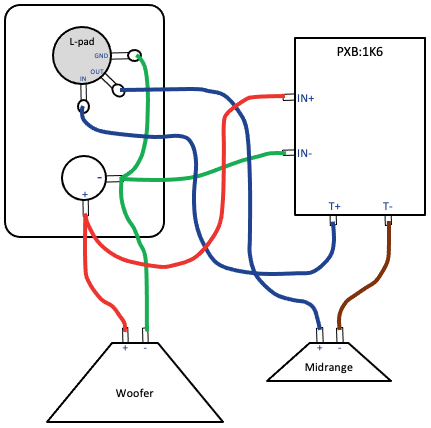
So, to the issue. When I rotate the L-pad all the way in either direction, I still get sound out of the mid. In fact rotating the L-pad seems to have no effect. Obviously, I was expecting that all the way in one of the two directions would kill all sound from the mid.
I have yet to re-confirm all the wiring to ensure that it matches the diagram, but I wanted to check that the diagram is sound. Does the wiring diagram look good for this simple 2-way topology? My thought was that I might have the terminals on the L-pad wrong. The idea is that the midrange would be “grounded” (to in -) when turning all the way in one direction. (Ignore the IN-OUT-GND designation on the terminals, it was my guess - I don't believe the terminals are labeled)
Thanks ahead of time for your comments.
https://www.talkbass.com/threads/need-help-wiring-replacement-high-pass-filter-for-avatar-cabinet-mod.924361/
The wiring I used looks like this:
So, to the issue. When I rotate the L-pad all the way in either direction, I still get sound out of the mid. In fact rotating the L-pad seems to have no effect. Obviously, I was expecting that all the way in one of the two directions would kill all sound from the mid.
I have yet to re-confirm all the wiring to ensure that it matches the diagram, but I wanted to check that the diagram is sound. Does the wiring diagram look good for this simple 2-way topology? My thought was that I might have the terminals on the L-pad wrong. The idea is that the midrange would be “grounded” (to in -) when turning all the way in one direction. (Ignore the IN-OUT-GND designation on the terminals, it was my guess - I don't believe the terminals are labeled)
Thanks ahead of time for your comments.