• TalkBass has been independent since 1998. Add your voice.
    Create a free account to reply to discussions, view embedded media, and browse with fewer display ads.
    Join freeLog in
    Want zero display ads or expanded classifieds tools? Compare plans.

Question About Binding Posts

So, I have an old BGW Proline 6000 power amp that seems like it'd be an improvement over the Peavey Centurion bass amp that's currently living its second life as a power amp for vocals in the PA.
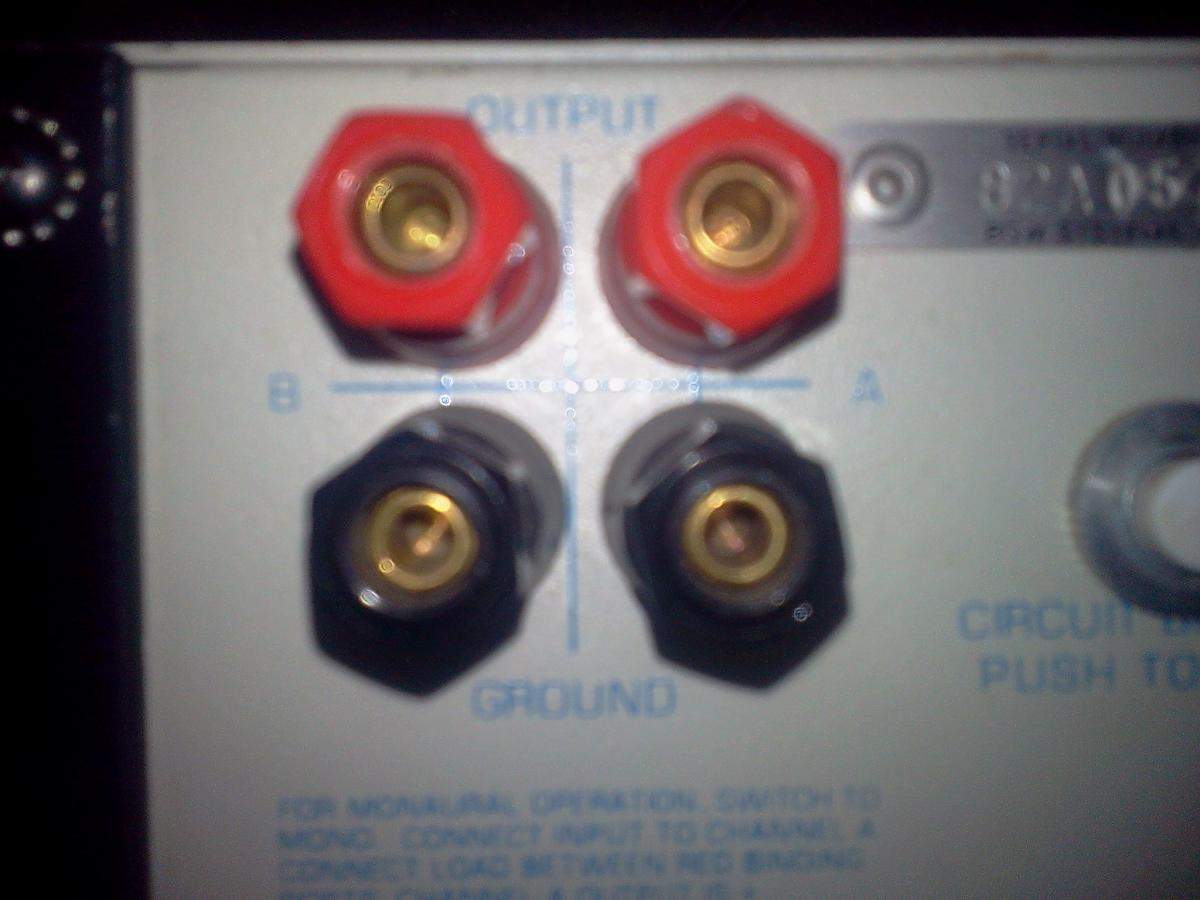
attachment.jpg


I'm not super familiar with binding posts. But my understanding is that if I cut one of my speaker cables in half (really more towards an end), then the outer shielding wire would connect to the bottom (black) ground post and the inner signal wire would run to the upper (red) output post.

Is that correct?
 

Attachments

  • 2013-09-10 11.22.42.jpg
    2013-09-10 11.22.42.jpg
    68.2 KB · Views: 532
look up banana plugs.

P.S. There is no outer shielding on a speaker cable. Speaker cable is closer to an extension cord than to a guitar cable.

Crud. Forgot about that.

I'm specifically trying to avoid banana plugs as dropping $20 on Hosa adapters at GC seems like a waste to me.

Never opened speaker cable before. Are the T and S wires going to be identifiable? Are their individual insulators going to be color coded?
 
Speaker cables are normally a twisted pair cable, one should be black, the other may be white or red. Black is ground, the other color is Hot. Youtube and common sense should cover the rest, if not...May The Gods Help You.

Peace,
Greg

Black = Positive +
White = Negative -

...in a 2 conductor cable. 4 conductor:

Red = Positive +
Blue or Green = Positive +
Black = Negative -
White = Negative -

Just make sure your connections are the same on both end...works well for the color blind.

BTW, if you decide to go with banana plugs, google / search "Neutrik Rean Banana Plug". They have strain relief unlike the cheapos.

Edited the color designation above...I was looking at the reference upside. 2 conductor is a bit of a crapshoot...I use household wiring as a reference where black is hot, white is neutral, green is ground.
 
Black = Positive +
White = Negative -

...in a 2 conductor cable. 4 conductor:

Red = Positive +
Blue or Green = Positive +
Black = Negative -
White = Negative -

Just make sure your connections are the same on both end...works well for the color blind.

BTW, if you decide to go with banana plugs, google / search "Neutrik Rean Banana Plug". They have strain relief unlike the cheapos.

Edited the color designation above...I was looking at the reference upside. 2 conductor is a bit of a crapshoot...I use household wiring as a reference where black is hot, white is neutral, green is ground.

White signal, black ground worked. Thanks for the help. And now I've got two spare neutrik plugs. Maybe I'll shorten an instrument cable and create an extra shortie.
 
White signal, black ground worked. Thanks for the help. And now I've got two spare neutrik plugs. Maybe I'll shorten an instrument cable and create an extra shortie.

Negative on the instrument cable...they're shielded and inappropriate for use as speaker cables.

As far as the black / white thing goes....as long as both ends are wired the same positive & negative, you're good to go. I could find reference to the 4 conductor scheme but nothing concrete re: 2 conductor. Then again, that seems to vary by manufacturer....black & red, black & white, etc.

As far as binding posts go, you have 3 choices: bare wire, "Y" terminal ends which slip behind the red & black knurled knobs, and banana plugs. Good luck with the project!

Riis
 
White signal, black ground worked. Thanks for the help. And now I've got two spare neutrik plugs. Maybe I'll shorten an instrument cable and create an extra shortie.

Negative on the instrument cable...they're shielded and inappropriate for use as speaker cables.

Riis

I don't mean to use it as speaker cable.

Zooberwerx is right on the instrument cable's inferiority for use in a speaker system. Instrument cable is Coaxial cable - center (hot) conductor, surrounded by a dielectric, then a cladding, and then has a braided shielding that acts as ground, then a jacket which is usually neoprene, Bakelite, or some other plastic/rubber.

The problem with using instrument cables for high-level signals is that the conductors are not physically large enough to handle the amount of electricity pumping through them, so they run a serious risk of heating up, melting things, overloading equipment, and/or starting fires.

And if this was a household wiring job he would have been right WRT to the Black being Hot and White being Neutral because Alternating Current Electrical applications have a different color code than Low-Voltage applications (You can thank the NEC for that one).

Source: 8 years as an Electronics Tech in the Army, currently a Low Voltage tech working in commercial construction, plus done lots of handyman work throughout my life. Planning on being an Electrical Engineer...ya, I like things that buzz, whir, and carry a risk of death due to electrical shock :)

Peace,
Greg
 
fires.

And if this was a household wiring job he would have been right WRT to the Black being Hot and White being Neutral because Alternating Current Electrical applications have a different color code than Low-Voltage applications (You can thank the NEC for that one).

Can you link me a reference on the low voltage applications?

Thanks

Riis
 
Crud. Forgot about that.

I'm specifically trying to avoid banana plugs as dropping $20 on Hosa adapters at GC seems like a waste to me.

Never opened speaker cable before. Are the T and S wires going to be identifiable? Are their individual insulators going to be color coded?

Cut the 1/4" ends off of the amp end of your speaker cables and install banana plugs. You'll spend more and more time securing bare wires to those posts (and cussing at them) as the wires fray and wear, and there's always the chance that a strand of wire will get loose and short out your amp. Using bare wires in those terminals is OK for a permanent installation but no good for a stage setup.
 
I'm not an engineer, but I do build a lot of cabling.

Many of the lighter-duty cables are made of 'lamp cord' in different gauges.
Most of these will have a ridge or grooves down one side for the positive connection.
Others will have an inner wrap, either white or black.

I have a stock of the older bananas, these have a small tab on the side.
wire that for pos, no fumbling for polarity in the dark.

One final caveat: the banana plug pins can flatten a bit over time,
and can get loose enough to not make a good connection, or fall out of it's connection entirely.
Check 'em at least once a month.

If you absolutely HAVE to go with the bare wire scenario
(may the gods have mercy on your soul)
then tin the ends. They'll last a bit longer.

I've added an extra plate on the back of some of my racks,
and put in TS or speakon connectors to be wired directly to the terminal posts.
 
Zooberwerx is right on the instrument cable's inferiority for use in a speaker system. Instrument cable is Coaxial cable - center (hot) conductor, surrounded by a dielectric, then a cladding, and then has a braided shielding that acts as ground, then a jacket which is usually neoprene, Bakelite, or some other plastic/rubber.

The problem with using instrument cables for high-level signals is that the conductors are not physically large enough to handle the amount of electricity pumping through them, so they run a serious risk of heating up, melting things, overloading equipment, and/or starting fires.

And if this was a household wiring job he would have been right WRT to the Black being Hot and White being Neutral because Alternating Current Electrical applications have a different color code than Low-Voltage applications (You can thank the NEC for that one).

Source: 8 years as an Electronics Tech in the Army, currently a Low Voltage tech working in commercial construction, plus done lots of handyman work throughout my life. Planning on being an Electrical Engineer...ya, I like things that buzz, whir, and carry a risk of death due to electrical shock :)

Peace,
Greg

All I meant was that I cut 1/4" neutriks off a pair of speaker cables. So I have 2 spare plugs.

Shorten a long instrument cable a bit and I now have an extra shortie for my pedalboard.
 
I'm not an engineer, but I do build a lot of cabling.

Many of the lighter-duty cables are made of 'lamp cord' in different gauges.
Most of these will have a ridge or grooves down one side for the positive connection.
Others will have an inner wrap, either white or black.

I have a stock of the older bananas, these have a small tab on the side.
wire that for pos, no fumbling for polarity in the dark.

One final caveat: the banana plug pins can flatten a bit over time,
and can get loose enough to not make a good connection, or fall out of it's connection entirely.
Check 'em at least once a month.

If you absolutely HAVE to go with the bare wire scenario
(may the gods have mercy on your soul)
then tin the ends. They'll last a bit longer.

I've added an extra plate on the back of some of my racks,
and put in TS or speakon connectors to be wired directly to the terminal posts
.

You mean like this? Built for PA. Take a look at the wiring and guess what-does-what. BTW, you can see I've used black for +...but at least I'm consistent.

PatchBayRear.jpg


Riis
 
You mean like this? Built for PA. Take a look at the wiring and guess what-does-what. BTW, you can see I've used black for +...but at least I'm consistent.

PatchBayRear.jpg


Riis

Yup that's the one.
In fact I have the exact same plate in the studio to carry the 16/4/2 mixer.
I've done the same on several converted combo cabs (w/o amp)


My apologies, I'd meant to say gnd for the tab. Good catch.
I should proofread my posts better.