• TalkBass has been independent since 1998. Add your voice.
    Create a free account to reply to discussions, view embedded media, and browse with fewer display ads.
    Join freeLog in
    Want zero display ads or expanded classifieds tools? Compare plans.

Question for the Double P owners

atquinn

All gear, no talent
Supporting Member
Mar 21, 2004
731
2,022
51
Long Island, NY
If you have a double p bass with the neck split p pickup in the correct position, how far away is the bridge split p (when measured from a like point on the neck pickup). I'm thinking about making one, but I'm not sure where exactly to place the bridge pickup :D
 
If you have a double p bass with the neck split p pickup in the correct position, how far away is the bridge split p (when measured from a like point on the neck pickup). I'm thinking about making one, but I'm not sure where exactly to place the bridge pickup :D

Are you just adding another splitter to an existing P bass?...or starting from scratch with a blank body? One option is to reverse the pickups. To say this bass sounds "bold" is an understatement. :woot:

upload_2024-6-19_21-32-19.jpeg

upload_2024-6-19_21-32-52.jpeg
 
Starting with an existing p bass and the bridge pickup will be in the normal orientation.

I don’t currently have one, but I might look at lining up the pole pieces of the bridge P pickup in the same place you’d line up either a 70s or 60s position Jazz bridge pickup, depending on what sound you were looking for.

just a thought . Hopefully my explanation makes sense
 
if it were me id put the bridge pickup as close as i could to the normal P. like maybe touching.
the reason is that a split coil close to the bridge will really sound different on the E and A strings compared to the D and G. being towards the end of the scale length really exaggerates this effect. i have a bass like this and it sounds like two different instruments between the low and high strings. it would be better to use a double jazz or some other big ol humbucker instead. but if you must go PP then yea, don't P next to the bridge
 
If you’re gonna mod, I too would suggest the dual reverse P configuration. Not necessarily in Lee Sklar positions, but that surely is an option. I found all the sounds more useful with reverse Ps. But I think two classically oriented P pickups work fine, particularly if you don’t solo the bridge pickup.

Regardless of orientation, I favor one location for bridge pickups on a P bass - centered between the bridge and the pickguard. On a typical p bass, that’s about the 70s j bridge position (centerline, where the two P halves meet). This position I think works well visually and sonically.

years ago a tried a bunch of positions and orientations on a mule bass and my favorite was a dual reverse P configuration with pickups centered over the 70s j positions.
 
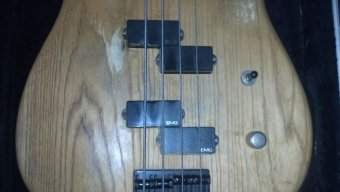
Here are my current (3) Double P pickup basses. Only the one on the right (had it since 1988) is as you described your build will be. The space between the (2) split P pickups is about an inch. The one on the left is a build from '22 and the gap is more like 3/4 inch. The one in the center has that magic special sauce and is now my #1. That gap is 1/2 inch. All with active EMG pickups, all 100% Warmoth. I hope that helps.

Triplets.jpg
 
If I were doing this, I wouldn't use two full P pickups. I'd go for the pickup and a half like this:

Invalid Link Removed

That gives you a regular P and a reversed P - the D/G side is always active, you just switch in different E/A pickups, and (this is key) nothing ends up too close to the bridge. The issue with dual P's in the regular sense is that, whichever side of the bridge pickup ends up closer to the bridge is going to sound a bit thin if solo'ed. I had a dual P years ago, and never used the bridge pickup solo'd - it was just too thin sounding - in that case on the G/D side. A reversed P bridge pickup doesn't fix that problem - it just moves it to the other strings.
 
  • Like
Reactions: JimmyM
Here are my current (3) Double P pickup basses. Only the one on the right (had it since 1988) is as you described your build will be. The space between the (2) split P pickups is about an inch. The one on the left is a build from '22 and the gap is more like 3/4 inch. The one in the center has that magic special sauce and is now my #1. That gap is 1/2 inch. All with active EMG pickups, all 100% Warmoth. I hope that helps.

View attachment 5484075

Which P pickups did you use? P, PA, or PCS?
 
If I were doing this, I wouldn't use two full P pickups. I'd go for the pickup and a half like this:

Invalid Link Removed

That gives you a regular P and a reversed P - the D/G side is always active, you just switch in different E/A pickups, and (this is key) nothing ends up too close to the bridge. The issue with dual P's in the regular sense is that, whichever side of the bridge pickup ends up closer to the bridge is going to sound a bit thin if solo'ed. I had a dual P years ago, and never used the bridge pickup solo'd - it was just too thin sounding - in that case on the G/D side. A reversed P bridge pickup doesn't fix that problem - it just moves it to the other strings.
I thought that was an absolute stroke of brilliance. Made me want to get one but I decided I'm still married to using PJs.
 
I thought that was an absolute stroke of brilliance. Made me want to get one but I decided I'm still married to using PJs.

I have another Precision that I made into a PJ (with the J pickup in the 70s position and Tony Franklin wiring) and it's great. The Wattplower wiring is interesting, but it doesn't give you any 2-pickup sounds and that is primarily what I am looking for in adding the 2nd pickup in this case.

My other thought was that, with a PJ bass, you have a somewhat weird signal blend because the distance between the low strings and the J pickup and the high strings and the J pickup is different. Using 2 split Ps oriented in the same direction (both reverse or both regular) eliminates this whereas having opposite orientations would make it even more extreme. Since I already have a PJ, I figure I'll keep both pickups the same orientation for a different effect when both are on. As a bonus, it looks better to me too!

There is the question of whether to have the pickups reverse or not, but based on sound samples I've hear and my own experience with the current split P in the regular orientation, I think I'll be fine with both of them in the normal orientation.
 
Last edited:
I have another Precision that I made into a PJ (with the J pickup in the 70s position and Tony Franklin wiring) and it's great. The Wattplower wiring is interesting, but it doesn't give you any 2-pickup sounds and that is primarily what I am looking for in adding the 2nd pickup in this case.

My other thought was that, with a PJ bass, you have a somewhat weird signal blend because the distance between the low strings and the J pickup and the high strings and the J pickup is different. Using 2 split Ps oriented in the same direction (both reverse or both regular) eliminates this whereas having opposite orientations would make it even more extreme. Since I already have a PJ, I figure I'll keep both pickups the same orientation for a different effect when both are on. As a bonus, it looks better to me too!

There is the question of whether to have the pickups reverse or not, but based on sound samples I've hear and my own experience with the current split P in the regular orientation, I think I'll be fine with both of them int he normal orientation.
I just buy PJ sets that work well together. Mostly Geezers but I have a Yamaha 5 with an SPB1 and soon an Apollo J. But I know they're not for everyone, so that's cool. Enjoy your project!
 
I just buy PJ sets that work well together. Mostly Geezers but I have a Yamaha 5 with an SPB1 and soon an Apollo J. But I know they're not for everyone, so that's cool. Enjoy your project!

I have 2 PJs (one fretted, one fretless) and they're both awesome. I was just thinking of trying something different. In the end I might end up doing another PJ, but with the J in the 60s position (since it's in the 70s position with my other PJs). We'll see.
 
  • Like
Reactions: JimmyM
I have another Precision that I made into a PJ (with the J pickup in the 70s position and Tony Franklin wiring) and it's great. The Wattplower wiring is interesting, but it doesn't give you any 2-pickup sounds and that is primarily what I am looking for in adding the 2nd pickup in this case.

My other thought was that, with a PJ bass, you have a somewhat weird signal blend because the distance between the low strings and the J pickup and the high strings and the J pickup is different. Using 2 split Ps oriented in the same direction (both reverse or both regular) eliminates this whereas having opposite orientations would make it even more extreme. Since I already have a PJ, I figure I'll keep both pickups the same orientation for a different effect when both are on. As a bonus, it looks better to me too!

There is the question of whether to have the pickups reverse or not, but based on sound samples I've hear and my own experience with the current split P in the regular orientation, I think I'll be fine with both of them in the normal orientation.

PJ is tricky, and I mostly dislike them for the reason you described. I find the reverse PJ usually works better, giving the larger gap on the DG side. Dual reverse P works even better. But I actually found I like the P best by itself :) it’s kind of a weird pickup and I like it mostly because of history. And it does work really well, it just doesn’t seem to pair great with other pickups…

These days, I’d probably go for two Big Splits if I wanted a balanced “PJ” sound.
 
  • Like
Reactions: atquinn