• TalkBass has been independent since 1998. Add your voice.
    Create a free account to reply to discussions, view embedded media, and browse with fewer display ads.
    Join freeLog in
    Want zero display ads or expanded classifieds tools? Compare plans.

Question on ported vs. non-ported cabs - need advice/opinions!

May I be the first to recommend the Bergantino NV610?

The punch you get from it with an SVT is visceral.

+1 You beat me to it.

And, if you'd like to read up on some of the differences between sealed versus ported enclosures from a technical perspective, Anthony Lucas (from Eminence) discussed this topic in his column, "The Speaker," back in Link Removed.
 
I'm a huge vintage speaker fan and have had lots of them and I always hear the best definition with the sealed....the ported can give a nice fat full sound but it doesn't necessarily mean it's going lower into the frequency range. I've got some Acoustic Research 91's that are only 3 feet tall with a 12" woofer and the bass in that speaker will smoke any ported speaker I can think of. I also had some ads l1290s and they had dual woofers and the bass w/ them was pretty tight and deep....not that all porteds are flabby mind you...just that some are executed better than others.
 
No, Bill, group delay is not inaudible and excessive delays (that typically show up in big vented enclosures with deep tuning) can easily be detected.

+1
I made a ported cabinet with 1,23 QTS speakers and i sounded "wooly", group delay was about 30ms. The same speakers in sealed cab sound well.

I sometimes hear cheap H-Fi subwoofers that play audibly later of time with the rest, like there was a time mismatch.
 
Not necessarily. With many musical instrument drivers the roll off below F3 can be made identical with both a sealed and vented alignment, with the only difference being the low frequency sensitivity. The Ampeg ten is one example.Group delay is inaudible in the low frequencies. Oddiophiles get all excited about it as it can be seen on a chart, but in the real world below 100Hz its effect is insignificant.

I said, in theory, you can "model" vented cabs so they have not a very steep roll off. Thats the reason I wrote 18-to-24dB/oct.
The audibility of group delay is a much talked about issue. The question is, what is the impact if you take the room acoustics into account.

Where sealed and ported alignments differ the most is in low frequency sensitivity. It takes considerably more power for the sealed cab to subjectively sound as loud, and that higher power results in higher levels of harmonic distortion in the midbass and mids. We call it 'punch'. To some extent you can emulate the response of a sealed cab by turning down the bass EQ, but the overall effect isn't the same. But try it anyway, it could help.

The harmonic distortion can possibly be a part of the persieved sound, but it's not the whole picture IMO.
 
No, Bill, group delay is not inaudible and excessive delays (that typically show up in big vented enclosures with deep tuning) can easily be detected. It has been studies done on it.
For most application it is however of less impact than other design related shortcomings of most LF systems.

The one who does not belive it should try to hear a PA rig with and without time alignment of the subs in relation to the rest of the rig...


The reason time alignment is necessary is typically due to physical placement of the subs vs the mid/high array.
 
+1
I made a ported cabinet with 1,23 QTS speakers and i sounded "wooly", group delay was about 30ms. The same speakers in sealed cab sound well.

I sometimes hear cheap H-Fi subwoofers that play audibly later of time with the rest, like there was a time mismatch.
Group delay had nothing to do with the result. Using a driver totally unsuited to a VB did. I'd never use a driver with a Qts of even .7 in a VB. As for the cheap subs, they sounded bad because they were cheap subs. The audibility of low frequency delay directly correlates with the directionality of low frequencies. Your ear/brain is not configured to detect either below 80 Hz, and the lower you go the less effective they are in so doing. To do so requires that the distance between the ears be a significant percentage of a wavelength. When the wavelength is 14 feet and longer the only way you directionally locate or hear group delay is if you're a pachyderm.
 
+1 You beat me to it.

And, if you'd like to read up on some of the differences between sealed versus ported enclosures from a technical perspective, Anthony Lucas (from Eminence) discussed this topic in his column, "The Speaker," back in Link Removed.

Thanks for the article! That definitely gave me a general answer, but now I'm beginning to find myself much more interested in learning the science behind it all :D

The Berg has definitely been on my radar for a while now, but they never seem to pop up too often in my area, and when they do they tend to be super expensive. I might see if I can unload one of my GB's for a used Ampeg 810 or 610. I see those cabs going for $400-$500 on CL all the time, so I wouldn't be out any money on one of those.
 
Translation: If you don't agree with BFM, you are scientifically proven to be very fat and unattractive!
Not to another pachyderm. :D
But to understand how sound works you need to delve into how your hearing works. It's not just physics, it's also biology. Among biologists it's well known that elephants communicate at frequencies well below what we can hear, because the distance between their ears allows them to. Since that's the case their brains are hardwired to deal with very low frequency information. The distance between our ears doesn't allow for detection of direction, pitch or even fairly large periods of delay at very low frequencies, so our brains aren't wired to process that information. That saves computing power for what's most important to us, our vision. Elephants OTOH have very poor vision, partly because of the amount of processing power allocated to hearing and smell, partly because you don't have to see all that well to find other elephants. :p
 
I'm a huge vintage speaker fan and have had lots of them and I always hear the best definition with the sealed....the ported can give a nice fat full sound but it doesn't necessarily mean it's going lower into the frequency range. I've got some Acoustic Research 91's that are only 3 feet tall with a 12" woofer and the bass in that speaker will smoke any ported speaker I can think of. I also had some ads l1290s and they had dual woofers and the bass w/ them was pretty tight and deep....not that all porteds are flabby mind you...just that some are executed better than others.


You have good taste. When I was building my Hi-Fi set, I was looking for either a pair of ADS 910, or Acoustic Research AR-9, either one are probably the best cabs known to man, and they are sealed. Rare, and when they come up for sale, the goods ones are just too pricey. But being sealed, they are huge power vampires. The AR-9 are 87db, the ADS 910 at 93db. For my monster speakers, I settled on a cheap used pair of Cerwin Vega D-9, ported, with sensitivity of 101db.
 
So, basically, this explains why bass is omnidirectional, correct? If I understand correctly, since the ears aren't far enough apart to perceive the beginning and end point of a wavelength as it passes from one ear to the other, the human brain can't "locate" the direction of the wave's origin.


Not to another pachyderm. :D
But to understand how sound works you need to delve into how your hearing works. It's not just physics, it's also biology. Among biologists it's well known that elephants communicate at frequencies well below what we can hear, because the distance between their ears allows them to. Since that's the case their brains are hardwired to deal with very low frequency information. The distance between our ears doesn't allow for detection of direction, pitch or even fairly large periods of delay at very low frequencies, so our brains aren't wired to process that information. That saves computing power for what's most important to us, our vision. Elephants OTOH have very poor vision, partly because of the amount of processing power allocated to hearing and smell, partly because you don't have to see all that well to find other elephants. :p
 
So, basically, this explains why bass is omnidirectional, correct? If I understand correctly, since the ears aren't far enough apart to perceive the beginning and end point of a wavelength as it passes from one ear to the other, the human brain can't "locate" the direction of the wave's origin.
Exactly. And it's why our ears are most sensitive to directional cues, time align and intensity in the range where our ears are about 1/2 wavelength apart, 500 to 800Hz. At 50Hz you can't hear time align issues of 20ms, at 500Hz even 3ms is very obvious. That fact was painfully realized in 1936, when virtually every theater speaker in the world had to be replaced as their time align was audibly flawed, and why crossing from woofers to mids in the 500 to 800Hz region is avoided whenever possible.
 
Very low frequency group delay is unimportant in low frequencies as the delay values are still extremely low relative to the bandwidth and in fact is an unavoidable part of the process of extending low frequency response and sensitivity.

Group delay is caused in parts by the following:

1. Driver inertia will always cause some lag between the electrical signal and mechanical action. This can be compounded by the reactive nature of the driver. There are group delays for both voltage and current and they will be different numbers.

2. The box itself will cause inertia with the time lag due to the spring constant of the air mass and the summation of phase shifted internal reflections within the box on the incident signal.

3. The act of porting takes a phase shifted (acoustic) signal in combination with the air spring-mass to recombine with the incident signal (which is also shifting phase as it falls off wioth lower frequency) to reinforce the rolloff by summing with a complimentary signal "generated" by the tuned box via the ports. This tuning only acts over ~1/2 octave effectively and then the rate of falloff is even faster. (The can't get something for nothing rule)

So, there is a trade-off between low frequency extension & sensitivity versus group delay and for every practical purpose that I can think of, having the LF response is more desireable then lower group delay in an area wher there is now much less signal. Of course, a sealed box has value because it's possible to get different acoustic tunings, different voicings (due to the different drivers that can be used) and a different feel. These are frankly independant of any group delay effect IMO.
 
+1
I made a ported cabinet with 1,23 QTS speakers and i sounded "wooly", group delay was about 30ms. The same speakers in sealed cab sound well.

I sometimes hear cheap H-Fi subwoofers that play audibly later of time with the rest, like there was a time mismatch.

What makes you think that the group delay was responsable for what you heard. I can think of many other possibilities that are more likely. Same for your cheap subs... by the time group delay becomes an issue the response is so far down that it' wouldn't be audable even in the worst possible cases.

I agree with Bill on this, there are so many other things going on that to place blame on GD is missing the much bigger picture.
 
What makes you think that the group delay was responsable for what you heard. I can think of many other possibilities that are more likely. Same for your cheap subs... by the time group delay becomes an issue the response is so far down that it' wouldn't be audable even in the worst possible cases.

I agree with Bill on this, there are so many other things going on that to place blame on GD is missing the much bigger picture.

One of those possibilities is the high Q of 1.23, there's no way you can use such a driver in a ported design, it will indeed sound very wooly. Even in a closed box the results will not be satisfying. I see no purpose in using such a driver for any design, maybe an open baffle or transmissionline.
 
Just an update:

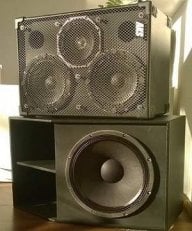
I played a gig this weekend where I had the opportunity to sound check beforehand and really play with my cabs and the SVT with a lot of different settings. The verdict: it's just not cutting it.

My issue of not having enough punch had been replaced by my rig simply sounding far too muddy in the mix. I couldn't hear myself for the most part. I tried my rig with a number of different settings and with two different basses and I was never able to find the sweet spot.

Personally, I would of been fine with either not having a lot of note definition so long as I could feel the punch of each note, or with having lots of definition and little punch, but I couldn't get either of those. And since my goal is to have definition AND punch it just seems like it's time to move on to something new.
 

Latest posts