Todd Stanley said:
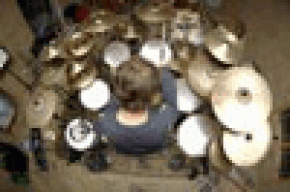
No need for spending money, hang blankets on the wall and drape the drums with towels to dampen the sound, lots and lots of bath towels. Or those bristle stick things as shown.
Audio and acoustics is rather a specialty of mine, and if I could add a little perspective to this suggestion..
Remember that the thickness of the absorbtive material that you use is tied to the range of frequencies that will be absorbed. A blanket flat against the wall is going to be nearly transparent to even upper midrange frequencies; lows and lower-mids will reverberate as much as they ever did, and now your room will sound 'woofier' - this might not be a help. Pleating them like draperies to about half-area or better (make a ten-foot length of cloth cover five-feet of wall) helps considerably, but you can't much expect to get
economical broadband absorbtion with cloth. This fact is why carpeting can be a problem - you're lowering reverb times in the treble, but not mids or lows; this can be worse, especially for recording.
In more advanced treatments where there
has to be carpet, a good idea is what I've heard called "contra-carpet", where they let the carpet absorb highs and reflect lows, but then put resonant-type absorbers on the cieling that absorb lows, and reflect the frequencies that the carpet is absorbing to even-out the reverb.
One of the best absorbtive materials is fiberglass fluff; six inches thickness will pretty much completely absorb and elliminate reflections from the wall area where it's mounted.
One thing that seems to be commonly misunderstood is based on the fact that the ultimate absorbtive device is an opened window. What's important about this is that nothing can absorb more sound than what waves actually strike it! Some people seem to think that there are absorbers have the capability to 'suck sound into them', as though they'll grab waves that don't acually impinge on them - this is not true. The closest that this can be to true is that if you damp CORNERS of a room, then you have a geometric advantage having to do with 'reflections terminating in corners'.
If you're planning on treating a room for acoustics a little, and don't want any unpleasant surprises, it's best to use fairly evenly distributed, fairly broad-band absorbtion. The cheapest, generally most effective, and very common method is to make four- to eight-inch thick panels (4in at absolute minimum to avoid some real potential troubles with wooofy, bassy, thuddy sound!) that are something like 2ftX4ft, or maybe 2 or 3ft by 6ft (something like that, it's not critical) in dimention. These panels can simply be one-by lumber frames mounted directly to the wall (no need to have a 'back' on them) with little L-brackets, filled with regular pink insulation, and then covered with cloth stapled to the frame. Make them as polished and fancy as you like, but just stapling the 'glass to the wall would work (it'd make you itchy, though).
These panels are mounted vertically on the walls. The easiest way to go about this is to just decide on how many of these things you're willing to construct. any number of them (including ONE) only helps, up to about half the total wall area being covered - then the returns are diminishing (this is all just generally speaking). You can't go wrong by just distributing these evenly, and in a manner that one panel is not directly across from another. Also, if you're installing more than one or two it's best to distribute them between both the north-south, and the east-west walls, else modes and flutters that occur because of the un-treated dimension could 'stick out' and be more noticeable than before.
Another misconception seems to be that acoustics can make a sound source quieter - this is definately untrue. The sound coming directly from a source is the volume that it is, and only distance from the source can make any difference. Now here's where dampening in the room can help: if you were in a completely absorbive ('dead') room, then you can benifit from sound volume following the true, theoretical 'square law' that says sound energy will decrease proportional to the SQUARE of the difference in distance (move twice as far away, and the audio energy will be one-quarter of what it was - the square of two - three times as far, and the sound goes to 1/9, etc.). The more reflective a room is, the more sound WON'T follow the square law, because the sound isn't dispersing away (remeber that a broadband absorber is the same as an 'open window'); the room is containing the sound by just reflecting it around. These two facts, bytheway, are why you need tons of power when you play outdoors -- square-law!
You can, of course, put absorbtive material BETWEEN the source and listener (our 4ft.-high walls really DO quiet the drums considerably; he just plays so LOUD!) - that way you're eating-up some of the sound that's on its way.
(I'd better get back to work. I'm supposed to be writing a document for my BOSS right now... but I wish I was playing the Bass)
Joe