
I am just into my second week of recovery from inguinal hernia repair, so it will be awhile before I will be lifting/shifting any DBs. This is a follow-up to my query about using scrapers to clean the glue off a neck/fingerboard before making them a unit. Since I have previously used scrapers only to remove wood and since I did not want to risk compromising that camber that is milled into the neck to make it easier to reach the G string, I opted for a less invasive scraper to remove the old glue and one that pretty much assures removing only the glue.

A plain old paint trim guard: a flat, even scraping blade that is plenty "sharp" enough to scrape away softened glue but not so sharp as to remove wood. Plus, the blade is long enough to enable the entire width of the mating faces of the neck and fingerboard to be scraped with each stroke, thereby reducing the risk of "un-evening" the surfaces.
But anyway, the scraping is done. The old glue has been removed and I am ready to unite the neck (on a 1/2 sized Framus) with its new fingerboard, which is a perfect fit. Top of the 'board snugs right up against the nut, 'board taper and neck taper align all the way down. Only thing is, it turns out this fingerboard is for a 3/4 size bass. The fingerboard extends past the upper eyes of the f-hole. A visual comparison with my Englehardt EM-3 suggests the 'board ought to stop about 4-5 inches before reaching the eyes and I'm guessing the same would hold true with a half-size board on a half-size bass.
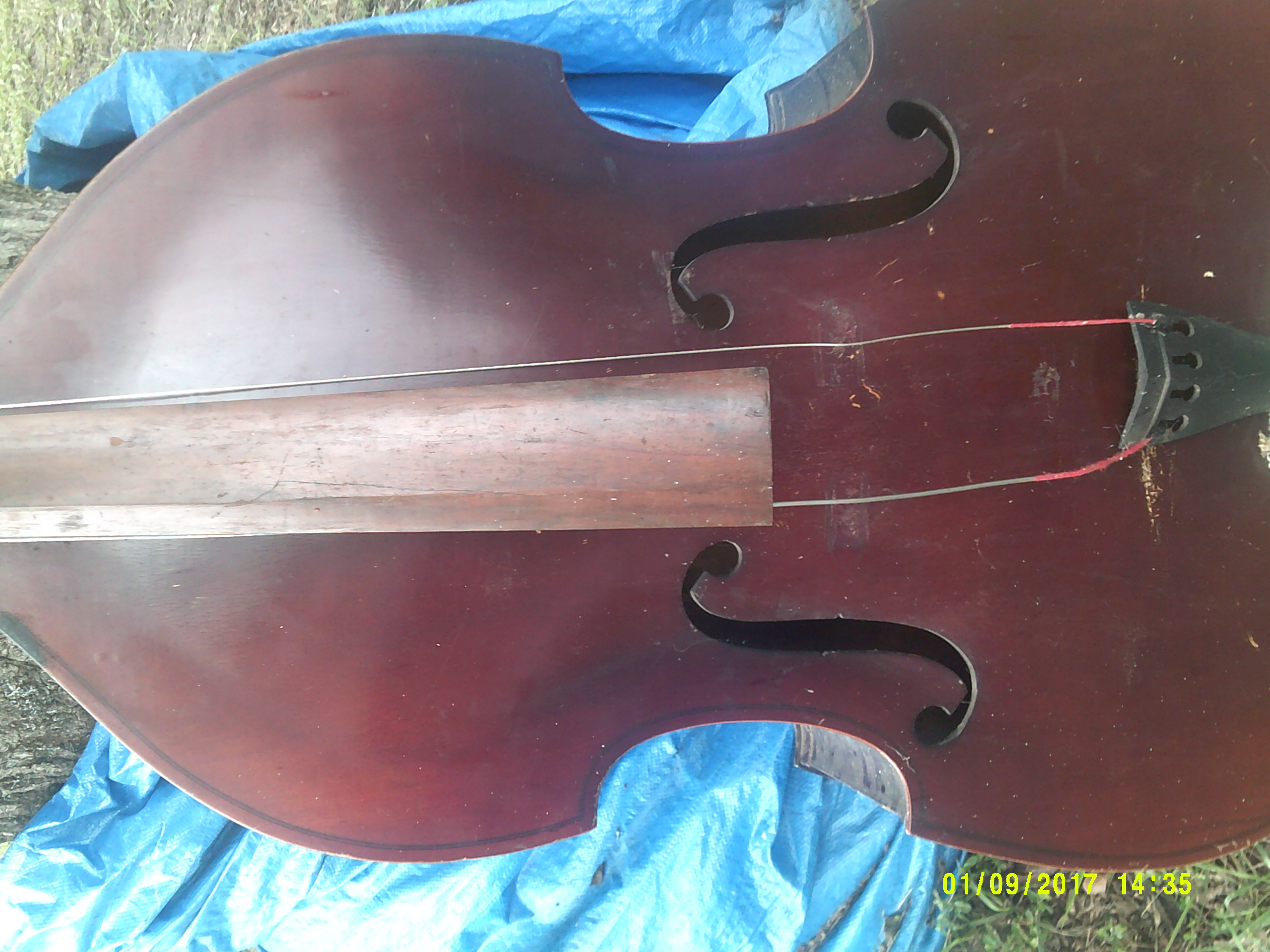
My question is, should I cut off the fingerboard to half-size length, of just leave it as it is? My gut instinct is to leave it, since cutting is an irreversible modification which rules out that fingerboard ever being transferred to a 3/4 size. If I don't cut, I still have options.
A couple of other things:
1) Should I score with a knife edge the face of the neck and the mating face of the fingerboard? Proponents say yes, as scoring will help the glue to "grab" for a tighter bond. Doubters say that tighter bond will make it more difficult to remove that fingerboard cleanly if it ever has to be removed. I'm on the fence on this one.
2) Down to what grit of sandpaper should I sand to prepare the two surfaces for mating? Too rough a grit could possibly permit gaps even to the point where daylight could be seen through, while too fine a grit could make the mating surfaces impossibly slick to hold a secure bond.
Like I said, any of this work is weeks away, but I want to be informed of the "right way" before I begin.
Thanks for any insights.
Mods: please move to Double Bass- Set-up and Repair.
A plain old paint trim guard: a flat, even scraping blade that is plenty "sharp" enough to scrape away softened glue but not so sharp as to remove wood. Plus, the blade is long enough to enable the entire width of the mating faces of the neck and fingerboard to be scraped with each stroke, thereby reducing the risk of "un-evening" the surfaces.
But anyway, the scraping is done. The old glue has been removed and I am ready to unite the neck (on a 1/2 sized Framus) with its new fingerboard, which is a perfect fit. Top of the 'board snugs right up against the nut, 'board taper and neck taper align all the way down. Only thing is, it turns out this fingerboard is for a 3/4 size bass. The fingerboard extends past the upper eyes of the f-hole. A visual comparison with my Englehardt EM-3 suggests the 'board ought to stop about 4-5 inches before reaching the eyes and I'm guessing the same would hold true with a half-size board on a half-size bass.
My question is, should I cut off the fingerboard to half-size length, of just leave it as it is? My gut instinct is to leave it, since cutting is an irreversible modification which rules out that fingerboard ever being transferred to a 3/4 size. If I don't cut, I still have options.
A couple of other things:
1) Should I score with a knife edge the face of the neck and the mating face of the fingerboard? Proponents say yes, as scoring will help the glue to "grab" for a tighter bond. Doubters say that tighter bond will make it more difficult to remove that fingerboard cleanly if it ever has to be removed. I'm on the fence on this one.
2) Down to what grit of sandpaper should I sand to prepare the two surfaces for mating? Too rough a grit could possibly permit gaps even to the point where daylight could be seen through, while too fine a grit could make the mating surfaces impossibly slick to hold a secure bond.
Like I said, any of this work is weeks away, but I want to be informed of the "right way" before I begin.
Thanks for any insights.
Mods: please move to Double Bass- Set-up and Repair.