• TalkBass has been independent since 1998. Add your voice.
    Create a free account to reply to discussions, view embedded media, and browse with fewer display ads.
    Join freeLog in
    Want zero display ads or expanded classifieds tools? Compare plans.

Questions for those who alternate between 4 and 5 stringers

Played fours forever then bought a five-string. I believe it took about six months to get used to it but I did not follow the only 5-string advice which I believe would have been gold at the time. Now I'm like Spectre1966 and don't think about it too much. When playing live, I go out of my way to not switch basses midway through a set - not just for the time involved but also for the 'switching gears' in my brain.
 
  • Like
Reactions: stringthrough
I regularly play two 4s and a 5.

Is your “baseline” 5 strings and you think of a 4 stringer as missing the lowest string or is your “bassline” a 4 strings and you think of a 5 stringer as a 4 with an extra string?

Neither. I've consistently had at least one 4 string and one 5 string since the early 1990s, and played both. It's hard for me to see one or the other format as my "baseline," despite having started on a 4 string.

From a technical perspective, do you change right hand damping technique between the two types of bass? For example, do you float you thumb between the B and E string to dampen as needed when playing the A-G strings on a 5 string but use E string as a thumb rest on a 4 stringer when playing the A-G strings.

I use the lowest register string as a thumb rest on both the 4s and the 5. However, I do float my thumb to rest on other strings and use the side or base of my thumb or part of my palm to mute lower register strings. I think that generally my technique is fairly similar in both cases.

Do you go out of you way to play the lowest E-G# notes on the E string as opposed to higher up on the B string so as not to approach the same tune differently when playing it on a 4 versus a 5 string?

I play those E-G# notes on the E string sometimes and on the B string sometimes. The decision is usually related to what notes I'm playing before and after, and thus where I want my hand to be on the neck. I do find, however, that if I originally learned a tune on a 4 string, my muscle memory usually wants me staying off of the low B string. I have to actively make myself change that habit, and I probably only do so if it really seems like it would be more efficient to do so for a given tune.

Any thoughts along the lines on how you change you mental perspective and playing technique would be appreciated.

The three instruments vary in ways beyond number of strings:
  • 4-string fretless, 34" scale, roundwounds, single MM pickup, passive tone
  • 4-string fretted, 34" scale, flatwounds, P and J pickups, passive tone
  • 5-string fretted, 34.5" scale, roundwounds, modern J pickups (w/ switching between single and humcanceling modes), active 3-band on-board preamp
The choice about which I play and my approach to playing them is usually driven more by differences between the basses other than the number of strings.
 
  • Like
Reactions: stringthrough
Whaaaaa? Read music, what's that?

Just kidding. I was a rudimentary, but good enough to get by reader back in high school when I played upright for my school's jazz orchestra.

Cool. I currently play in a community big band where half the members played together in high school a zillion years ago. The first chair tenor is in his 90s and was their teacher. So the standard for reading in that band is pretty high, or at least well beyond my comfort zone.
Yel_wink.gif
 
  • Like
Reactions: stringthrough
For a while I only played 5s, then took up 4s again and played them almost exclusively, now I switch around. I guess I think of the 5 as a 4 with an extra string, not the 4 as a 5 that's missing a string. I really only pull the 5s out for sets that include songs where I need the extra low notes. I don't like creating dead air in a set by taking time to switch basses, so I try to arrange set lists so all the songs that need a 5 are in the same set and I play it through that whole set. Any songs in that set which I would normally play on a 4, I practice on the 5, mostly to make sure that any muting or string skipping bits don't throw me off with the extra string.
 
Some don;t agree with me but I find 4 string basses and 5/6 string basses to be two different instruments played in different ways. I played only 4 string for many years and then got a 5 string. Natch, I first thought a 5er was all about those extra low notes and loved the low Eb that I always wished for. However, I really never quite "got" what a 5er was all about until I got my 6 string. A 6 string just forces you into correct mode. The neck is wide and you have to deal with it, you need damping all over the place and you start to see the sense of playing "across" the strings rather than up and down them. In short it just gets your mind right. Then you find a 5er is just like a 6 string when you don't need the extended high notes (I always prefer 24 frets for a 6 string anyway) I choose 5 or 6 depending on the music. These days I play my G&L L2500 a lot. However, I do still play 4 string if I need to (old school classics tunes, using a borrowed bass at a jam etc.) When I play 4 string I found that if I just revert to my 5 string styles, I end up disappointed trying to use strings that aren't there and trying to move patterns that can't move. So I remind myself it's a 4 string and revert back to my standard 4 string styles (tends to be up and down the neck rather than across it) that I played for so many years. Works out fine.
 
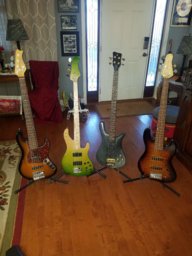
So here is my rig from Friday night's gig. 5 string bass for first set, 4 string bass for second set. In my band, we start a little early and so do some more ballad-y stuff early on, the fretless works better for that and the extra string gives me a little more flexibility although I usually don't go lower than the D below the low E. The second set has lots of "root, octave, repeat" stuff, it's just easier with frets.

This 5er is my first 5er but I've been gigging it for about 2 years or so now, so I consider myself competent on both, but if you were to ask which is my "baseline", I guess I would have to say that I think of myself as a 4 string player who also plays a 5er.

I try to float my right thumb a string or two above where I am playing, so I rest on the E string when playing notes on the A and D strings, one lower for G string, on nothing for the E string.

When I am playing the 5er I prefer to play my low E on the 5th fret of the B string rather than the open E, because it's more comfortable for me there (frets closer together, patterns the same as everywhere else, etc). Unless I'm just doing a run down to low E, in which case I'll go down to the open E.

6-WqtnHwMHhh6ggM0ZjQY12kEA0_A_LwiaGDN1wXiK2RCBG6VTAuRZzDa9aOx-YaXslGeOIWXUjo_Llx0E=w810-h1080-no.jpg
 
  • Like
Reactions: stringthrough
I play both during a "set" when it's beneficial. If I can get away with a 4 string, I will. But if the songs call for the lower notes or I want to root myself off the B string higher up the neck to maintain a familiar fretting pattern, I will use it that way as well. I don't find it overly difficult most of the time.
 
  • Like
Reactions: stringthrough
I play four-string basses in standard tuning and five-string basses with either high C or low B, both upright and otherwise. I don't think my technique changes, but I don't pay much attention to right-hand thumb position unless I need it to sound a note. When switching between string layouts I have to be more aware of which string I grab while reading. Beyond that I find the key to success is keeping the relative intervals in mind, not the string position. Thinking in intervals has given me a lot more facility with different tunings on banjo, cello, guitar and baritone guitar as well.
 
  • Like
Reactions: stringthrough
* Update *
*------------------------------------*

I'm getting a lot of replies (which I appreciate) from players who made the switch from one to the other and more or less never went back. However my questions are directed at players who go back and forth "concurrently" (that's why I used the word ALTERNATE) and not "I played the 4 for 10 years then went to the 5 for a few years and recently returned to the 4".

I switch back and forth all the time. I usually need a 5 string for two bands I play in, but in my other band I only use 4 string basses. If you're having trouble going back and forth just keep at it. Like anything else in music, practice makes it easier. For me I don't think about it, I'm just playing the bass in my hands.
 
  • Like
Reactions: stringthrough
I've been switching back and forth for a few years now. I don't really think about the number of strings, beyond checking a set list to see if I need to bring a particular bass because the bass line needs the range of a 5. My thumb moves the same whether I'm on 4, 5, or my 7. It's rarely more than a string or two behind my plucking fingers. It took a little while to get the hang of jumping back and forth without having to stop and think, "hey, this is my E right here" a bit, and more than once while making the transition I'd accidentally start a song in the wrong key as a result. Over time that went away for me.

When it comes gig time, well, my 5ers are also my only P and fretless basses. While range and key of what I'm playing are a factor, I'm just as likely to pick which bass(es) to take to a gig or to church based off the type of bass rather than just the number of strings.
 
  • Like
Reactions: stringthrough
Like others here, I go back and forth, depending on the particular situation. For my most recent gig, I brought a 5 to the rehearsal, but once I became familiar with the material, I ended up bringing a pair of 4s to the actual gig.

Someone recently posted a link to a Scott Devine video which caught my attention. In the video, he articulated his pros and cons of 4 vs. 5, and one of his points involved muting. Almost every accomplished bass player has developed muting techniques for the 4, but the 5 (or 6 or 7, for that matter) presents an additional challenge. Whether you choose a 5 for extended range or for versatility's sake, there is a learning curve involved.
 
  • Like
Reactions: stringthrough
I switch back and forth between a Spector Euro Rebop and one of several different 4-string basses I own.

I have always approached a 5-string bass as an entirely different instrument - not a standard bass with an extra string. So much so that I made a decision when I first got mine not to play any of my favorite riffs or usual progressions on it. Not that it turned out to be necessary in the end. My fiver feels and sounds different than my usual basses. Enough so that my technique and note choices change completely whenever I play it. And without me forcing myself to do it. Or even think about it really.

Stylistically I play the 5-string differently as well. I tend to veer toward a more chordal and melodic style than the usual rhythmic way I tend to favor playing a 4-string. About the only drawback is I can occasionally be guity of overplaying with a 5-string if I don't watch myself. Probably because I play a 5-string with something resembling a guitarist's finger-style as opposed to my other basses. That (I'm guessing) is because with the narrower string spacing on my particular fiver, it's harder to get in between and "dig in" like you can with the wider 4-string spacing. So that tends to keep my already fairly light touch more up on top of the strings, which makes it easier to fire off a lot of notes. I imagine if you're using one of those bass ramps the same thing could happen.

I never had to do anything to get myself "in the frame" for playing a 5-string per se. I approach every bass I play as being its own thing. So it was just natural for me to let the 5-string tell me what it wanted to do and then go along with it. It's hard to explain, but my brain just naturally seems to reprogram itself for whatever instrument I'm working with. I play a few other instruments and it happens with them as well. So it's not just with bass I do that.

Good muting technique is IMO even more important on a 5-string than it is on a 4-string.

The lower notes aren't really all that important to me except for having that convenient C and D below the low E because I play mostly rock and similar genres.

I don't consider a 5-string better or more advanced or versatile than a 4-string bass. I just see it as something different. Yet another bass range instrument that has its own advantages and disadvantages. It's good for some things, excels at others, and is about par with other choices - depending on the song or the genre it's being used for. Same goes for a 4-string. Or a 6-string for that matter. I like all types of basses and see no reason for not going back and forth as musical necessity or your whims dictate.

But I try not to overanalyze things like this these days. I prefer a more Zen-like approach and "just play" music. And as long as it sounds good and serves the song, I'm happy to let whatever I'm doing happen - and let it go at that.

That's my story. And I'm sticking to it. YMMV. :thumbsup:
 
Last edited:
  • Like
Reactions: stringthrough
I primarily use my 4 string and pull out the 5-string when I need to go that low. My Rogue 5-string was the original LX405 Pro from back when they were made in Korea and it's a surprisingly good bass. Fit and finish is excellent, it's lighter than my Jazz, and sounds good too. But, it's just not the same as my 4-string Jazz. I could use it as a back up if anything happened to my Jazz but usually I just pull it out when I need to play something on that low B string.

I normally do play my 5-string with my thumb resting on the B string when I am playing the other strings. I didn't really thing about the muting I do on it, but looks like I primarily mute it with my thumb when playing other strings and with fretting hand finger pressure when playing on the B string. I don't really thing about it, just do it.
 
Here's what I experienced: When I started switching from 4 to 5, and vice versa, I found it daunting to go back to the 4. The reason is, one of my bass idols told me to treat the B string like a thumbrest when I switched to the 5'er. Then I got to the point where I was VERY comfortable on the 5, and when I pick up the 4 during a gig, not only was the "thumbrest" gone, but I also couldn't lay on the low B note to bring some parts of the songs home. But, to be fair, it made me a much better player, because it made me make it work. So, for about the first 4 times, it was an adjustment.
 
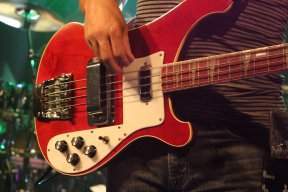
I play both and go back and forth. I think because I started on a 5 string, I think of it as my normal type of bass. When I bought my first 4 string bass (Rickenbacker), I did have some reservations. Over time, I really move back and forth between them without much thought.

Literally, you can play 5 extra notes on a 5 string bass. I find the more useful part of it above the 5th fret to make playing without changing positions easier. I also think it is more natural for me to play a 5 string than a 4 string in drop D. I play the music the way I want to and don't really get as caught up in thinking it was played this one way so it can only be played the way it originally was.

Regarding right hand technique, my overall technique stays the same. I play with a floating thumb most of the time, but on a 5 string it rests on the B string a bit more than it does the E string.
 
I am amazed at how many people think five string basses are something new. Five-string contrabasses have been used in the classical world since the 18th century.

Most of us haven't been around since the 18th century. If your instrument is bass guitar and your genre is one like blues or rock, the basses were just about always 4 strings until the 80s, when 5s started catching on. By then some of the older members of this forum had already been playing for 20 years. It was new to them.
 
  • Like
Reactions: Thisguy
I'd played bass for almost 30 years when I got my first fiver. On Monday I played 4 string. On Tuesday, I played 5 string. No problem experienced.
I chalk it up to the fact that I also played 6 string guitar (mostly acoustic, but not exclusively), which had allowed me to be fairly nimble and flexible with various string instruments, and played comfortably with a pick or fingers ( only decent w/slap). It presented no challenge to add a string to my bass.
Use-wise, I typically use the low B as an extension, meaning it comes into play for notes lower than the low E.
I have had an experience working as a sub with a dance oriented pop/disco band where the first song was counted in and I started playing and 1 1/2 measures in found that the band was tuned down a half step and the song was in key of E. Had I not been paranoid enough to be playing a 5 instead of my more usual (with other bands) 4 it could have been ugly. I'd just followed my instincts about the situation. It paid off.
 

Latest posts