• TalkBass has been independent since 1998. Add your voice.
    Create a free account to reply to discussions, view embedded media, and browse with fewer display ads.
    Join freeLog in
    Want zero display ads or expanded classifieds tools? Compare plans.

Radial DI box vs. Combo Direct out

Jan 15, 2019
3,765
6,559
I play with a community big band jazz group that only plays a few times each year. For most gigs we play without a house system and I use my Ampeg Rocket Bass combo. We have an upcoming gig at a club that has a sound guy and full house system. This will be my second time to play there. Last time I just took my smaller combo amp and the sound guy connected to the DI output on the amp. The downside is that amp does not have a fixed level output - it is affected by the combo volume knob. I also have a Radial Pro48 that operates from phantom power. Looking for suggestions on which approach is better for the sound guy and how to use the DI box.

I haven't actually used the DI box before. I figured I would just use the "Thru" output directly to the input on my combo. Going this route, the board would get the direct bass output without any coloring from the Ampeg. Is that the way to go? Or should I connect it to the FX output. (or some other way). Or I can just leave the DI box at home.

Thanks for help on this - I'm pretty much ignorant about live sound.

This is the box I have.
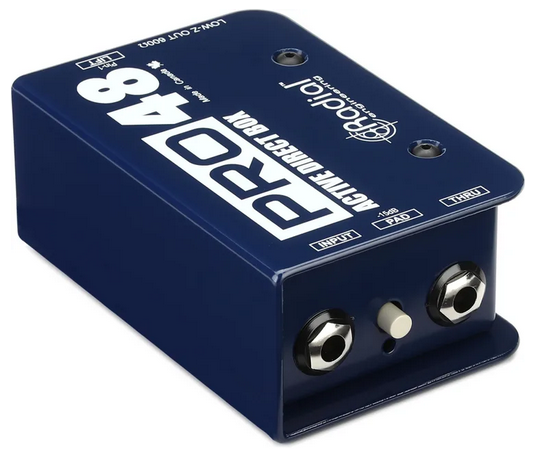
1781622554207.png
 
  • Like
Reactions: One Way and Zbysek
well, generally a pre-eq and volume DI box allows you to tweak your sound on stage without breaking the FoH.

the FX loop is after the volume, drive and EQ per your amp's manual, so isn't any different from the combo's DI.
just plug it in the front.

this said, you might want to use drive from your amp to be heard in the FoH, in that case use amp's DI and try not to tweak it after the soundcheck.
 
  • Like
Reactions: skycruiser
well, generally a pre-eq and volume DI box allows you to tweak your sound on stage without breaking the FoH.

the FX loop is after the volume, drive and EQ per your amp's manual, so isn't any different from the combo's DI.
just plug it in the front.

this said, you might want to use drive from your amp to be heard in the FoH, in that case use amp's DI and try not to tweak it after the soundcheck.
I play with a clean sound, no drive at all. And pretty much flat EQ.

Last time a monitor was provided but my own amp was my primary bass monitor. It would be nice to be able to fiddle with the volume without affecting the house audio. So in that case sending him the DI box output may be be the better approach.
 
I play with a community big band jazz group that only plays a few times each year. For most gigs we play without a house system and I use my Ampeg Rocket Bass combo. We have an upcoming gig at a club that has a sound guy and full house system. This will be my second time to play there. Last time I just took my smaller combo amp and the sound guy connected to the DI output on the amp. The downside is that amp does not have a fixed level output - it is affected by the combo volume knob. I also have a Radial Pro48 that operates from phantom power. Looking for suggestions on which approach is better for the sound guy and how to use the DI box.

I haven't actually used the DI box before. I figured I would just use the "Thru" output directly to the input on my combo. Going this route, the board would get the direct bass output without any coloring from the Ampeg. Is that the way to go? Or should I connect it to the FX output. (or some other way). Or I can just leave the DI box at home.

Thanks for help on this - I'm pretty much ignorant about live sound.

This is the box I have.
View attachment 7516855
DI to FOH and pass thru to your amp
 
well, generally a pre-eq and volume DI box allows you to tweak your sound on stage without breaking the FoH.

the FX loop is after the volume, drive and EQ per your amp's manual, so isn't any different from the combo's DI.
just plug it in the front.

this said, you might want to use drive from your amp to be heard in the FoH, in that case use amp's DI and try not to tweak it after the soundcheck.
Let FOH worry about making you heard. Adding dirt "to be heard" is generally not a good plan. It will get you turned down as often as not
 
  • Like
Reactions: s0c9
I play with a community big band jazz group that only plays a few times each year. For most gigs we play without a house system and I use my Ampeg Rocket Bass combo. We have an upcoming gig at a club that has a sound guy and full house system. This will be my second time to play there. Last time I just took my smaller combo amp and the sound guy connected to the DI output on the amp. The downside is that amp does not have a fixed level output - it is affected by the combo volume knob. I also have a Radial Pro48 that operates from phantom power. Looking for suggestions on which approach is better for the sound guy and how to use the DI box.

I haven't actually used the DI box before. I figured I would just use the "Thru" output directly to the input on my combo. Going this route, the board would get the direct bass output without any coloring from the Ampeg. Is that the way to go? Or should I connect it to the FX output. (or some other way). Or I can just leave the DI box at home.

Thanks for help on this - I'm pretty much ignorant about live sound.

This is the box I have.

View attachment 7516855
I do own one of these Pro48's and like it a lot for a simple and straightforward DI box. As already been suggested, XLR out to FOH and THRU out into the front of the amp for full control for stage without affecting FOH. I actually like this little uncomplicated box enough to have ordered another one to help a local church with their stage setup for bass.
 
  • Like
Reactions: skycruiser
If the choice is between Pre DI from an amp VS passive DI. Try both and choose whichever sounds best. DIs on some amps are very good. But IME the quality varies a lot, and some are pretty bad. My perception is amp DIs tend to have a higher tendency for noise and ground loops. So if you have to make a decision without the ability to test, use the DI.

Also not a bad to carry the DI in case you get an unresolvable ground loop with the amp. Sometimes a DI will not have the same problem.

Good luck!
 
DI outputs in modern amps are generally good. But the one in your Ampeg is indeed post-master volume, which does constrain your flexibility. The Radial is a great DI; in your situation I’d recommend running an output from the effects loop output to the DI.

Is there a difference between running the FX out to the DI box and using the built in DI on the amp? Based on the schematic they are both post volume/eq.

1781633698769.png
 
If he's going direct in, the only one using your amp is you. Do you need the amp to hear yourself on stage, or can you get away with floor monitors or whatever the venue is supplying?
We were not able to do a very thorough sound check to set the monitor mix last time. So I'd like to be able to adjust my combo volume just in case I have trouble hearing myself.
 
In general I prefer to use a DI between my bass and the amp. This allows me to adjust my amp without effecting the signal going to FOH. IME experience, this is the most preferred method among audio techs as it gives them a more consistent, unprocessed signal that is easier to work with.

I don't use drive or other effects. I do make subtle tone tweaks using the controls on my bass to better suit different songs. If I need general changes on stage, like more volume or more treble, I reach for the amp's controls.

There are viable reasons to use a Post EQ DI. The most valid is if you rely on the preamp in your amp to produce drive or harmonic content. If you are using a pedal board for effects, in most instances I suggest placing the DI after the pedals, but before the amp.

I would caution that if you are not using a bass cab that is essentially full-range, flat-response, Post EQ is not going to accurately capture the tone you hear on stage. Many bass cabs are fairly heavily voice and filter the highs and lows. A post EQ DI does not capture the tone shaping provide by the cab and may actually represent the opposite of what you want.
 
DI outputs in modern amps are generally good. But the one in your Ampeg is indeed post-master volume, which does constrain your flexibility. The Radial is a great DI; in your situation I’d recommend running an output from the effects loop output to the DI.
Why? It will still have the same issue with output varying with amp volume changes
 
If you do change it, the soundman does his or her job. Pretty easy.

I tends to be messier than this implies.

If all the bassist does is change volume, it's an easy fix if the bass is only going through the FOH system. If bass is going through the monitors, the audio tech has to guess as they cannot hear how the bass balances in each of the monitor mixes on stage. Normally if the bass bumps the level of their DI send to FOH, I reach for the input trimmer on the channel. I bring it down to provide about the same balance in the mains with the idea that it will also rebalance all of the monitors. My impression is this works pretty well, but it's not 100% accurate. Often good enough though.

If the bassist messes with the amp's tone controls with post EQ DI, it tends to be a lot more difficult. IME it's not easy to get bass to sound good live, and it's really frustrating to put in a lot of effort only to have the bassist invalidate all of the work by fiddling with the amp's tone controls.

You may point out that guitar is mic'ed, so adjustment to the guitar amp made during the show are essentially post EQ. This is true, but IME it's usually way easier to massage guitar back into shape. Way less of a problem dealing with a post EQ signal from guitar.

As I pointed out earlier, unless you are using a full-range, flat-response cab, post DI does not accurately represent the tone you hear on stage anyway. I will repeat: "IT'S NOT THE SOUND OF YOUR FULL RIG!" Instead, it's unfiltered sound of your amp before you cab and the acoustic environment works it's mojo.
 
I tends to be messier than this implies.

If all the bassist does is change volume, it's an easy fix if the bass is only going through the FOH system. If bass is going through the monitors, the audio tech has to guess as they cannot hear how the bass balances in each of the monitor mixes on stage. Normally if the bass bumps the level of their DI send to FOH, I reach for the input trimmer on the channel. I bring it down to provide about the same balance in the mains with the idea that it will also rebalance all of the monitors. My impression is this works pretty well, but it's not 100% accurate. Often good enough though.

If the bassist messes with the amp's tone controls with post EQ DI, it tends to be a lot more difficult. IME it's not easy to get bass to sound good live, and it's really frustrating to put in a lot of effort only to have the bassist invalidate all of the work by fiddling with the amp's tone controls.

You may point out that guitar is mic'ed, so adjustment to the guitar amp made during the show are essentially post EQ. This is true, but IME it's usually way easier to massage guitar back into shape. Way less of a problem dealing with a post EQ signal from guitar.

As I pointed out earlier, unless you are using a full-range, flat-response cab, post DI does not accurately represent the tone you hear on stage anyway. I will repeat: "IT'S NOT THE SOUND OF YOUR FULL RIG!" Instead, it's unfiltered sound of your amp before you cab and the acoustic environment works it's mojo.
I've had good luck with it in the past, but then, I don't mess with my amp after it's set. Other people do things differently. I get that.