• TalkBass has been independent since 1998. Add your voice.
    Create a free account to reply to discussions, view embedded media, and browse with fewer display ads.
    Join freeLog in
    Want zero display ads or expanded classifieds tools? Compare plans.

Request Ramones - Teenage Labotomy

At some point in your career (even if the height of your career is having a beer with some friends and jamming a bit) you will need to be able to play by ear - listen to a tune and play something that fits. A Ramones tune (pretty much any Ramones tune) would be ideal for starting that process. 40 years after I started this, that skill is still the most important skill in my arsenal.

Process: Play along. You suck? Of course, you do, we all do when we start. Try again. One less mistake? Good, you're making progress. Keep going, you'll get there.
Thanks for all the help so much inspiration to keep me going.
Good luck and rock on.
 
  • Like
Reactions: Spidey2112
Dear OP;
Welcome to Bassdom! It's a wonderful/frustrating/awesome/loathsome...place. I'm glad you sought out advice & help. Some people get frustrated & just give up; you didn't do that. There are a lot of great & helpful suggestions in the preceding posts. Try to take all of them with a kernel of salt, but remember if you disagree with someone, it doesn't make them wrong (doesn't necessarily make them right either).
My advice as a salty, grizzled 30 year vet;
1) Always remember that you're doing this because it's FUN & rewarding. It is hard work at the beginning, but the payoffs are pretty sweet.
2) Never be afraid to try something that a more experienced player suggests. Some things will work for you, some won't, but you'll learn something every time.
3) Be open to ALL kinds of music, playing styles, lessons, & genres. I'm still amazed at the amount of things I've picked up along the way from styles I wasn't all that into.
4) I said it before, I'll say again; HAVE FUN!
I know this post is a little off-topic (sorry), but I think a bit of encouragement can go a long way. Again, welcome to the club!
K J
 
Dear OP;
Welcome to Bassdom! It's a wonderful/frustrating/awesome/loathsome...place. I'm glad you sought out advice & help. Some people get frustrated & just give up; you didn't do that. There are a lot of great & helpful suggestions in the preceding posts. Try to take all of them with a kernel of salt, but remember if you disagree with someone, it doesn't make them wrong (doesn't necessarily make them right either).
My advice as a salty, grizzled 30 year vet;
1) Always remember that you're doing this because it's FUN & rewarding. It is hard work at the beginning, but the payoffs are pretty sweet.
2) Never be afraid to try something that a more experienced player suggests. Some things will work for you, some won't, but you'll learn something every time.
3) Be open to ALL kinds of music, playing styles, lessons, & genres. I'm still amazed at the amount of things I've picked up along the way from styles I wasn't all that into.
4) I said it before, I'll say again; HAVE FUN!
I know this post is a little off-topic (sorry), but I think a bit of encouragement can go a long way. Again, welcome to the club!
K J
Thanks man. Have a great day.
 
Thanks for all the help so much inspiration to keep me going.
Good luck and rock on.

You're welcome.

There's a really cool thing that comes when you learn to play by ear. It takes a while, but when you start to get it, notes just seem to "fall under your fingers" - things become more and more automatic over time. That's when music starts to become fun - what you're thinking comes out of your hands; it's no longer a technical thinking process that you have to work at. The shortest path to that "flow" state is learning to play by ear, which is, unfortunately, a trial and error process - there's no real way to short cut it. In the long run, if you persist, though, it's well worth it.
 
OP, instead of getting into the habit of reaching for tabs, watch some bass covers on YouTube. It's kinda like receiving a lesson (provided they play it correctly). The videos will also, generally, increase the overall bass volume, so it might be easier to train your ear.


I'll wager, without watching the video, that he's probably spot on, or really close.

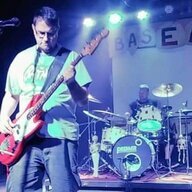
Why? Because of the DIY duct tape tumor that he's crafted to anchor both ends of his strap! That's like 400-500 punk points right there, even before parsing the sharpie written all over the tumor...

EDIT:;)
 
I disagree. OP could be trying to learn Lobotomy or Teen Town at the moment. They are at the base of a fairly steep learning curve, which ever way you cut it. They can't currently follow tab, and some other options have been put on the table. There isn't a quick fix or cheat-code solution to OP's problem, regardless of the complexity (or otherwise) of what they want to learn. OP has turned up to the job without the necessary tools, and there are ways and means by which they can get those tools together. This isn't a personal attack on OP, just an observation.

And, in a weird way, a Ramones tune is probably difficult to work out from TAB if you have limited skills in this department. It would be like trying to piece together one of those jigsaws of a plate of beans or an empty blue sky. Lots of root notes, very little embellishment. You need to play 16 E notes... if your ear isn't yet trained into this way of thinking then you count out each of those 16 notes.
lsson.

Fair points, all of this, but I bristle at the thought of a young player being discouraged by being told he or she has to get a teacher or dive into a formal study of theory if maybe all they want to do is have some fun with friends playing a Ramones song. I am not anti- lessons in the least, I just know that I couldn't afford them when I started (and there were no bass teachers in the woods where I grew up, either). I thought some of the people posting in the thread were being unhelpful verging on dickhead with all that "if you can't figure out, maybe you shouldn't be playing bass" and "it's JUST a Ramones song" crap. There are no formal credentials required to be a certfied bass player. as far as I know. After doing it for 35 years, I give the OP permission to play bass and just have fun.
 
Tabs for a Ramones song? Does it get any easier?

Just curious, what do you think this contributes to this thread? Do you think it helps in any way? Does it make any contribution at all? I certainly can't imagine it makes anyone think very highly of you as a person or a player. Is the idea to make a young player feel bad and regret asking for help? And then that makes you look cooler or something?
 
At some point in your career (even if the height of your career is having a beer with some friends and jamming a bit) you will need to be able to play by ear - listen to a tune and play something that fits. A Ramones tune (pretty much any Ramones tune) would be ideal for starting that process. 40 years after I started this, that skill is still the most important skill in my arsenal.

Process: Play along. You suck? Of course, you do, we all do when we start. Try again. One less mistake? Good, you're making progress. Keep going, you'll get there.
I do agree that you need to be able to play by ear, but taking lessons, learning scales and chords makes that much easier. Trial and error is the hard way to learn. If you understand scales and chords, it gives you a frame of reference and a first logical place to look for the notes you are trying to figure out by ear. I've seen some unschooled musicians try to figure something out and it's just painful, NOT to say that is the case for ALL unschooled musicians.

Fair points, all of this, but I bristle at the thought of a young player being discouraged by being told he or she has to get a teacher or dive into a formal study of theory if maybe all they want to do is have some fun with friends playing a Ramones song.
There is a HUGE difference between telling someone they should get a teacher and telling them they need to start a formal study of theory. And having a basic skill level will make it more fun to play music with your friends. In one of my first bands we all decided to take lessons. It was extremely helpful.
 
  • Like
Reactions: Spidey2112
I do agree that you need to be able to play by ear, but taking lessons, learning scales and chords makes that much easier.

I'll respectfully disagree. I was a classically trained violinist, but that training never really helped me learn to play by ear. Totally separate things - at least the way my brain works.
 
I'm not sure how it couldn't help, but of course you are entitled to your opinion.

Classical training teaches you how to take something that you see on paper, and turn it into notes. You read a bit ahead, so you know what's coming up - there's no guesswork. You don't develop the aural relationships of various pitch intervals this way, and you don't have to anticipate anything. It's all on paper.

Playing by ear, you have nothing to look at - the input is what you're hearing, and anticipating what's next. It's a very different skill set.

One of the interesting things about learning to play by ear is that, without practicing scales, you learn them. The relationships of the notes (which is what scales are about) get drilled into your brain subconsciously. I regularly play in pretty much every key - church gigs, where you play the same songs a lot, but the singers get to dictate keys (which change every week) does this to you.
 
Classical training teaches you how to take something that you see on paper, and turn it into notes. You read a bit ahead, so you know what's coming up - there's no guesswork. You don't develop the aural relationships of various pitch intervals this way, and you don't have to anticipate anything. It's all on paper.

Playing by ear, you have nothing to look at - the input is what you're hearing, and anticipating what's next. It's a very different skill set.
You're only half right here. Classical training does teach you how to turn something on paper into notes, but Classical training includes ear training, so you should know what something sounds like before you play it; i.e. aural relationships. However, I never said that training as a classical musician helps with learning a song by ear, I said that knowing your scales and chords helps.
One of the interesting things about learning to play by ear is that, without practicing scales, you learn them. The relationships of the notes (which is what scales are about) get drilled into your brain subconsciously. I regularly play in pretty much every key - church gigs, where you play the same songs a lot, but the singers get to dictate keys (which change every week) does this to you.
I've never known anyone that learned scales without practicing them. I'm not sure how that would even work. I suppose with enough trial and error you'd figure it out eventually.

But back to my original comment, which I stand by; If you understand scales and chords, it gives you a frame of reference and a first logical place to look for the notes you are trying to figure out by ear. If you know that the first notes in an E scale are E, F#, G#, A and you are listening to and trying to learn a line that is walking from E to A, knowing your scale gives you a pretty good idea of where you can start. And if you know your E-7 flat 5 chord is E, G, B flat, D and you are trying to figure out a line over E-7 flat 5, that also gives you a pretty good idea of where to start.

It's never just either or. If you want to be a well rounded musician, you need to have a good ear and know what you are playing.
 
I've never known anyone that learned scales without practicing them. I'm not sure how that would even work.

Well, you do now. Hi! I'm Micguy, and having played lots of stuff in every key for a few years, I play scales much better than I ever did when I practiced them regularly. Yes, practicing scales can help you move around an instrument better, but learning to move around an instrument better also makes you better at scales. The thing that playing by ear works better at is intervals that aren't half or whole steps - as you do those all the time playing music, that training is more complete than practicing scales, which move a half or whole step at a time.

Music theory is a backwards thing from what most people think. It's derived from practice,not the other way around. The practice existed long before people ever developed a theory to explain things. Octaves, thirds, fourths, and fifths sound good - why? It's because the frequencies of the two notes in those intervals have frequency relationships that are small number integer ratios of each other. That coupled with our ears being attuned to those relationships, certain intervals sound better to us than others. Chords are simply groups of notes that sound good when played together - people learned what notes sounded good together long before anyone developed a theory to explain why.

If you want to be a well rounded musician, you need to have a good ear and know what you are playing.

Thousands of years ago, although people could intuit some of those relationships, due to string lengths, pipe lengths, and such, nobody had a frequency counter to really know what frequencies were being played, but primitive people knew certain things sounded good. They, to use your words, knew what they were playing, even if terms hadn't been invented for it yet. The point is, music theory exists as a way to explain what works in practice, not the other way around. Theory can be invoked to explain why something sounds good, but "sounds good" came a long time before theory; a lot of folks seem to forget that, and think that theory is somehow vital to being a good musician, and should always be taught first. Humanity didn't learn to make music in that order - good musicians existed eons before people knew music theory.
 
so you're learning how to play bass like I learned out how to play bass/guitar - making a lot of noise trying to play along to your favorite songs (my first band only "knew" one song, 'smells like teen spirit,' and we would play it for HOURS in the drummer's garage). eventually we all grew as musicians
personally, I had maybe 6 months of guitar lessons prior to that where I learned what tab was and that was about all I was interested in (not being able to shred from jump didn't help somebody so into instant gratificationh
I've learned by playing along to music or just playing and hearing what sucks or what sounds good
I did take a few music theory courses and aced them even though I can't read music because it's all algebra
playing with other folks is what kept me interested and helped me get better - like the other guy, I play in a worship band at church where I know most of the songs but the keys change based on what the singer(s) that week think they can sing. sometimes i 'borrow' a note from another key, but I value 'mistakes' like these as learning experiences, especially in not making a stank face and/or beating myself up. it's only music

welcome, but. turn it up until your mom yells!