• TalkBass has been independent since 1998. Add your voice.
    Create a free account to reply to discussions, view embedded media, and browse with fewer display ads.
    Join freeLog in
    Want zero display ads or expanded classifieds tools? Compare plans.

Ray does not like this battery (or vice-versa)

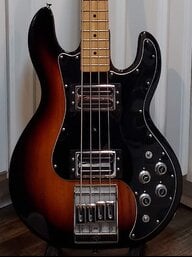
Sbmm....at least the 2 I own and the few that I've played at stores all have a battery snap.
I too use 1000aH rechargeable batteries with no problems, but I have heard and read about the ultra lithium batteries being problematic and that standard alkaline batteries were recommended by the manufacturer. I haven't needed to dig into the science of it all, but I'm sure there's something to it, as the issue seems to come up for effects pedals, wireless units and other 9v products.
 
I don't recall the battery brand that this happened with but, I did have an issue of my KH4 making all kinds of bizarre scratching and ticks all the sudden and when we went through it, it was one of the batteries making all the problems. We think maybe internally a connector wire came loose, but who knows. We replaced it and time has moved on...just one more thing we check when things come up now. I know people have their 'brand' they trust, but I typically buy what's on sale at the moment...as long as its Duracell or Energizer, but that said, I always have about eight 9-volts and ten AA's on-hand at any given day.
 
Another version of this has been an issue for years. There are slight sizing differences in 9V batteries. Also, some battery boxes have terminal "holes" that fit Energizers better than Duracels (or the other way around). For a time, the terminals themselves were shaped differently. Some had a more square minus terminal. There was even talk of a conspiracy at one point in the 80s by manufacturers to force users to use one brand or another based on that difference.

Some Lithium batteries have an additional protection circuit in them to prevent them from overheating/overloading because they can fail differently than an Alkaline that's been abused. I suspect that special circuit may be what's interfering with some music applications.
 
  • Like
Reactions: Kipp Harrington
I would say 8/10 times it's the chemical composition making it sound different, not the size of the battery, I literally stick batteries halfway out of my bass sometimes as long as the metal is touching and not sliding around, there is no sound difference IME. In fact the batteries I use that work best are rechargeable NiMH that hardly fit in any bass because they're so big.
 
Hmm, my recollection, at least from the flashlight world, is that it's actually the opposite: alkaline slowly drops, lithium is nearly constant until blam, dead.
Also- many lithium battery “packs” such as those used in power tools shut off (with a transistor) when the voltage drops below a safe operating level. This is to prevent overheating and fire.

Edit: yep, validated via the interwebs:
View attachment 4755542
 
I would say 8/10 times it's the chemical composition making it sound different, not the size of the battery
I'm not a battery nerd, so I can't get too far into the weeds with this. But I do know enough about the subject to say the following:
The preamp and other electronic devices run on electricity. The chemical makeup of a battery only has to do with how the battery produces the electricity and how it recharges if it's rechargeable. The device using the electricity doesn't see, know or care about the chemical makeup of the source or how the electricity is being made. It just cares that it's getting the electrical current it needs to operate.
So, as long as the preamp is getting it's 9vdc, it wouldn't matter if the battery is lithium, nickel, lead,cheese, a little windmill, phantom power from an amp, a 9v transformer plugged into120vac, etc.
That's the simplest way to put it. I know this stuff in a little more detail, but it's long winded and boring. I generally just educate myself on a subject right up to the point that I know enough to make informed decisions. So, I haven't gone full battery geek. I had to research batteries when I was installing an auxiliary 12v system in a van I'm turning into a camper. I learned what I needed and got out of there. Some of those folks are intense. I also researched a bunch 20 years ago when I was thinking of building a small windmill generator.
Also, I've been in the trades all my life and have done a lot of 120/220vac work. Electricity is electricity and the principals all apply.
Hope that helps.
And I would bust your chops about the 8/10 times thing, but we've never spoken before and you might take it the wrong way ;)
 
One possibility that popped in my head is that preamps likely have a range of voltage that they will operate properly in.
I'll make up a number, say, 8-10vdc. Anything above or below could cause issues. Different preamps might have different tolerances.
Perhaps, some lithium batteries start out at a higher voltage that cause some preamps to throw a fit? I dunno, just spit ballin. Someone more knowledgeable would have to chime in.
 
  • Like
Reactions: Kipp Harrington
I've used those Energizer Lithiums in various basses for over a decade.... Laklands, StingRays, etc. Also in my Countryman Type85 DI and other effects pedals. Never once had any of those issues. The ONLY issue - as others have pointed out - is that the battery body/case itself is a bit bigger and fits more snugly in some battery boxes vs others. That said, a more snug fit should ensure a more secure connection.... thus reducing the chance of shorts or dropouts as you experienced.
 
...
The chemical makeup of a battery only has to do with how the battery produces the electricity and how it recharges if it's rechargeable. The device using the electricity doesn't see, know or care about the chemical makeup of the source or how the electricity is being made. It just cares that it's getting the electrical current it needs to operate.
...

99% yes and 1% no. The chemical makeup does affect the internal resistance which in turn affects the ability of the battery to meet instantaneous current demands and any associated voltage drop. With most batteries, the internal resistance increases over time as the battery becomes discharged. So not only does the static voltage fall away, the ability to deliver current also declines. So not all types will deliver current in the same way. So agree when the batteries are in a relatively fresh state, but disagree when they start to decline - I would expect to see (and hear) differences in how the circuits behave, especially towards the bitter end of the discharge cycle.

That said, the current demands of the SBMM and EBMM preamps are so low that the internal resistance in the circuit has no real significance.
 
Last edited: