• TalkBass has been independent since 1998. Add your voice.
    Create a free account to reply to discussions, view embedded media, and browse with fewer display ads.
    Join freeLog in
    Want zero display ads or expanded classifieds tools? Compare plans.

Double Bass Reaching 5th position on DB for the vertically challenged!

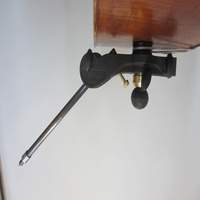
That bass does look a bit large for you and it's probably not necessary, but a 5/8's would probably be more comfortable for you. That said, if you teacher hasn't suggested it yet, you might experiment with sitting for two reasons: it's a good skill to be able to sit or stand - sometimes, you're just tired of standing! and second, it'll give you an idea about how much better or not your reach and comfort will be. If sitting does work for you, then you can take much of what you learn to your standing position. A bent endpin can help with leaning the bass back into you. Bent endpins are also called Laborie endpins. I have one called a Lammax endpin. It's expensive but I think priced fairly for what it is and it works great for me. Here's a pic:

lammax3.jpg
 
I agree with @damonsmith on this one. It’s all about the angle of the bass. Check out Lorraine Campet at about 4:10 in this video:


I was in the second row for this concert, and met her the next day - she’s no taller than you, and may even be shorter. But she plays the daylights out of the entire range of the bass. I was watching her manipulate the bass to reach different registers, and she has a very fluid choreography with how she positions the bass to reach certain registers. This was of special interest to me as I had several students who stood 5’0” at the time. It can definitely be done!
 
I agree with @damonsmith on this one. It’s all about the angle of the bass. Check out Lorraine Campet at about 4:10 in this video:


I was in the second row for this concert, and met her the next day - she’s no taller than you, and may even be shorter. But she plays the daylights out of the entire range of the bass. I was watching her manipulate the bass to reach different registers, and she has a very fluid choreography with how she positions the bass to reach certain registers. This was of special interest to me as I had several students who stood 5’0” at the time. It can definitely be done!


That's really useful, thanks! I've been looking for videos of women playing DB, and there aren't many that actually have useful camera angles. Jane Little is an obvious example. There are some of Esperanza Spalding - she's 5'6", and I notice she's often (but not always) wearing high heels. Raises the interesting question of if you change position according to your footwear that night!!
 
  • Like
Reactions: Chris Fitzgerald
I agree with @damonsmith on this one. It’s all about the angle of the bass. Check out Lorraine Campet at about 4:10 in this video:


I was in the second row for this concert, and met her the next day - she’s no taller than you, and may even be shorter. But she plays the daylights out of the entire range of the bass. I was watching her manipulate the bass to reach different registers, and she has a very fluid choreography with how she positions the bass to reach certain registers. This was of special interest to me as I had several students who stood 5’0” at the time. It can definitely be done!


AHA! Yes, changing the hold according to where she's working. That's great. Rather than one-stance-for-all.
 
  • Like
Reactions: Chris Fitzgerald
That bass does look a bit large for you and it's probably not necessary, but a 5/8's would probably be more comfortable for you. That said, if you teacher hasn't suggested it yet, you might experiment with sitting for two reasons: it's a good skill to be able to sit or stand - sometimes, you're just tired of standing! and second, it'll give you an idea about how much better or not your reach and comfort will be. If sitting does work for you, then you can take much of what you learn to your standing position. A bent endpin can help with leaning the bass back into you. Bent endpins are also called Laborie endpins. I have one called a Lammax endpin. It's expensive but I think priced fairly for what it is and it works great for me. Here's a pic:

View attachment 3671732

That looks interesting. As far as I've found, it's about $600? That may be for down the road a little.
 
That's really useful, thanks! I've been looking for videos of women playing DB, and there aren't many that actually have useful camera angles. Jane Little is an obvious example. There are some of Esperanza Spalding - she's 5'6", and I notice she's often (but not always) wearing high heels. Raises the interesting question of if you change position according to your footwear that night!!


I noticed the heels right away as well in the Lorraine Campet vidoe, and I would expect an end pin adjustment if she decided to wear flats.
 
  • Like
Reactions: Chris Fitzgerald
That looks interesting. As far as I've found, it's about $600? That may be for down the road a little.
Yes, $500 to $600 USD. There are other solutions and probably most are cheaper and also very good for their niche in the market, and yes, I think I'd recommend that you continue to experiment while working with your teacher before you spend any money. If your teacher will explain your goals, you, a mirror, a bow and a curious mind will get you a long way to your goals with your current bass, IME. And don't be surprised if you finally feel that you've got it all sorted out only to start considering something slightly different.
 
  • Like
Reactions: Bass Momma
@Bass Momma - one of my smaller-statured students, the one who played standing, was constantly struggling with how to set the endpin in order to find the place where both of her arms could reach where they needed to go. If the pin was set too low, she couldn't reach down to the bridge to comfortably get the bow where it needed to be. If she set it higher, she was having to reach way over her head to reach notes with the left hand in the lower positions. I don't know that she ever solved this issue (she is no longer at my school and I haven't seen her for nearly a year) because she was hesitant to experiment with angling the bass either from a standing or seated position.

The other one, a classical bassist studying jazz as a secondary interest, is a force of nature and will not be stopped in any endeavor. She found a way to play seated that allows her access to all registers of the bass. We spent a fair amount of time talking about the mechanics of seated playing, and how the tilt of the torso on the seat combined with an ergonomic angle of the bass can allow the body to be in position to play in all registers. I sent her a video of Ms. Campet after witnessing that brilliant performance with a note about how all of that seated ergonomic theory can translate to the standing posture. She still plays seated, but I'm sure she learned a few things from it, as anyone who actually watches that aspect of the performance would if they were watching it through that lens.

One thing that I advise all students to be aware of is the geometry and mechanism they are working with. With smaller-statured students, I measure their wingspans and advise them to use these resources very judiciously because unlike longer limbed bassists, they have less to waste. For example, the two students above have spans of 62" and 60", respectively, compared to my 74" span. For this reason, teachers need to be aware that what works for them may not necessarily work for their students and vice versa. A good teacher should be aware of this and work with the student with the geometry they actually have to work with in mind.
 
@Bass Momma - one of my smaller-statured students, the one who played standing, was constantly struggling with how to set the endpin in order to find the place where both of her arms could reach where they needed to go. If the pin was set too low, she couldn't reach down to the bridge to comfortably get the bow where it needed to be. If she set it higher, she was having to reach way over her head to reach notes with the left hand in the lower positions....

...For this reason, teachers need to be aware that what works for them may not necessarily work for their students and vice versa. A good teacher should be aware of this and work with the student with the geometry they actually have to work with in mind.

There can be other factors; for example, I'm not short (5'9") and I've got long arms (72" span - yes, still more evidence humans descended from the apes) but I've also got two bum shoulders. So with my normal string length 3/4 bass, I have to set it lower than ideal so I'm not reaching back up over my head in the lowest positions - that would kill my shoulder. This means I have to bend over more than I should in general bowing and especially when I venture into thumb position. Playing with a compromise position is better than not playing at all which is what would happen if that shoulder impingement gets lit up again.
 
  • Like
Reactions: Chris Fitzgerald
@turf3 I completely agree. Have been nursing a jacked up shoulder for the past 10 months (It's back to about 85% at this point, which I am grateful for), and it really made me focus more on the "torso pivoting" part of my seated technique to take the pressure off of it. In the the game of "DB technique rock-paper-scissors", injuries are Dynamite and always win the day!
 
... In the the game of "DB technique rock-paper-scissors", injuries are Dynamite and always win the day!

Yup. I'm still nursing some arthritis-induced trigger-fingers, which according to my doc are probably going to be forever unless I opt for some risky hand surgery... So for me, the rule is: find a way to play on! I remember my 94-year old mom telling me, "Getting old is not for youngsters!"

My advice to the OP: don't forget to preserve your hands.
 
Yup. I'm still nursing some arthritis-induced trigger-fingers, which according to my doc are probably going to be forever unless I opt for some risky hand surgery... So for me, the rule is: find a way to play on! I remember my 94-year old mom telling me, "Getting old is not for youngsters!"

My advice to the OP: don't forget to preserve your hands.

Yes indeed! It's a real exploration process to figure out how to make this work with the body one has... compromise and perseverance.
 

Latest posts