If you want to excel, there is no substitute to learning the fretboard. You can't get improve by guessing. A lot of work, to be sure. Depends how hard you're willing to go. Learning theory will help as well. Good luck!Pianists have it so easy, mentally, when it comes to reading music. They have all the notes sitting there in a single row, and musical notation relates to the layout of those black & white notes on a keyboard.
Not so easy for bassists and guitarists. My reading method is a cumbersome hybrid. Can I do better? Here's what I do.
For positions near the nut, I simply know all the notes. So no problem (except I'm not good at reading complex rhythms, but that's another story).
For higher positions, I don't know all the notes, and use a different approach, which I'll illustrate for the case where the key is Ab major. I know how to play a major scale in a general position on the fingerboard - with different versions to allow for choice of string to have the keynote on. I do know the notes all the way up the lowest string, and can use that to pick a position so that my general way of playing a major scale comes out in Ab (and ideally I won't have to change to another position too often). Now suppose I'm reading a bar with the notes C-Db-Eb; I know that in Ab, C-Db-Eb is mi-fa-so (in terms of do-re-mi and all that); so I play mi-fa-so.
Well it's not a single-stage process. It requires a bit of knowledge of keys, scales and fingerboard. It can facilitate transposing, though. On the other hand, I can struggle greatly with music that isn't really in any key.
If I follow this approach for years, will I end up having learned the notes in all positions?

Enjoy the benefits of a premium membership!
Upgrade Account
-
TalkBass has been independent since 1998. Add your voice.
Create a free account to reply to discussions, view embedded media, and browse with fewer display ads.
Join free Log in
Want zero display ads or expanded classifieds tools? Compare plans.
You are using an out of date browser. It may not display this or other websites correctly.
You should upgrade or use an alternative browser.
You should upgrade or use an alternative browser.
More options
Who Replied?
I play all three of the referenced instruments, bass, guitar and keys. I learned how to read on piano at a very early age. When it came time to learn addition instruments I didn't know any other way than to learn where the notes are and then start reading. I really can't image life without reading standard notation.Was your remark from knowledge of guitarists? Mine was to an extent. I know of arguments between guitarists about the best reading method.
Last edited:

I find that working on my reading is helping me learn the upper fret board.
I've been reading music on keys (since I was about 6) and horns (since I was 13) and later on guitar. I at one point I was fluent in all clefs and key base (Bb or Eb horn parts). My primary tool on guitar and bass for "understanding" the fret board was using pattern recognition. Play "X" pattern for a major scale. Start it on C or Eb it makes no difference. This allowed me to easily transpose most any song easily. I knew I was functioning in the new key, but didn't really actively know all the noted I was playing. If anything, I knew it was the I or the V or the vi etc. It took some analysis to determine what the actual notes were.
In the last year, I've been working some jazz stuff and the Real book came into my life. I've been working on my reading with this and it is coming along. I still read very slow (nearly 30 years since I last tried to read music) and there's no way I could site read bass lines in a live situation, but I am getting familiar with what the notes are between the 5 and 12 frets and even becoming familiar up to fret 15.
It really helps if you can play with out looking at your fret board - not being able to do this has been a huge bottleneck in my reading progress - I keep losing my place on the chart when I steal a glance at my hands.
Be patient and deliberate - it'll come.
I've been reading music on keys (since I was about 6) and horns (since I was 13) and later on guitar. I at one point I was fluent in all clefs and key base (Bb or Eb horn parts). My primary tool on guitar and bass for "understanding" the fret board was using pattern recognition. Play "X" pattern for a major scale. Start it on C or Eb it makes no difference. This allowed me to easily transpose most any song easily. I knew I was functioning in the new key, but didn't really actively know all the noted I was playing. If anything, I knew it was the I or the V or the vi etc. It took some analysis to determine what the actual notes were.
In the last year, I've been working some jazz stuff and the Real book came into my life. I've been working on my reading with this and it is coming along. I still read very slow (nearly 30 years since I last tried to read music) and there's no way I could site read bass lines in a live situation, but I am getting familiar with what the notes are between the 5 and 12 frets and even becoming familiar up to fret 15.
It really helps if you can play with out looking at your fret board - not being able to do this has been a huge bottleneck in my reading progress - I keep losing my place on the chart when I steal a glance at my hands.
Be patient and deliberate - it'll come.

I don't know about everyone else but the OP's post after reading it gave me a headache. I can't read music but I can find any note on the neck in seconds or less. How? Understanding the difference between a half-step and a whole-step and taking that and knowing the notes on the strings (assuming it's not in standard tuning) with a little bit of practice finding notes on the fly on a neck becomes easy.

I don't know about you, but on my fretboard all the notes are in a row and there are these dots that show me where I am.Pianists have it so easy, mentally, when it comes to reading music. They have all the notes sitting there in a single row, and musical notation relates to the layout of those black & white notes on a keyboard.
Just learn the notes, there are not tricks, secrets or short cuts.


Coming from a trumpet program, I had the same issues with the same note being available on different strings. Learning some music theory has helped, as once you know the key of the song, it pretty much guides you to a hand position. Once you're there, use the notes at hand.
This program has helped me immensely: Invalid Link Removed
It's a little rough around the edges, as it is still in development. It quizzes the entire fretboard in many ways. I'm learning the strings and positions one at a time. I make a lesson on the string/fret range/key that I want to learn, plug my bass into my computer, and Nootka gives various notes, and you have to play the right note on the bass for it to continue. It has many other quizzing methods, too. It gives a range of feedback parameters, and will automatically drill you more on the weak notes.
This program has helped me immensely: Invalid Link Removed
It's a little rough around the edges, as it is still in development. It quizzes the entire fretboard in many ways. I'm learning the strings and positions one at a time. I make a lesson on the string/fret range/key that I want to learn, plug my bass into my computer, and Nootka gives various notes, and you have to play the right note on the bass for it to continue. It has many other quizzing methods, too. It gives a range of feedback parameters, and will automatically drill you more on the weak notes.
Last edited:
"My instrument is harder than your instrument."Pianists have it so easy, mentally, when it comes to reading music.
...
Not so easy for bassists and guitarists.
Perhaps you will but you will have expended an enormous amount of unnecessary effort in the pursuit.If I follow this approach for years, will I end up having learned the notes in all positions?
I'm guessing that's for iOS. I can't find it in the Google Play Store.Catloaf Fretuoso bass version
I really didn't expect it to make any difference.
- John
Someone here said that learning bass is a matter of faith. It's true. Don't worry or overthink. You aren't going to "solve it" and suddenly be great at reading. Just keep reading and regularly take some time to analyze what you are playing relative to the chord/scale/previous note(s) and when you need to shift to a new position look for one that will give you the ability to play the next group of notes all in that position. When you think about it, that's how a lot of bass lines are created... the player shifts to a new position and plays a handful of notes there. You will eventually start seeing patterns in the dots on the page. It doesn't happen overnight, it's gradual. This isn't to say that some shifts aren't just to play one note and then shift immediately again... it might also help you to practice scales straight up one string at least to the 12th fret, playing 2 notes per shift.

to the op,
you think pianists have it easy because you haven't struggled on their side of things the way you currnetly are on the bass. only 4 strings to deal with, generally reading only one clef, getting to use your own instrument for performances, being able to tune your instrument within a few seconds, i can go on and on.
really nothing is easier. reading music can be difficult at first, and without good guidance can seem impossible. take realistic steps every day towards becomming a little better at it. you'll get there!
but please don't make excuses for other musicians - if a pianist can read their butt off, trust me, they struggled as hard and often harder then you are right now. hang in there!
you think pianists have it easy because you haven't struggled on their side of things the way you currnetly are on the bass. only 4 strings to deal with, generally reading only one clef, getting to use your own instrument for performances, being able to tune your instrument within a few seconds, i can go on and on.
really nothing is easier. reading music can be difficult at first, and without good guidance can seem impossible. take realistic steps every day towards becomming a little better at it. you'll get there!
but please don't make excuses for other musicians - if a pianist can read their butt off, trust me, they struggled as hard and often harder then you are right now. hang in there!
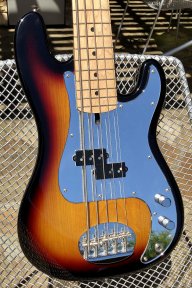
One of the best ways to learn your way around a fingerboard is to transpose something you already know how to play really well. For example, let's say you know how to play something in E minor/G major (meaning you play the part utilizing the open E string - many typical bass parts are like this). Transposing to A minor is relatively easy, just move the part up one string. Now try transposing to Ab minor or C minor instead - you have some new fingerings to figure out, but also some new notes. You can choose any other notes to transpose to that you'd like, I just chose these as examples. Now trying playing the same things (E, A, Ab, C, etc.), but an octave higher - find all the places on the fingerboard that you can do this. This is really not any harder than on a piano except that space between the frets gets smaller as you go up the neck. Still, this is really not an issue unless you're playing fretless where you'll have to be a little more careful in terms of intonation. While this is applicable to all basses (4 strings included), I really didn't figure this out until I went to a 5 string and had to play parts that, on a 4 string, I had previously down-tuned to Eb or D. On the 5 string, I didn't need to down-tune, but I did need to transpose, which then forced me to figure things out better than I had before. In typical TB fashion, acquiring new gear was the answer.

If you havent already done this, be able to play all 7 major modes up the neck and the ii V I cadence without thinking. Will really help your jazz playing .Hi, I am not quite understanding this. Given that all basic major scales and their relative minors have the same intervals tone, tone, semi-tone, tone, semi-tone, tone and tone to octave, if you know one you can work out all the others. Two methods I use are to work in blocks and learn a scale within the first five frets, then the next three or four and so on to the octave so that you have split the neck into about four units before the octave. Next tip is to be able to do walking bass across the whole guitar in one key, say C major. Doing this means that you are having to play with invention continuously. Play to a record or midi track. Then move up to the next scales gradualy adding more different notes e.g. G major, D major, A major, E major etc or F major, Bb major, Eb major etc. Lastly, as my jazz theory teacher says, be able to play something in any key. My current jazz theory class is helping with this, something I am not sure you can get from any other music style.
To just learn the notes on the fretboard try to get away from saying things like the 5th fret on the E string. Think in terms of the actual notes and intervals. Try always saying the A on the E string or if you are in the key of E the 4th. Try to incorporate as much music theory and note naming into how you casually talk about things so that you are not thinking in tablature anymore.
Also, I know people have talked about using an app to learn the fretboard. Somehow clicking the right answers on that does nothing for my playing in real life. I tend to just go to a website like this (Random Note Picker) and set it to 4 notes (or how many strings I have) and turn a timer on and try to play all of the notes one string after the other before the timer runs out. As you start you can just click to get new notes.
Also, I know people have talked about using an app to learn the fretboard. Somehow clicking the right answers on that does nothing for my playing in real life. I tend to just go to a website like this (Random Note Picker) and set it to 4 notes (or how many strings I have) and turn a timer on and try to play all of the notes one string after the other before the timer runs out. As you start you can just click to get new notes.
I tend to just go to a website like this (Random Note Picker) and set it to 4 notes (or how many strings I have) and turn a timer on and try to play all of the notes one string after the other before the timer runs out. As you start you can just click to get new notes.
What a great tool! Simple but effective.
Smart idea, and musical.I learned the neck mainly by reading chord charts and only allowing myself to use one string for the whole song.
Try charting out a simple song in all 12 keys and play that song using only root notes on, say, the G string. In no time, you'll be able to name every note on that one string. The next day, try that same exercise on the D string. Keep this up for a couple weeks and you'll have the fretboard down cold.
When this becomes second nature, try the same thing but allow yourself to use two adjacent strings. Try all three combinations (G&D, D&A, A&E) in various neck positions.
I get your point, but my approach also has side benefits."My instrument is harder than your instrument."
Perhaps you will but you will have expended an enormous amount of unnecessary effort in the pursuit.

First off, I'm not suggesting transposing into all keys at once is a bad thing - it isn't. But, for someone who doesn't read or know key signatures, I would suggest a more progressive approach to learning to read. Start with music in C Major and Am - no sharps or flats. Move on to G, D and F Major - 1#, 2# and 1b respectively, along with the relative minors Em and Dm with 1# and 1b each. Then add A Major (3#) and the relative minor F#. Then move on to the remaining maj and min keys with 4, then 5 and 6 sharps/flats. In doing so you will avoid the 'moveable shape' approach to stepwise transposition and will really get 'under the hood' of each key in its own right.
Incidentally, this is not my idea - it is the approach used for graded exams by UK music schools and is based on the circle of 5ths/4ths.
Incidentally, this is not my idea - it is the approach used for graded exams by UK music schools and is based on the circle of 5ths/4ths.
Thanks, everyone.
Lots of advice that I should learn the whole fretboard in terms of note-names.
And three or four methods for doing so that I'm thinking about using.
I should own up that bass guitar is not my main interest, being perhaps the fifth or sixth string to my musical bow, and that anyway I improvise on it more than I read. So for me it was natural to import a reading method that I was already using (an octave up & in the treble clef) on guitar.
Of course my piano remarks were just a jokey/teasing intro - though with some grains of truth. The system of naming & writing down notes that now dominates the musical world is based on the keyboard layout and a semi-random use of letters. We need to know this stuff to understand why E# is F but F# isn't G.
In country music, they have the Nashville system of chord symbols that gives a song's chord sequence independently of key. I did wonder if a bassist used to working with that system might read the dots much as I (still) do.
Lots of advice that I should learn the whole fretboard in terms of note-names.
And three or four methods for doing so that I'm thinking about using.
I should own up that bass guitar is not my main interest, being perhaps the fifth or sixth string to my musical bow, and that anyway I improvise on it more than I read. So for me it was natural to import a reading method that I was already using (an octave up & in the treble clef) on guitar.
Of course my piano remarks were just a jokey/teasing intro - though with some grains of truth. The system of naming & writing down notes that now dominates the musical world is based on the keyboard layout and a semi-random use of letters. We need to know this stuff to understand why E# is F but F# isn't G.
In country music, they have the Nashville system of chord symbols that gives a song's chord sequence independently of key. I did wonder if a bassist used to working with that system might read the dots much as I (still) do.

I think intervals, not note names frequently. I see a note on the next line and I know it's a third above the one I'm playing. I do know the fingerboard quite well, but thinking names while reading is an additional layer.
I do that, myself. I work on learning where the intervals are to the left and right of the root. Numbers are easier to remember than letters. So if I'm trying to figure out a riff with a guitarist I'll say Dm 135, or C 158
(if we're both playing the same riff like with a Rush song). I think it would be a good replacement for tab. You'd have to label the octave, as well so it might read: C4 135 (middle c) D3 158. This would help learn the octaves as well. And, like standard notation, it would not matter what instrument one played.
I haven't incorporated it into reading music yet b/c 3 6 & 7 are half step lower for a minor. But if you've done it, I'll give it some more effort.
I need to get my speed up. There was a training video that said you learn to read in clusters, but didn't explain how. Do they just read the root note and intervals when they do this?


