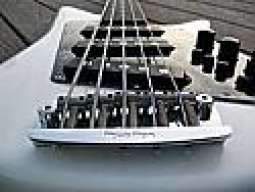
OK, I played 9 Fender basses today, 5 were Road Worn, 8 were new.
This morning, I learned that a local Kentucky dealer, Bob Willcutt has one RW P-bass at his Richmond, KY, store, and 2 RW P-basses and 2 RW Jazzes at his larger store in Lexington, KY. Besides these 5, I also played 2 60's classics (1 used) and 1 50's classic. Every single bass was MIM.
I started by spending about an hour with the first P-bass at the Willcutt Richmond, KY store while also visiting with some local community musicians and a former RSguitarworks tech who stopped in, as well as hanging with a couple of nice guys who work there. My initial impression was that the first P-bass felt a lot like my '55--a whole lot.
How so? Light and dry feel--complex tone. This was a very light P-bass! Moreover, there is a dry cool feel to the neck that is pretty much the same as a real vintage bass, minus some deeper wear on the lower fingerboard edges where one's fingers wrap around the first, second and third frets. The fretwork was very good, the body finish was pleasing, but I wasn't bowled over by the finish and wear, for better or worse--but I liked it. The exposed wood is mostly grey, as it should be, except where it is actively being worn by contact with skin/clothing.
In a good way, the RW P-bass C neck is much like a vintage C neck in shape, but (to me) not quite IT. The feel is very pleasing, action and frets are very fine. I just wish it were a bit shallower--fingerboard to back--though the nut width seemed about right--forget it, it's just me. I loved the tuners and neck tint. The cigarette burn, well, being a fool, I smoked on gigs for 15 years, yet never got a burn. Wish I hadn't done that smoking, but the burn is kinda cool in a "glad I haven't got cancer yet kind of way"

Tone: Excellent. Really sweet and warm. I was a bit surprised that with the tone knob full-on that the instrument produced a seriously bright top, but didn't become harsh. Good Bass. $1199.00 More on the tone later.
Next, off to Lexington, a 25 mile drive, across the Kentucky river and through rolling green Appalachian Spring into that lovely city. I reached the main Willcutt store about an hour and a half before closing. I brought my modified 2000/2001 60's classic.
The store was crowded, but no one was in the ample bass section (they have what must be hundreds of guitars, Fender, Gretch, Gibson, PRS, and more). There were 4 Road Worn basses waiting. I used a Mesa Carbine (model 6) amp, and started with a sunburst RW Jazz.
First impression: Wow. Set-up is dead-on. Not surprising, as owner Bob Willcutt is a terrific guitar tech with about 50 years experience. His crew do their jobs very well. The feel is about perfect, and even though I am not partial to the stock Fender SS round wounds, they sound great. In fact this bass sounds terrific. It invited me to spend a good 20 minutes playing, bouncing between jazz standard melodies, walks, Rock, Country guitar-style licks, chords, baroque bass lines, harmonics, slap etc. More than just very nice. Very very sweet! I want it--me bad.

$1249.00 USD. More later.
On to another RW P-bass. Finally Fiesta Red!. Good feel, heavier than the Jazz (!), but not HEAVY. Something about the upper mids on this bass makes so much sense. The neck is very very nice, just like the one played earlier today. I love the dry feel of the whole bass. It seems like the wood has been baked in an oven. Is it possible?
I began to wonder how a 50's classic would compare, and what do you know, there was one hanging a few feet away. It was a very pretty blonde ($849 USD). I plugged it in and played. Whoa. Not heavier than the Fiesta Red bass, but interestingly different. The neck has different dimensions (a bit thicker front to back?), but still nice. The setup is not as good. Sighting down the frets was less impressive than the RW, but this bass has too much relief--I suspect it has sat in the shop longer, as I believe I saw it here about 6 weeks ago. None of that matters...it's the tone that is the issue.
The tone of this 50's classic is really different from the two RW P-basses, and it is not about string age. The 50's classic has a lot more upper mids with the tone control full on. To me, there is a harsher, more aggressive quality. This is not bad, just different, but honestly, I very very much prefered the RW Fiesta Red P-bass I had just played. BTW, the 50's classic P-bass had a very creamy and lovely darkside with the tone rolled off.
I grabbed the other RW P-bass, another tobacco burst. I liked it a little less than the Fiesta Red P, but am not sure why. Perhaps it is just the set-up. After a few minutes, I realized I needed to compare a 60's classic Jazz to the RW Jazzes.
My modified 60's classic Jazz was sitting in front of me in my gig bag, but there was also a new one on the rack, so I took the new one, and plugged into the Carbine. Nice, but yipes, the feel reminds me of the 50's classic P. I think it is a combination of set-up and finish. I like it OK, but the RW sun-burst Jazz blows this 60's Classic Jazz away for feel--it's the neck, of course. Tone wise, it is not so different. I am finding it to be closer to the RW Jazz, but it I feel it lacks a certain sweetness and tonal complexity. I tried the typical settings I use on my 60's classic, and then went back to the Fiesta Red Jazz. The owner stopped by. He said he had heard that prices were not going down. I agreed that is was unlikely, if for no other reason than as far I knew, Fender has NEVER lowered prices, except due to inflation.
We agreed that the wood of the RW basses seemed baked or dried out like vintage instruments. Is he even older than I am? He must love his job--there is steady traffic in his shop. 
The RW Jazz is lighter than the classic, but not by much. Again, there is that dryer lighter feel with is hard to describe. There is a bright edge to the RW, but the upper mids are less harsh with the neck rolled off ~50% and playing on the bridge pickup.
I went to my own '60s Classic. Bam! My strings are totally dead compared to these basses. I can't even be bothered plugging in. Duh! I should have changed the strings!!!! Grrrr. Oh well. Back into the gig bag it goes--btw, it sounds pretty good with dead Sadowsky Bright Nickels, but no way can it be rationally compared to the Jazzes here with new SS Fender round wounds.

Ok. Quickly back to the tobacco burst Jazz. I want it, but I am too poor. A young lad who works in the shop stops by and says, "I'm sorry, but we are closing. You have about 8 minutes more."
I chatted with him a couple of minutes, played a bit more, then packed up to go.
Final impressions from today:
1) As with all Fender basses, one may be better than the other.
2) RW MIM basses feel great, both the Jazzes and P-basses. The neck dimensions, finish, fretwork and fingerboards of the ones I played were all excellent. They can clearly set-up extremely well--basically as good as it gets set-up wise on a new Fender bass. I think the fret work on the new American Standards is a notch higher, but not so much as that would decide things for me in a shoot out--but this is off topic...
3) The RW P-bass neck feels so authentically like a vintage bass that I was really convinced. Fender did a great job on these necks--the roll of the edges is not as dramatic as on my '55, but the vintage feel is really there, IHMO.
4) The Jazz neck was more pleasing than the 60's classic, but not a whole lot--the big difference was in the finish, set-up, and strings with the two examples I played. The dimensions are very similar between the RW and Classic Jazz. The tuners are the same, though the RW tuners are obviously aged.
5) Tone. Here is the subjective part. There is a subtle and complex quality to the tone of these basses. I have played and owned many Fenders. These all have that sweet tone which I am thinking has to do with a stronger upper top, but a mellower upper mid. I am guessing here. Let's say it this way: the instruments seem warmer, and sweeter than the Classic series, but not dull or harsh, even if the tone control is full on or off.
6) Total impression. These basses were all very good Fender basses with a vintage feel and a warm complex tone. The price is what it is. I don't like the prices. If they were $250 to 300 less, I could probably swing getting one. I really want that Jazz, and only because I have an ample supply of P-basses (three) I can't justify a RW P.
7) Comparison summary--to me the P-bass felt the most authentic as a vintage-type instrument (as Bob Willcutt pointed out, these are not Reissues, they are their own thing). The tone of all 3 P-basses and both Jazzes was just lovely. Yes, they sounded better to me than the stock Classics, but that is personal preference. The body finishes were not really a big issue to me. The feel and tone of the RW basses OWNED the day for me. P and Jazz both cooked red beans and rice. I am a believer, but who is surprised???