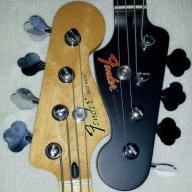
The low end J&D basses and some Harley Bentons have graphite rods,expect the necks come from the same factory.
Thing is they don't mention them, on a $100 bass that $2 spent on rods is a safeguard against QC returns. For the big F it's an added bonus you're getting.
Funny old world ain't it

You gotta love people's double standards, right?
When a budget company has no shielding, it's because it's a terrible instrument made to terrible standards.
When a $1700 Fender has no shielding and buzzes like a bee, it's because it's a vintage reissue.
When a budget company makes a one piece neck, it's because one piece is less labor.
When a brand name company makes a one piece neck, it's because it's vintage correct.
When Martin makes a completely cosmetic volute, it's an integral part of what makes it a Martin.
When Gibson attempts to make a structural volute, it completely ruins everything that makes it a Gibson.
When a budget company makes a bolt-on Fender copy, it's to cheaply take advantage of the Fender vibe.
When Suhr makes a bolt-on Fender copy, it's to make the best guitar possible for the money.
When a $200 guitar has basswood, it's terrible, sounds bad, and is not fit for any use in anything, ever.
When a $3500 JEM has basswood, it's the chosen wood of Steve Vai, a legend.
When a budget company has a solid color, it's to hide terrible quality of wood.
When a Fender is opaque shell pink, it's desirable and vintage.
When a budget company makes a scarf joint, it's because it's cheap and saves on materials.
When Ibanez makes a scarf joint, it's to strengthen the headstock area against breaks.
Etc.