Hi Folks,
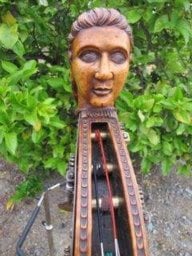
I have ~12 year old Romanian flat-back bass with the red polymer finish (yes, one of those ). I am the only owner, having bought the bass new. Ive noticed a rattle/buzz when playing an A on the G string (at the second fret). Unfortunately when amplified, the bass booms like crazy when this note is played, as the amplified sound is reinforcing the buzz, making the bass practically unplayable.
I put it on the bench and it seems that a couple of the cross braces have become separated from the back at their ends, which I am presuming is the problem. In reading other threads on this forum, the first piece of advice is to call the luthier, so I gave Arnold S. a call yesterday. In chatting with him it quickly became apparent that the cost to have a professional repair the instrument will exceed its value.
So here is my conundrum: The bass itself is plays well (Arnold has had it a couple of times over the years for a new fingerboard and a setup, and the instrument plays and sounds as good as it possibly can be expected.) For my needs, it sounds and plays fine, and though I play regularly, a new bass is not an option (as well as the added headache of trying to get rid of this one). In lamenting this to Arnold, and as someone who has been interested in working on my own basses for years, his closing comment was, simply, Then you need to fix it yourself.
And thus I write.
First, the situation. A few pictures are attached. Fig_1 is the instrument itself for reference. As you can see the back of the bass is warped inward near the part just before the knee (Fig_2) . The braces in question are the two topmost horizontal braces on the back (Fig_3) (where the back is curved) The topmost brace is thick (maybe 1.5 thick and 1.5 wide) and is located near the knee in the back where it starts to angle towards the neck joint. The second brace is smaller (maybe 1 x 1) located below the bigger brace near the upper violin corners. The topmost brace has popped on both sides, with the gap larger on the left (E-string) side (Fig_4, Fig_5) than the right (Fig_6). The lower, smaller brace has separated only on the left side (Fig_6), with the right side still attached (Fig_7). (Incidentally Figs. 5-7 were taken with an inexpensive inspection camera from the hardware store---very handy).
The gap for the larger brace is substantial, maybe 3/16 at the edge (Fig_4, Fig_5).
As I see it I have four options available:
Some thoughts:
Options #1 and #2 are comfortable in my skill set.
I think Option #4 is comfortably beyond my skill set.
Option #3 is probably beyond my skill set, but I am willing to give this a try, if the consensus is that (a) removing the top is not as terribly daunting as it looks, and (b) would provide for a better repair. Additional benefits of #3 include doing any modifications for tone (not that I would embark on them, but the potential is there), and getting over my phobia of doing any serious work on my bass. The obvious disadvantage, of course, is that I make a complete mess of the instrument and render it scrapwood.
#2 (drilling/screwing+ gluing) I know this likely violates the senses of many professionals on this list, and with good reason. However this bass is not an heirloom instrument, and if a 1-hour repair can get me several years of service out of it, I would have a hard time not taking this option.
Then there is the issue of glue choice for Options #1 and #2 (#3 and #4 would allow normal hide glue). If white glue was used on the original braces (I cannot tell, in fact there isnt much of any glue residue on the braces that I can see) there is the issue of other/new adhesive not sticking to it. Glue choices include a) hide glue, b) liquid hide glue, c) white glue d) wood (yellow) glue, e) two-part epoxy, and f) silicone. Yellow, white, and liquid hide glue are pretty much ruled out for the same reasons they arent used elsewhere. Epoxy isnt a bad choice due to its minimal shrinkage and gap-filling qualities, although there is a permanence to it that scares me.
I have granular hide glue and a glue pot, and some limited experience working with it. I will use traditional hide glue if this is the overwhelming recommendation, but there is the issue of adhesion to the old glue (white or hide, depending on what they used).
Believe it or not, I am attracted to silicone as the top candidate at this point , because it has good gap-filling qualities (think bathroom caulk), excellent grip to most other surfaces, and flexibility. It can also be removed fairly easily if and when I were to attempt a major repair in the future. I am almost certain that this will stop the rattling, however silicone doesn't have much strength as an adhesive, and will likely do little to help the brace in its original role of supporting the back as intended.
Note that whatever glue is used will have to span a gap of up to 1/8 between the foot of the brace and the back of the neck. Without taking the top off, there is no way to otherwise compress the brace against the back when gluing. I can also make up some wedges and work them into the gap before or during gluing.
A little about me: I do not have an enormous amount of woodworking experience, although I have many of the tools, and I have over 30 years experience with mechanical repairs of all kinds. Im a mechanical engineer by training and profession, and I work at a university, with a big part of my job doing engineering research. Thus thinking outside the box is something we do all the time, and Im not adverse to implementing a clever/untested solution. I own and have read the books by Chuck Yaeger and H.S. Wake.
Arnold had graciously suggested attending the Oberlin workshop in June, with this as my "project". This is also an option, although I have some scheduling issues that might be insurmountable, and I fear that the typical skill level there would be far beyond mine. I am looking into it now. Yet another option might be to make a temporary repair now and plan to attend next year.
Anyway, if you have gotten this far, thank you for reading. Any and all comments in terms of how to proceed, glue choice, what to avoid, things to watch out for, tools, and general opinions are be most welcome. If you would like additional pictures, information, or measurements, please let me know and I will provide them.
Thank you all for such a great resource,
-Jon Longtin
Stony Brook,Long Island, NY
I have ~12 year old Romanian flat-back bass with the red polymer finish (yes, one of those ). I am the only owner, having bought the bass new. Ive noticed a rattle/buzz when playing an A on the G string (at the second fret). Unfortunately when amplified, the bass booms like crazy when this note is played, as the amplified sound is reinforcing the buzz, making the bass practically unplayable.
I put it on the bench and it seems that a couple of the cross braces have become separated from the back at their ends, which I am presuming is the problem. In reading other threads on this forum, the first piece of advice is to call the luthier, so I gave Arnold S. a call yesterday. In chatting with him it quickly became apparent that the cost to have a professional repair the instrument will exceed its value.
So here is my conundrum: The bass itself is plays well (Arnold has had it a couple of times over the years for a new fingerboard and a setup, and the instrument plays and sounds as good as it possibly can be expected.) For my needs, it sounds and plays fine, and though I play regularly, a new bass is not an option (as well as the added headache of trying to get rid of this one). In lamenting this to Arnold, and as someone who has been interested in working on my own basses for years, his closing comment was, simply, Then you need to fix it yourself.
And thus I write.
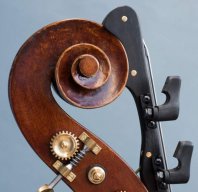
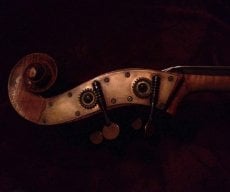
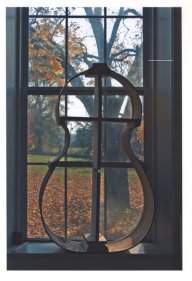
First, the situation. A few pictures are attached. Fig_1 is the instrument itself for reference. As you can see the back of the bass is warped inward near the part just before the knee (Fig_2) . The braces in question are the two topmost horizontal braces on the back (Fig_3) (where the back is curved) The topmost brace is thick (maybe 1.5 thick and 1.5 wide) and is located near the knee in the back where it starts to angle towards the neck joint. The second brace is smaller (maybe 1 x 1) located below the bigger brace near the upper violin corners. The topmost brace has popped on both sides, with the gap larger on the left (E-string) side (Fig_4, Fig_5) than the right (Fig_6). The lower, smaller brace has separated only on the left side (Fig_6), with the right side still attached (Fig_7). (Incidentally Figs. 5-7 were taken with an inexpensive inspection camera from the hardware store---very handy).
The gap for the larger brace is substantial, maybe 3/16 at the edge (Fig_4, Fig_5).
As I see it I have four options available:
- OPTION 1: Glue/wedge braces through f-holes. I can reach the seam between the brace and back through the bass-side f-hole and was thinking of attaching a small syringe with glue that I can get to the joint (or using a syringe + a tube on a wooden dowel to get the glue to the joint--a detail).
- OPTION 2: Drill small holes for glue and screws through back (sacrilege I know!!)+ glue/wedge through f-hole. I also have a fine (23-gauge) pneumatic pin nailer that would be virtually undetectable.
- OPTION 3: Remove top + R/R braces, refit, and reglue.
- OPTION 4: Remove back and rebuild.
Some thoughts:
Options #1 and #2 are comfortable in my skill set.
I think Option #4 is comfortably beyond my skill set.
Option #3 is probably beyond my skill set, but I am willing to give this a try, if the consensus is that (a) removing the top is not as terribly daunting as it looks, and (b) would provide for a better repair. Additional benefits of #3 include doing any modifications for tone (not that I would embark on them, but the potential is there), and getting over my phobia of doing any serious work on my bass. The obvious disadvantage, of course, is that I make a complete mess of the instrument and render it scrapwood.
#2 (drilling/screwing+ gluing) I know this likely violates the senses of many professionals on this list, and with good reason. However this bass is not an heirloom instrument, and if a 1-hour repair can get me several years of service out of it, I would have a hard time not taking this option.
Then there is the issue of glue choice for Options #1 and #2 (#3 and #4 would allow normal hide glue). If white glue was used on the original braces (I cannot tell, in fact there isnt much of any glue residue on the braces that I can see) there is the issue of other/new adhesive not sticking to it. Glue choices include a) hide glue, b) liquid hide glue, c) white glue d) wood (yellow) glue, e) two-part epoxy, and f) silicone. Yellow, white, and liquid hide glue are pretty much ruled out for the same reasons they arent used elsewhere. Epoxy isnt a bad choice due to its minimal shrinkage and gap-filling qualities, although there is a permanence to it that scares me.
I have granular hide glue and a glue pot, and some limited experience working with it. I will use traditional hide glue if this is the overwhelming recommendation, but there is the issue of adhesion to the old glue (white or hide, depending on what they used).
Believe it or not, I am attracted to silicone as the top candidate at this point , because it has good gap-filling qualities (think bathroom caulk), excellent grip to most other surfaces, and flexibility. It can also be removed fairly easily if and when I were to attempt a major repair in the future. I am almost certain that this will stop the rattling, however silicone doesn't have much strength as an adhesive, and will likely do little to help the brace in its original role of supporting the back as intended.
Note that whatever glue is used will have to span a gap of up to 1/8 between the foot of the brace and the back of the neck. Without taking the top off, there is no way to otherwise compress the brace against the back when gluing. I can also make up some wedges and work them into the gap before or during gluing.
A little about me: I do not have an enormous amount of woodworking experience, although I have many of the tools, and I have over 30 years experience with mechanical repairs of all kinds. Im a mechanical engineer by training and profession, and I work at a university, with a big part of my job doing engineering research. Thus thinking outside the box is something we do all the time, and Im not adverse to implementing a clever/untested solution. I own and have read the books by Chuck Yaeger and H.S. Wake.
Arnold had graciously suggested attending the Oberlin workshop in June, with this as my "project". This is also an option, although I have some scheduling issues that might be insurmountable, and I fear that the typical skill level there would be far beyond mine. I am looking into it now. Yet another option might be to make a temporary repair now and plan to attend next year.
Anyway, if you have gotten this far, thank you for reading. Any and all comments in terms of how to proceed, glue choice, what to avoid, things to watch out for, tools, and general opinions are be most welcome. If you would like additional pictures, information, or measurements, please let me know and I will provide them.
Thank you all for such a great resource,
-Jon Longtin
Stony Brook,Long Island, NY




![DSC_0002[1].jpg](/data/attachments/2735/2735500-761e79d320ae625dc048d631e8621bb2.jpg?hash=dh550yCuYl)