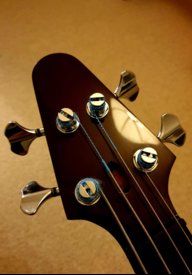
I play on a lot of dark stages, and all my basses have the treatment below. I play enough gigs that I may be an "expert" in the OP's eyes, but here's the thing that good players know: Anything you can do that makes you even a bit better, you do. Yes, I can play most anything I know with my eyes closed, but once in a while, I'm back there, it's dark, and I have to start somewhere up the neck. I'd hit the right note well over 90 percent of the time without this, but with this, I'm even closer to 100 percent.
What is it? White Rustoleum paint, Sharpie industrial or extreme (the ones with longer lasting pigment), and then polyurethane over the top. If you do it right, you don't feel the transition (although you might argue you could use that as another position cue).
Most of the stages I play on have overhead UV lights - when the stage goes dark, or in "unlit" ares of the stage, you still have those lights so people don't trip, and so the spike tape on the floor is visible so stage hands can place things in the "dark". With this scheme on a neck, I can see where I am better than even glow in the dark dots.
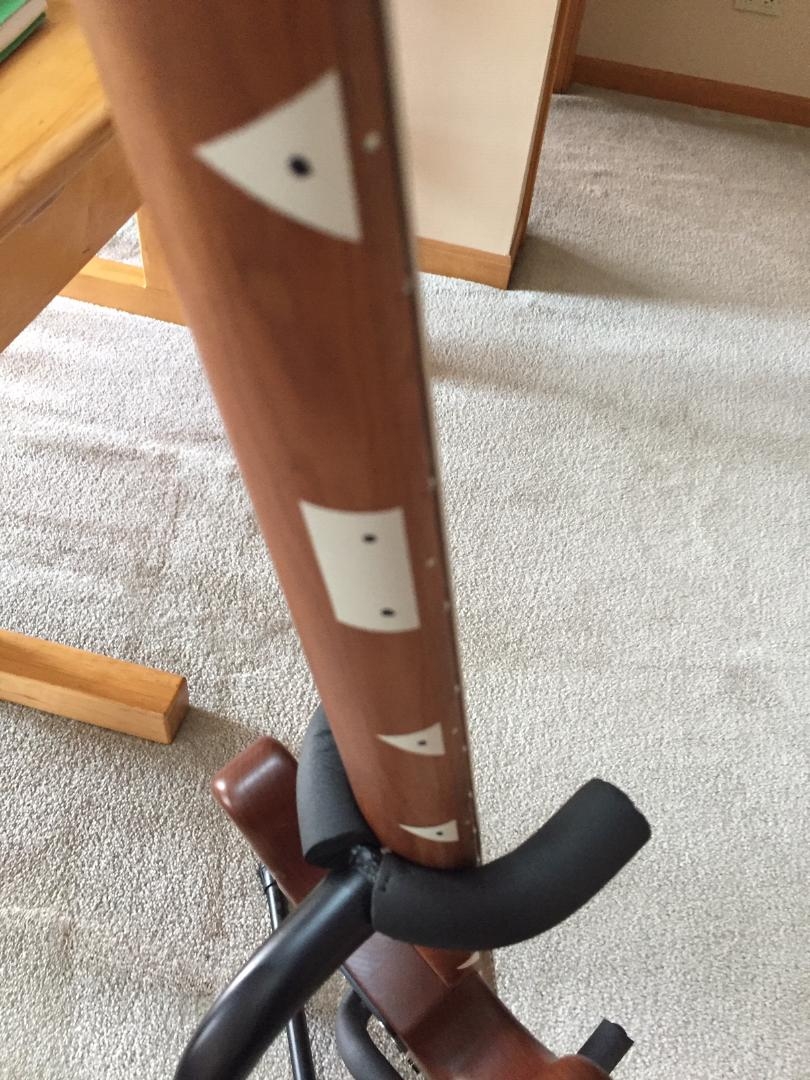
What is it? White Rustoleum paint, Sharpie industrial or extreme (the ones with longer lasting pigment), and then polyurethane over the top. If you do it right, you don't feel the transition (although you might argue you could use that as another position cue).
Most of the stages I play on have overhead UV lights - when the stage goes dark, or in "unlit" ares of the stage, you still have those lights so people don't trip, and so the spike tape on the floor is visible so stage hands can place things in the "dark". With this scheme on a neck, I can see where I am better than even glow in the dark dots.