• TalkBass has been independent since 1998. Add your voice.
    Create a free account to reply to discussions, view embedded media, and browse with fewer display ads.
    Join freeLog in
    Want zero display ads or expanded classifieds tools? Compare plans.

Replacing the bridge on an acoustic bass

I recently got a super cheap Harmonia 6-string acoustic bass. The bridge is problematic because the instrument is totally un-intonated, so I need an adjustable bridge to fix this. Can I just slap pretty much any adjustable bridge onto the instrument and have it be ok?

Also, I can google this myself so don't feel obliged to answer, but is there anything I should keep in mind when replacing the bridge?
 
The bridges on most acoustic basses are like the bridges on acoustic guitars. Unlike a solid body electric bass where most of us can simply slap a bridge on with screws into the solid body after measuring to fit, an acoustic bass has a brace structure under the top that helps maintain the integrity of the instrument in relation to the bridge, as well as help the guitar have proper tone as well as intonation, and must be positioned and glued on very carefully, including the hardwood plate under the top that anchors the strings (on most instruments). Unless you are experienced with acoustic guitar bridge work, I would leave this particular repair to a luthier.
 
  • Like
Reactions: mbelue
The bridge is problematic because the instrument is totally un-intonated, so I need an adjustable bridge to fix this.
it's a glued-on flat top guitar, so no.

you'd need to remove the original bridge entirely and re-glue it in the right spot, or fill the saddle slot and re-cut it at the correct spot. both of these operations would cost more than the instrument did.
 
besides, the problem may not even be the bridge! if the rest of the setup is off, that can throw out the intonation.
 
agreed, but this is a chinese 6-string acoustic bass guitar that i've never heard of, and am seeing on Reverb for like $200; it could very well be actually built wrong.

You could be right.

If it is, moving it would be an expensive proposition.

Since wood to wood contact is important for a good glue bond, the first time tech will learn quickly that blasting through a thick, hard poly finish is a thankless job.
 
  • Like
Reactions: JLS
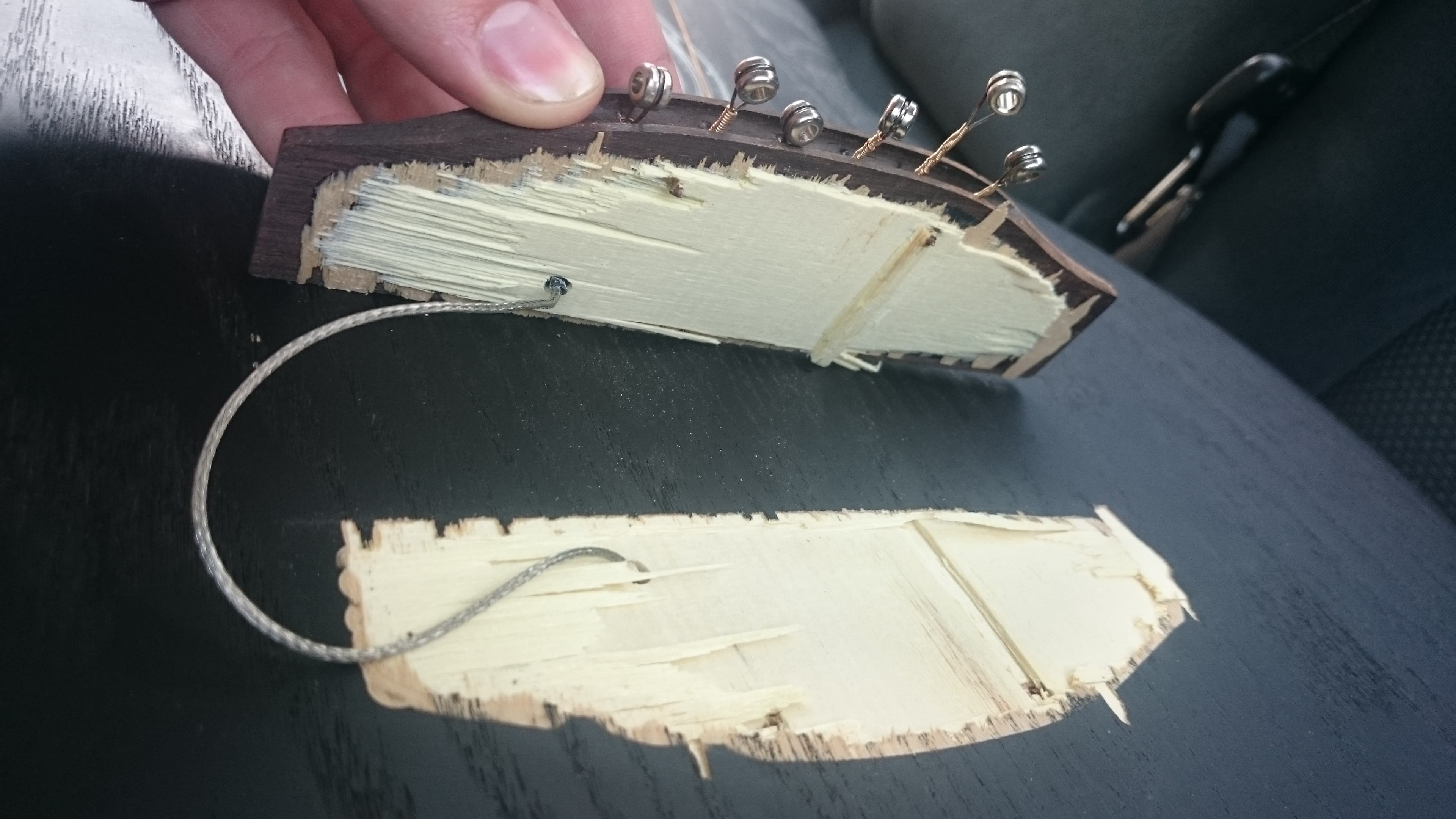
Okay, well now this conversation is more urgent because the bridge straight up snapped off the guitar.
y6Ivp0X.jpg

So, removing the glue bond isn't a problem anymore. Is this structurally sound enough to slap another bridge on? Would an adjustable metal bridge be ok to use?
 
Not so super cheap, now.
Well, seeing the picture it is obvious slapping on any old bridge will not get it. That wire coming out of the body into the bridge means you have piezo pickup that is built in to the bridge.
Sorry, but I think, unless you can return the bass, you been screwed.
 
  • Like
Reactions: domportera
Okay, well now this conversation is more urgent because the bridge straight up snapped off the guitar.
So, removing the glue bond isn't a problem anymore. Is this structurally sound enough to slap another bridge on? Would an adjustable metal bridge be ok to use?

The wood failed, not the glue. The glue is still there. And now you have a chunk out of the top.

Try to return it as defective and get your money back.

To fix it you'd have to remove the wood piece from under the bridge without it crumbling into toothpicks, glue and clamp that back on, sand the top flat, then re-glue that bridge or a different wooden bridge to the top in the right spot. But then that one will probably pull off as well, because it's the same bad wood underneath, so you'd need to reinforce it somehow, like with a block under the top and runing screws through the bridge and top into that block. Those screws will end up vibrating loose and sounding bad.

Seriously, throw it away if you can't get a refund and try again with a better instrument. A Warwick Alien is the only inexpensive 6 string acoustic bass I know of that is structurally sound. They're supposed to be good quality for the money. They're available used under $500.
 
  • Like
Reactions: domportera
Thanks for the quick replies guys. I think I'm going to try to get my money back then.

I don't care too much about the pickup in the bridge, but I am wondering - if I were to use epoxy or something similar to fill that gap and make it nice and smooth, would it hold?
 
Thanks for the quick replies guys. I think I'm going to try to get my money back then.

I don't care too much about the pickup in the bridge, but I am wondering - if I were to use epoxy or something similar to fill that gap and make it nice and smooth, would it hold?
Just return it, if you can. It will never be right.
If you can't return it, make a video of smashing it and post it here. We would all get a kick out of that. :thumbsup:
 
The variable here is the bridge plate, which is a thin "block" under the top under the bridge. Typically bridge plates are solid maple or rosewood. The idea is that the bridge plate stiffens the top to prevent a belly forming. But it must be light enough so that it does not impede vibration in the top.

What kind of block is in there now? Dollars to high caloric breakfast food it is plywood. Plywood bends. That's the opposite of stiff. Coupled to a plywood top, it's a prescription for disaster. Which has already happened.

Removing and replacing a bridge plate is a major pain in the arm. Literally, because the tech must get inside with heat and tools to loosen the glue and pry off the exiting bridge plate. The service would easily cost as much as the instrument. Installing a veneer reinforcement might work. But that's time consuming (read: expensive), too. Plus, the bridge and top have to be addressed.

Replacing the instrument is the best course of action. If the seller/vendor is unwilling to replace it, it is a good project instrument on which to learn acoustic repair.

Epoxy: Wood glue is the right adhesive. Hide glue would be better. Epoxy will work, but it is likely to make a bigger mess than already exists. If you can imagine that.

Screws: Can be used to locate. But screws will not hold a bridge onto a top. That's a job for glue.

Repair: As pointed out above, the top that is still glued onto the bottom of the bridge should be removed carefully and glued into place first. Then the bridge can be prepped and glued. Deep throat clamps are necessary to reach through the sound hole to access the bridge. Good fitting, non-marring cauls will need to be fabricated, too. All of this assumes that there is no finish on the top that is glued to the bridge. All finish must be removed before glue and clamps are applied.

This advice is merely an overview of the work to be done. If you do not possess the tools it will get expensive in a hurry. In addition, this is a job for the seriously handy who have a good understanding of woodworking.
 
  • Like
Reactions: domportera
Thanks for the quick replies guys. I think I'm going to try to get my money back then.

I don't care too much about the pickup in the bridge, but I am wondering - if I were to use epoxy or something similar to fill that gap and make it nice and smooth, would it hold?

No.

If you do end up trying to fix it, you will need to remove the original screws (probably machine screws) that were securing it in place, and drill out for a larger size screw. The originals weren't doing the job. If there is a bridge plate beneath the top, it should still be usable. If not, something should be added to back up the new screws.

The bridge can also be glued back in place as is, after making sure it fits tight against the top. Any splinters of wood interfering with the fit should be removed until it fits with no gaps. Wood glue (tite bond) would be fine. The new screws can be used to clamp the bridge in place while glueing. I would also use fender washers and lock nuts under the top.

-
 
My guess, given the price of the guitar and its origins ($200 from china) it's a plywood block. I wouldnt be surprised if the whole body is plywood haha. I am certainly no expert luthier though and down really have any tools or knowledge of woodworking or types of wood. Thanks so much for the information though! I love this community, I'm always learning something new and people are always around to help.

I contacted the distributors and they are going to send me a new one. As soon as I get that in the mail, I might just have to make that video of me smashing this one ;)
 
Good to hear they are replacing it.

You do realize the same thing may happen again?

I would examine the broken one and try to determine why the screws failed. My guess is they were undersized. You might be able to head off a failure with the new bass.

Glue alone cannot hold a bridge in place, or maybe it's better to say the top alone cannot hold a bridge in place. Either the strings go through the top and are anchored beneath by the string ball ends, or the bridge is bolted on with machine screws.

-
 
Glue is what is used to attach bridges to acoustic guitars. Martin, Gibson, et al have been doing it that way since the eighteenth century. Mechanical fasteners do not have the strength to do the job.