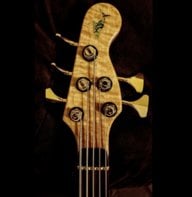
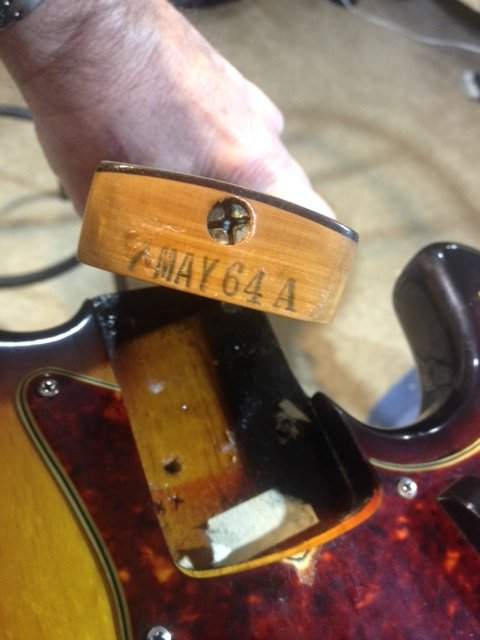
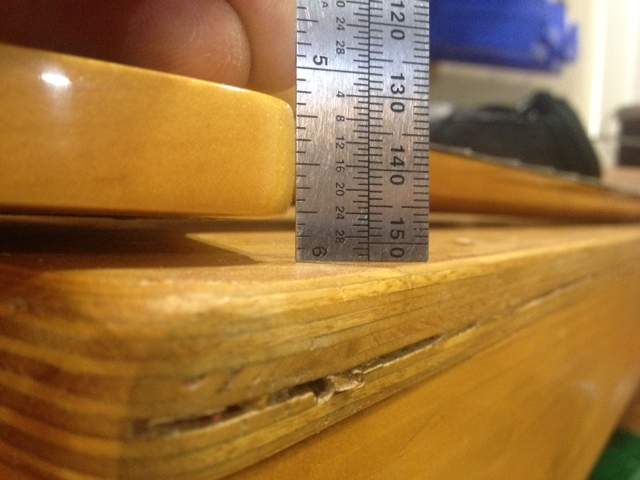
When I got my first look at this thoroughly warped and twisted '64 Jazz neck, my first thought was that it would just be a throw-away - just too far gone, left outside, under tension in too many hot garage days in the triple-digit Las Vegas summers, maybe? Clamping the neck down I found a full 1/4" of really ugly twist from one end to the other.
But, having just recently had the job of un-twisting some pernambuco cello and bass bows, I knew there was still a slim possibility of success with the much larger and denser maple bass neck, applying the same principles. What did I have to lose, anyway? Another luthier had already given it the do-not-rescuscitate tag. So I've been reading of another luthier currently being sued for breaking a twisted, but very valuable old cello bow, and read all the expert analysis as to how that occurred, and set about coming up with a strategy for un-twisting this neck, without making the same mistakes apparently made by this poor guy. The key, apparently, to a successful un-twisting is the even, consistent application of a sufficient level of heat that warms the entire neck to its core, before applying pressure in the opposite direction. And then, keeping it for a sufficient time under steady heat and pressure to effect the desired change.
My first challenge was coming up with a way to be able to heat the entire neck, and be able to keep it consistently heated to the core for a long enough period of time (even weeks if necessary) to allow the wood to re-set. I also didn't want there to be too much heat, as to cause any other damage to the finish or the glue holding the fingerboard on. Since I don't have a kiln, it occurred to me to wrap it with a long, 22"x12" heating pad, that I keep around for my sore back. After wrapping it tightly around a piece of scrap for a while, I found that on medium setting, it keeps the wood at a consistent 130 degrees, just about the same temp as a typical Las Vegas garage during the summer, as luck would have it.
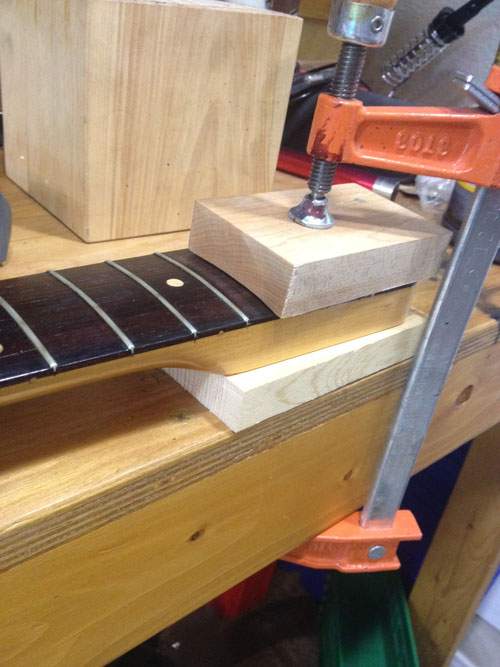
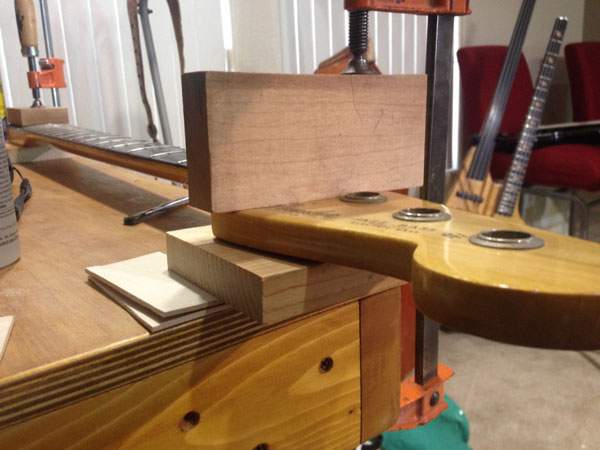
So, I set up on the edge of a workbench, with a 3/4" block under each end to make space under the neck for fully wrapping the heating pad around it; a radiused clamping caul over the frets on the treble end; and some 3/32" shim stock under one side of the block under the tuning head end to set the opposite twist a little beyond dead flat in the other direction. I removed the truss rod nut, let the neck warm up for a couple hours, and then clamped the treble end down hard, and fortunately did not hear any cracks, creaks or groans from the neck as I gradually increased the clamp pressure on the tuning head, applying twist in the opposite direction.
After only a couple days, I opened it up to check - no real measurable progress, but also no heat damage to the finish or the fingerboard glue seam or any cracking evident, so I figured Ok just let it continue and re-clamped it, with a little bit more shim stock under the tuning head end. A couple days later I checked again, there was finally about 1/16" less twist! (25% closer to my goal!) That got me excited. So I re-clamped it and didn't even look again till Day 7, where it had reached within 1/16" of perfect flatness!
So, now I've re-clamped it - My question is, now that I have it almost flat
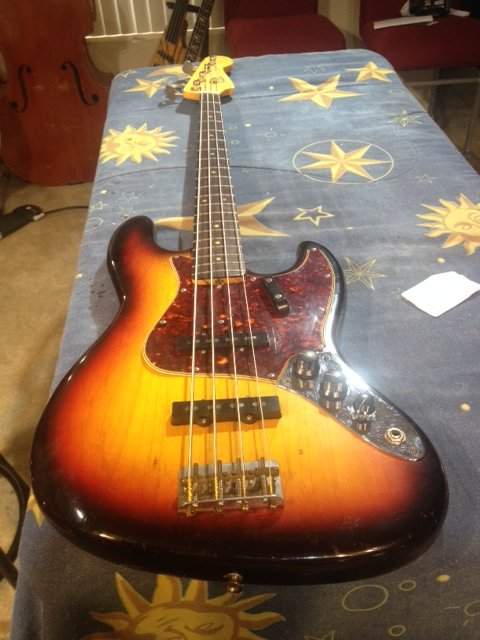
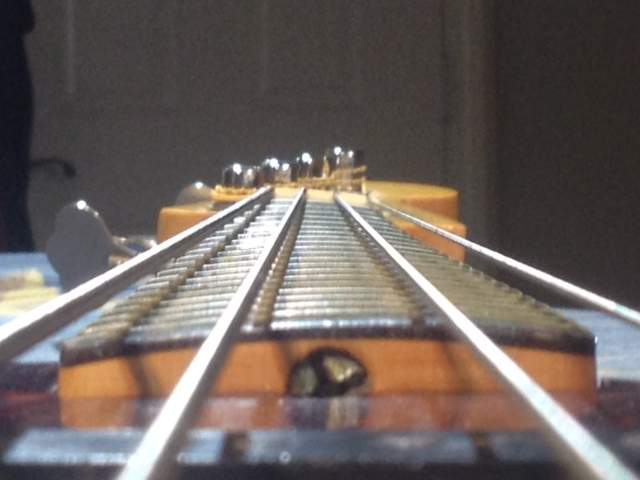


 should I expect some twist-back, and keep it clamped until it's actually slightly twisted in the other direction? Or should I just relax, and stop the heat-press process as soon as it's exactly flat? Or - should I wait till it's flat, and leave it clamped flat for a few days to let it "set"?
But, having just recently had the job of un-twisting some pernambuco cello and bass bows, I knew there was still a slim possibility of success with the much larger and denser maple bass neck, applying the same principles. What did I have to lose, anyway? Another luthier had already given it the do-not-rescuscitate tag. So I've been reading of another luthier currently being sued for breaking a twisted, but very valuable old cello bow, and read all the expert analysis as to how that occurred, and set about coming up with a strategy for un-twisting this neck, without making the same mistakes apparently made by this poor guy. The key, apparently, to a successful un-twisting is the even, consistent application of a sufficient level of heat that warms the entire neck to its core, before applying pressure in the opposite direction. And then, keeping it for a sufficient time under steady heat and pressure to effect the desired change.
My first challenge was coming up with a way to be able to heat the entire neck, and be able to keep it consistently heated to the core for a long enough period of time (even weeks if necessary) to allow the wood to re-set. I also didn't want there to be too much heat, as to cause any other damage to the finish or the glue holding the fingerboard on. Since I don't have a kiln, it occurred to me to wrap it with a long, 22"x12" heating pad, that I keep around for my sore back. After wrapping it tightly around a piece of scrap for a while, I found that on medium setting, it keeps the wood at a consistent 130 degrees, just about the same temp as a typical Las Vegas garage during the summer, as luck would have it.
So, I set up on the edge of a workbench, with a 3/4" block under each end to make space under the neck for fully wrapping the heating pad around it; a radiused clamping caul over the frets on the treble end; and some 3/32" shim stock under one side of the block under the tuning head end to set the opposite twist a little beyond dead flat in the other direction. I removed the truss rod nut, let the neck warm up for a couple hours, and then clamped the treble end down hard, and fortunately did not hear any cracks, creaks or groans from the neck as I gradually increased the clamp pressure on the tuning head, applying twist in the opposite direction.
After only a couple days, I opened it up to check - no real measurable progress, but also no heat damage to the finish or the fingerboard glue seam or any cracking evident, so I figured Ok just let it continue and re-clamped it, with a little bit more shim stock under the tuning head end. A couple days later I checked again, there was finally about 1/16" less twist! (25% closer to my goal!) That got me excited. So I re-clamped it and didn't even look again till Day 7, where it had reached within 1/16" of perfect flatness!
So, now I've re-clamped it - My question is, now that I have it almost flat
Last edited: