• TalkBass has been independent since 1998. Add your voice.
    Create a free account to reply to discussions, view embedded media, and browse with fewer display ads.
    Join freeLog in
    Want zero display ads or expanded classifieds tools? Compare plans.

Double Bass Research Continues

... Epiphone in fact did make basses. Anybody checked any of those to get some clarity re linings?

Epiphone basses had internal and external linings. That applies to both the 1940s/50s models made in New York, and the 50s/60s models made in Kalamazoo...
 
No external linings on the Kalamazoo stuff. At least not on the Studio model in my shop right now.

Interesting, there must have been variations. The one I recently had was a B4S model, made late in their production (possibly as late as 1965, when they were winding down). You can just see the outer linings in the C bout at the top of this photo:

top and bridge.jpg
 
  • Like
Reactions: Rebop
I notice your top still seems to have plenty of arching. The B4S had a really thin top (like 3 layers of 1mm ply) and had collapsed. I re-shaped the top and then added another layer of veneer on the inside of the top. Interesting experiment, which thankfully worked, but probably not something I'd rush to do again...
 
Interesting, there must have been variations. The one I recently had was a B4S model, made late in their production (possibly as late as 1965, when they were winding down). You can just see the outer linings in the C bout at the top of this photo:

View attachment 5352987

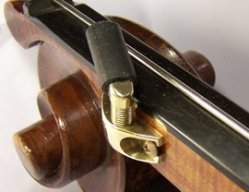
What I find most interesting here is those bridge adjusters. Never seen anything like them before, and I would not be surprised if they are much easier to turn to raise the bridge with the strings under tension than the thumbwheel version so common now.
 
... What I find most interesting here is those bridge adjusters. Never seen anything like them before ....

Those are George Van Epps adjusters, with the patent # stamped right on the bridge. He was a guitarist and inventor. With the metal to metal threads, they seemed to work quite well, so long as they were lubricated. They kind of remind me of Sputnik or Telstar, one of those early satellites.
 
Those are George Van Epps adjusters, with the patent # stamped right on the bridge. He was a guitarist and inventor. With the metal to metal threads, they seemed to work quite well, so long as they were lubricated. They kind of remind me of Sputnik or Telstar, one of those early satellites.

I've known Van Epps was a guitarist, played a seven-string I believe, but him as an inventor is news to me. I will look into this more. Thanks.
 
  • Like
Reactions: eh_train
Those are George Van Epps adjusters, with the patent # stamped right on the bridge. He was a guitarist and inventor. With the metal to metal threads, they seemed to work quite well, so long as they were lubricated. They kind of remind me of Sputnik or Telstar, one of those early satellites.

Very interesting design, but I'm not a fan. Not only are they hard to look at, but they must be quite heavy. Mass is no friend to a bridge. I think the problem has been solved by whoever created the one piece aluminum wheel adjuster with 1/4-UNC thread. If they are hard to turn they either weren't installed properly or the top has moved and caused side forces in the thread.
 
  • Like
Reactions: Ned Smith
Fred Van Epps was famous for his banjo playing and building starting in the late 1890s. He recorded some of the early ragtime cylinders for the Edison Phonograph Company and many other early recording companies of the time. He was one of the longest living original "classic" 5-string banjo players, active into the early 1960s.

His son, George Van Epps of guitar fame, is the person who designed the adjusters in question.

Here's a take-off of those adjusters, on my Deuce bridge:


As someone who has these adjusters, I'm ok with their visual affect, but in my opinion they are functionally overkill. A person shouldn't need to adjust their action very often.
 
Last edited:
  • Like
Reactions: eh_train
Work progresses. The mold has been built and rebuilt. The Oak for the ribs has been resawn and is ready to be reduced to the proper thickness.This will be a flat back instrument so I have selected 1/4 birch plywood for that.

I am now searching for wood for the front. The minimum price I have found is $645 including shipping for marine grade Sitka Spruce. Here, I am going to go against the advice of the group and go to Lowes and get the clearest Spruce 2x6s I can find to glue up a 44"x28"x2" block for carving.

I have watched several videos on carving the front. They all use small gouge planes sometimes called "thumb" planes. I can get a set of 6 for $36 or one for ~$90. I would like to get a good one but at those prices I can afford only one. Which one?

Also I have seen a device that looks like a small hole saw used to set the depth of wood to be removed when carving the front. I don't know what to call it so I can't find it. Can you help me with that?
 
Work progresses. The mold has been built and rebuilt. The Oak for the ribs has been resawn and is ready to be reduced to the proper thickness.This will be a flat back instrument so I have selected 1/4 birch plywood for that.

I am now searching for wood for the front. The minimum price I have found is $645 including shipping for marine grade Sitka Spruce. Here, I am going to go against the advice of the group and go to Lowes and get the clearest Spruce 2x6s I can find to glue up a 44"x28"x2" block for carving.

I have watched several videos on carving the front. They all use small gouge planes sometimes called "thumb" planes. I can get a set of 6 for $36 or one for ~$90. I would like to get a good one but at those prices I can afford only one. Which one?

Also I have seen a device that looks like a small hole saw used to set the depth of wood to be removed when carving the front. I don't know what to call it so I can't find it. Can you help me with that?

Ned, you may want to do a TB search for Joey Nager's Home Depot bass project.

Thumb planes are great for more final carving, smoothing and graduation. You'll be starting with a large gouge, or a power rotary plane type of tool.