• TalkBass has been independent since 1998. Add your voice.
    Create a free account to reply to discussions, view embedded media, and browse with fewer display ads.
    Join freeLog in
    Want zero display ads or expanded classifieds tools? Compare plans.

Responsible use of amp power

I think I see the disconnect. That's digital information. Humans take note of the steady state with a fast enough refresh rate making it ''new info'' again and again.

Fortunatelly the real world is analoge rather than digital.
But flipping a coin is the least storable information even in the analoge world.

If a sine wave shall at least store the least storable information of the anaolge world (just flip a coine) then the "coin" must show a head on the top side and also a tail on the bottom side of the coin.

If a sine wave is switched from on to off randomly then the generated frequency spectrum equals noise just the moment the level goes Hi or Low, that means shows Head or Tail.
When this happens its not valid anymore to consider the pure frequency number of the sine wave.
 
Last edited:
What about the durational information in a finite length sine? Humans register it as 'still on still on still on.....'' until it's off then what was just heard becomes the note.

Some humans can read it written down and ''hear it'' in any time they like. That's three 'pieces' of information embedded in the one note to be played Pitch, relative duration and tempo.
 
What about the durational information in a finite length sine? Humans register it as 'still on still on still on.....'' until it's off then what was just heard becomes the note.

Some humans can read it written down and ''hear it'' in any time they like. That's three 'pieces' of information embedded in the one note to be played Pitch, relative duration and tempo.
I do comprehent your words and meaning.

In science of information theory any input that is nothing but
still on still on still on
does not store information

In the science of system theorie a signal that is
still on still on still on
demands a transfer channel with nothing but its Fourier harmonics.


Try to imagine a random guy who might spell nothing but the sustaining vocal "o"

How are you?
"o"

How is the weather in your town?
"o"

Do you feel all right?
"o"

Do you play a gig this night?
"o"

How old are you?
"o"

do you feel sad?
"o"

how are you?
"o"


different situation for just the same procedure

How are you?
"o"

How is the weather in your town?
""

Do you feel all right?
"o"

Do you play a gig this night?
""

How old are you?
""

do you feel sad?
""

how are you?
"o"

The question asked how old are you can't be answered with just "o" or ""

But in this case we can conclude that

he feels alright
the weather isn't fine in his town
he don't plays a gig that night

the guy could also use a beeper just to give a comprehensible answer.
But it would make no sense anymore if the beeper was ON all along the time.
Similar like a steady state sine wave there was no more information stored anymore.
Just as Shannon told the least storable information is flipping a coin.
 
Last edited:
ok, some folks may ask a valid question what the hell does it all have to do with a bass guitar amlifier?

Amplifier power ratings are derived from steady state sine waves.
A steady state sine wave does not tell anything about the amplifier capability how the amplifier feels in real practice with dynamical signals such as a bass guitar signal.
In real practice any amplifer has to deal with rather complex stuff than the amp was measured on the bench with a "simple" steady state sine wave.
IMO it makes no sense to discuss THD numbers such as 1% vers 0.5% and try to figure gainable numbers for clean output power.

There is something different going on under the hood than a steady state sine wave when ever we play the bass guitar in real practice.
I ain't a guy how expects an amplifier for 100% duty cycle capability cause in real practice its anyway not possible to get the power out of the amp like was rated RMS 1% THD.

In a rather conservative consideration I'd expect at best 100 Watt clean power with a bass guitar if the amp was rated 400 Watt RMS 1% THD.
 
Last edited:
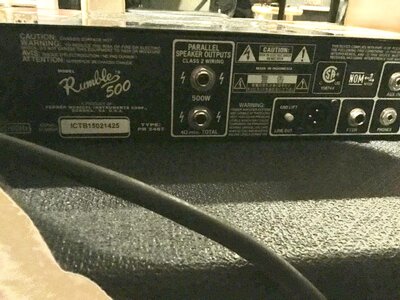
...so, if this amp is rated 500, and I have one cab with a speaker rated at 225, does that leave room for another cab at 225.

OP, to me, a bulletproof rig - or one that comes as close as you can get - would be a cab or cabs that have at least twice the wattage rating as the head, not the other way around. if you have a 500 watt head and 1200 watts of cabs, you can still damage your cabs, but it's a lot less likely than the setup you described in your initial post.
 

Attachments

  • 3C29D4F9-3E3A-46AF-B68E-CFD8C81D2C25.jpeg
    3C29D4F9-3E3A-46AF-B68E-CFD8C81D2C25.jpeg
    910 KB · Views: 20
Giving everyone an update from this green bass player. I took the amp and head to Momar Music in San Antonio, and at first he agreed it seemed like a blown speaker, which sounded like the 15” speaker was blowing its nose, but switching output to another speaker, it sounded awful there as well, which directed Michael Marks’ attention to the Fender Rumble Head. Upon examination, all the pots were tight and the gain was scratchy when rotated. So he cleaned the gain pot, which loosened up, then the rest of the pots. The raspy sound is gone and full throat is now back and sounding great. Thanks to everyone for their comments, and the problem is solved, for now. I’m still not comfortable with the variability of “responsible use” directive from the Eminence tech, but I was able to turn up past 12 o’clock. I may eventually get a heartier speaker for peace of mind. Something like this... https://www.musiciansfriend.com/acc...amic-bass-replacement-speaker/j40261000001001
 
  • Like
Reactions: pcake and Wasnex
Why did the tech not test the speaker before assuming that it was bad? Just because it sounds like a bad speaker doesn't rule out MANY other possible causes within an amp.
 
  • Like
Reactions: pcake
Why did the tech not test the speaker before assuming that it was bad? Just because it sounds like a bad speaker doesn't rule out MANY other possible causes within an amp.

He did what I couldn’t do, he lined out to another bass speaker cabinet in his shop, and discovered the same sound effect - concluding the problem likely was in the head. After the twist test, a scratch was discovered in one of the pots, so cleaning became obviously needed, and at the end, the noise dissipated in the shop speaker. Plugging back into my cabinet, the result was confirmed. No additional electronic test of my speaker was necessary at that point.
 
Thanks for that bit of advice.

I’m playing country in one band and classic rock in another on a short scale 4 string bass, never pushing anything. I want to play with fingertips and smooth as velvet, with only n occasional attack stance, but I want to ply at a volume that gives me the assurance I need to play without look8ng over my shoulder. When my amp started rattling, I used my line-out and went directly to the PA with no problem (the Rumble head transitioned perfectly) and the PA took the signal well - I have 15” mains by EV. I can’t afford at this time to upgrade my cab, but if these two bands create more paying gigs, I will consider.

what do you like about the twin 10” vs one 15”?

https://www.sweetwater.com/store/de...2x10-inch-700-watt-bass-cabinet-silver-grille, you're looking for a simple answer where there is none.

you can fry a cab easily if you play hard with lots of distortion or lots of lows or mids. for that matter, lots of drive can change things, too. the settings you show would work as long as you don't do anything crazy, but playing with serious attack and heavy mids or some effects could make that risky.

i wouldn't use a 225 cab with that head at all. i'd replace that 225 watt cab with one of these
Robby Sturgis (there's also a version with a black grill). will it hold up to everything you can do to it with a 500 watt rumble head? probably not, but it will handle a lot more, and that's a good start.

a friend of mine - let's call him chris because that's his name - is a bass player. his rig was 300 watts, and it served him well. then he played with my future husband, who at that time played rehearsals and jams at full punk rock / death metal concert hall volume. chris tried to keep up, but instead of saying "hey, dude, you need to turn down", he tried to turn up to get over the mighty 100 watt ampeg V4. the bass was never audible, but he destroyed pretty much everything - his head as well as his cab.

i mention this because since you're new to separate components, not only do you always want headroom when possible, but you want a speaker that can handle more just in case. especially if you're unsure if your ears can tell you when something is wrong.

and please re-read Wasnex's post until you understand it. ask about the parts you don't understand or google them.