Hi All, I bought new strings for my uprght ( Thomastik Spirocores). I searched but didn't find much info on changing the strings. I know it's not a hard process Just that I've never changed strings on an upright before and was wondering if the sound post will move. I believe you start with the G or E string and then work your way over to the next string. Sorry for being lengthy and asking a nerdy question lol.

Enjoy the benefits of a premium membership!
Upgrade Account
-
TalkBass has been independent since 1998. Add your voice.
Create a free account to reply to discussions, view embedded media, and browse with fewer display ads.
Join free Log in
Want zero display ads or expanded classifieds tools? Compare plans.
You are using an out of date browser. It may not display this or other websites correctly.
You should upgrade or use an alternative browser.
You should upgrade or use an alternative browser.
Double Bass Restringing Question
- Thread starter banks
- Start date
More options
Who Replied?


- Jan 24, 2002
- 2,117
- 950
- Disclosures
- NS Design / AER Endorsing Artist
Marty's advice is exactly right. One at a time, always keeping some tension on both sides of the bridge. However, you might need to slightly loosen other strings to get the strings fit into the peg holes. I like to change them in order of closeness to the nut, so on most basses E-G-A-D. Graphite for lubrication is a must.
If you have a particularly loose-fitting sound post, you could try changing the strings with the bass on a table, horizontal. However, if the sound post is really that loose, it ought to be replaced.
Also, make certain you are turning the peg in the right direction when you put the new string on. If standing from behind the scroll, that would be counterclockwise. Check to make sure the balls of the string aren't about to pop out of the tailpiece before you tune the string up completely. If using an electric drill, be very careful not to over-tighten the string. It's very easy to go from totally loose to snapped with a drill.
This may be more aesthetic than anything else, but I like to keep the string continuing a straight line from the nut to the peg, so they are all parallel to each other. This can take a little finagling, and took me a number of attempts before I learned how to do it consistently. I'm not sure it makes a big difference (or any difference), though I've been told it's decidedly best to avoid the strings crossing each other in the pegbox.
If you have a particularly loose-fitting sound post, you could try changing the strings with the bass on a table, horizontal. However, if the sound post is really that loose, it ought to be replaced.
Also, make certain you are turning the peg in the right direction when you put the new string on. If standing from behind the scroll, that would be counterclockwise. Check to make sure the balls of the string aren't about to pop out of the tailpiece before you tune the string up completely. If using an electric drill, be very careful not to over-tighten the string. It's very easy to go from totally loose to snapped with a drill.
This may be more aesthetic than anything else, but I like to keep the string continuing a straight line from the nut to the peg, so they are all parallel to each other. This can take a little finagling, and took me a number of attempts before I learned how to do it consistently. I'm not sure it makes a big difference (or any difference), though I've been told it's decidedly best to avoid the strings crossing each other in the pegbox.

One more thing (actually two)
1. Before you start, measure the length of the string from the nut to the bridge. Write it down.
2. With a soft lead pencil and a ruler, mark the positions of each corner of each bridge foot.
When you finish changing the strings, make sure all the measurements and positions are the same as before you started.
1. Before you start, measure the length of the string from the nut to the bridge. Write it down.
2. With a soft lead pencil and a ruler, mark the positions of each corner of each bridge foot.
When you finish changing the strings, make sure all the measurements and positions are the same as before you started.
Thanks for the great advice, I appreciate it. Is there anything i need to do when putting the string through the peg hole?
First of all, you want the bass to be stable. If it's moving around as you tighten the strings it will make things very frustrating.
I leave some slack in the string to start. As I wind it onto the peg I pass it to one side of the string end as it comes around. On the second revolution I pass the string over the other side. This prevents it from pulling loose. I pull the string -kind of like an archer - as I wind it onto the peg to allow it to wind neatly. Just as the string begins to tighten, I guide it to keep it in line with the nut slot.
Be careful not to let them ride up against the walls of the pegbox, and don't forget to drink your Ovaltine.


If it gets a little tight in the pegbox to keep the strings winding evenly with just fingers, especially as the string is starting to tighten up, or if you started on the A or D string and are now trying to tuck underneath with a G or E string, a little help from something small, like a small wooden ruler or even a popsicle stick, can help guide the string so it doesn't bind or overlap, but stays even on the post. Evenly wound = stability in tuning.

One more thing (actually two)
1. Before you start, measure the length of the string from the nut to the bridge. Write it down.
2. With a soft lead pencil and a ruler, mark the positions of each corner of each bridge foot.
When you finish changing the strings, make sure all the measurements and positions are the same as before you started.
This is great advice. My luthier penciled this measurement on the underside of my bridge, and I check this measurement regularly.
He marked the G-side bridge foot position with two pin holes [if you saw the top of my bass you would not be outraged by this].
- Aug 1, 2005
- 3,546
- 1,421
- Disclosures
- Private Inventor - Bass Capos
This is great advice. My luthier penciled this measurement on the underside of my bridge, and I check this measurement regularly.
He marked the G-side bridge foot position with two pin holes [if you saw the top of my bass you would not be outraged by this].
Not a bad idea. I went in to my luthier once for something routine and he pointed out that my bridge was so out of alignment that E string was like 1/4" longer (nut to bridge) than my G. I guess it happened gradually and I just adjusted my playing on the go. I think that if you play guts you need to be particularly attentive on this.

Another restringing issue which you will probably need to address sooner or later is whether or not to trim string ends. Some people are adamant that you should always use the full length of the string, never cut.
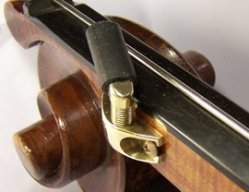
I personally dislike big ugly wads of string on the peg and back-and-forth overlapping turns that rub on the lead of the next higher string, so I trim. It needs to be done carefully, though. I calculate how many winds I want on the peg and how much extra string length I need to achieve that. Then I slip a piece of shrink tubing over the string end, slide it down to the cut location, and shrink it down tight with a heat gun. I can then cut through the string and heat shrink tubing together without fear of the silking or the wrap wire unwinding. The result is a neat and tidy pegbox with smooth straight string leads (photo).
The one big disadvantage of trimming that I see is it makes the strings less attractive for resale if you try a set and decide for whatever reason that you don't want them.
=====
I personally dislike big ugly wads of string on the peg and back-and-forth overlapping turns that rub on the lead of the next higher string, so I trim. It needs to be done carefully, though. I calculate how many winds I want on the peg and how much extra string length I need to achieve that. Then I slip a piece of shrink tubing over the string end, slide it down to the cut location, and shrink it down tight with a heat gun. I can then cut through the string and heat shrink tubing together without fear of the silking or the wrap wire unwinding. The result is a neat and tidy pegbox with smooth straight string leads (photo).
The one big disadvantage of trimming that I see is it makes the strings less attractive for resale if you try a set and decide for whatever reason that you don't want them.
=====
>> Upton now includes a notched stick, a "ruler," if you will, that you place the offset butt against the fingerboard and the notch on the bridge. If you're at the correct distance, the bridge just slips right into the slot.
That's a clever idea, I think I'll make one of those. If you were to put that in place for the first few retunings after you install a new set of strings, I wonder if it would keep the top of the bridge from tilting towards the fingerboard, as it tends to do?Attachments

Of course! I thought that was understood.Good idea, but this only helps if the positions of the bridge feet are also marked.
>> Upton now includes a notched stick, a "ruler," if you will, that you place the offset butt against the fingerboard and the notch on the bridge. If you're at the correct distance, the bridge just slips right into the slot.That's a clever idea, I think I'll make one of those. If you were to put that in place for the first few retunings after you install a new set of strings, I wonder if it would keep the top of the bridge from tilting towards the fingerboard, as it tends to do?
I made one out of masonite. It works really well.

I read in a different thread about the common problem of the D string rubbing on the G in the pegbox. I am finding it hard to avoid this due to where the holes are in the tuners (I've seen pix of other tuners with holes positioned so that it's less of a problem).
Looking at the pegbox, it really looks like I could switch those two strings and they would be clear of each other. The G would just run along the edge of the box, and as long as the D (on the G tuner) didn't wind all the way to the edge they would be clear.
Personally, I would actually find this arrangement more intuitive. Is there some other reason why it's a bad idea?

Looking at the pegbox, it really looks like I could switch those two strings and they would be clear of each other. The G would just run along the edge of the box, and as long as the D (on the G tuner) didn't wind all the way to the edge they would be clear.
Personally, I would actually find this arrangement more intuitive. Is there some other reason why it's a bad idea?
- Aug 1, 2005
- 3,546
- 1,421
- Disclosures
- Private Inventor - Bass Capos
Thanks!
I pushed the G over there to clear the D. It's not rubbing the cheek. Still, I don't like the D running across the hole in the G post. The hole positions just aren't that great.
I pushed the G over there to clear the D. It's not rubbing the cheek. Still, I don't like the D running across the hole in the G post. The hole positions just aren't that great.

Another restringing issue which you will probably need to address sooner or later is whether or not to trim string ends. Some people are adamant that you should always use the full length of the string, never cut.
I personally dislike big ugly wads of string on the peg and back-and-forth overlapping turns that rub on the lead of the next higher string, so I trim.
You can have it all-- almost. I never have and likely never will trim strings. I've never had an issue with rubbing at all. (The G is just kissing the cheek and, since changing strings, I've moved it even further over so that there's no contact). Note that the G tuning peg is the lowest on my bass.
AntonLargiader
Hi - my pegbox looked exactly like yours, and no matter how carefully I tried to arrange the strings, the D rubbed on the G windings and the G hole. I thought that this shouldn't do any harm - after all, how much do the strings move after initial tuning? After a couple of months, both strings had not only worn through on the silk, but the windings were wearing through as well.
I bit the bullet, bought two new strings, and reversed the D and G. Result - no rubbing and no wear. It doesn't look like it's too late for you, so my advice is - do it!
It was also surprisingly easy to remember not to tune the strings with the wrong tuner, but I expect the price of strings helps to jog my memory!
I found absolutely no detectable change in sound either, by the way.
Hi - my pegbox looked exactly like yours, and no matter how carefully I tried to arrange the strings, the D rubbed on the G windings and the G hole. I thought that this shouldn't do any harm - after all, how much do the strings move after initial tuning? After a couple of months, both strings had not only worn through on the silk, but the windings were wearing through as well.
I bit the bullet, bought two new strings, and reversed the D and G. Result - no rubbing and no wear. It doesn't look like it's too late for you, so my advice is - do it!
It was also surprisingly easy to remember not to tune the strings with the wrong tuner, but I expect the price of strings helps to jog my memory!
I found absolutely no detectable change in sound either, by the way.

Old post here, but I notice your E string is on the second tunings post. I've been to two luthiers that have different opinions on if this is the "right thing" to do. Currently my E string is on the the first tuning post, but would like to try it on the second post. Why do you have your E string on the second tuning post? Do you prefer that to the first tuning post? ThanksYou can have it all-- almost. I never have and likely never will trim strings. I've never had an issue with rubbing at all. (The G is just kissing the cheek and, since changing strings, I've moved it even further over so that there's no contact). Note that the G tuning peg is the lowest on my bass.
View attachment 2044274


