You liked it enough to make a thread about it. I’d say that Reverb’s algorithms are spot on.

TalkBass has been independent since 1998. Add your voice.
Create a free account to reply to discussions, view embedded media, and browse with fewer display ads.
Join free Log in
Want zero display ads or expanded classifieds tools? Compare plans.
It's normal to see the saddles for heavier strings set back further than the saddles for lighter strings, that's how you intonate guitars. Not strictly necessary for fretless instruments but it makes playing a little easier, particularly on lined fretless. In this case, it's pretty extreme and that might be because the action is really high, there's a huge difference between the low and high strings, or neither of the above and the bridge was just placed wherever.OK, I have a question. Kind of a real question actually. If the bridge is set at an angle to the neck, and the nut is square to the neck, how does that work?? I have a fretless bass, and while I am NOT very good at playing it, I understand where the "frets" would be. I understand how a fan fretted bass works, but this one has me confused. Is it like a fan fretted only different? Why isn't it more common? Is it more comfortable to play? Here's your teaching moment for the day. Thank you.

I have family in Greensboro, live an hour from there, and until this exact moment had no idea Roscoes were made there.It's unfair to call it lazy when he's charging the low hundreds for fully custom basses.
When somebody wants a fully custom bass and isn't willing to spend four-digit sums for one, this is the level of work they should be expecting.
Fun fact: Wish is in Winston-Salem, and Roscoe is in the city next door, Greensboro.
OK, on a regular bridge, I understand the slight forward and backward adjustment of the saddles. I think what is throwing me off is that this bridge has fixed saddles (like an upright bass), where a fanned fret bass has adjustable saddles. So does that mean the only way to do any intonation is only by shifting your finger position up or down the neck as needed, for each string? It seems to me this could get kind of... challenging? It's all new to me.It's normal to see the saddles for heavier strings set back further than the saddles for lighter strings, that's how you intonate guitars. Not strictly necessary for fretless instruments but it makes playing a little easier, particularly on lined fretless. In this case, it's pretty extreme and that might be because the action is really high, there's a huge difference between the low and high strings, or neither of the above and the bridge was just placed wherever.

too bad they took down the vid of him demoing one of his fretlesses awhile back. nobody can make a bass sound like a cow mooing like wish!
Holy cow.
this?

It's probably a floating saddle, so that you can position it wherever you like.OK, on a regular bridge, I understand the slight forward and backward adjustment of the saddles. I think what is throwing me off is that this bridge has fixed saddles (like an upright bass), where a fanned fret bass has adjustable saddles. So does that mean the only way to do any intonation is only by shifting your finger position up or down the neck as needed, for each string? It seems to me this could get kind of... challenging? It's all new to me.
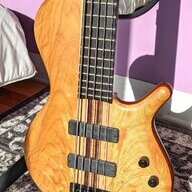

That what violins family instruments, mandolins, Archtop guitars, amongst others do to achieve intonationSo you set the intonation by moving the fixed bridge back and forth until it’s….sorta close?


this?

Wow. That really does sound like a cow. Is that the builder playing it?


Not sure if it's the exact 1, but that's certainly.......... something.
 The sound of that made my face hurt.