Hi Everybody!
Let me start off by saying I really hate doing reviews, but I feel compelled to write one on the Underhill PD-2 Filter Onboard Preamp because I was really surpised and am now a huge believer in this little bit of tech. Let me start off by saying I'm not the most knowledgable player when it comes to technology, but I do appretiate innovation and gear that just works solidly ever time. Plus, for me to personally take a moment and write a review about a new product I've come across, it'd have to be something that I felt not only sounded amazing, but filled a nitch in the bass gear market that was severly lacking and take a big step forward from a design perspective from that of any similiar product available on the market. This filter preamp easily definitely ticks all those boxes in my opinion.
First a bit of backstory, I was recently in a position where I'd aquired a new bass (a Wal Mk.2 clone) with a Lusithand preamp installed. Unfortunately, within weeks of accepting shipment, the Lusithand failed on me. It seems one of the push/pull pots which are wired directly into the circuit board just popped free of the housing and ceased working. It'd just spin freely within it's housing and not engage the filter any longer. Following this, I reached out to the owner of Lusithand in the UK where they're located and they were very nice in offering for me to send it to them directly for replacement. Unfortunately, the turnaround time to do so would leave me without a working instrument for quite some time. While I contemplated this I thought I'd do a little research and see what if any domestic builders were availible on this side of the pond currently building onboard filter preamps. That's when I first came a cross a local company called Underhill basses (https://www.underhillbass.com/) and it's owner Tim who just recently began building his own dual filter based preamps inhouse and I'm sooooo glad I did.
Sound-
While I truly love the sound of the Lusithand NFP-Special and an ACG I recently had the chance to try, I gotta give Tim over at Underhill huge props for taking his own spin on a sound of which Wal has set the standard and not only making it his own but improving upon it significantly in my opinion. I use to own an old '84 Wal mk.1 and neither the Lusithand or ACG really duplicated that rich tone I remember. The Underhill PD-2 on the other hand offers something the other two significantly lack. The two filter knobs not only seem to offer a wider sweep across their respective bands, but also contain more usuable tones as well. The PD-2 I currently have installed is also much quieter overall as well and since I picked up this bass mostly to use in recording, that's a huge bonus. This preamp through the stock pickups allows for deep dub like tones to the Wal like growl someone like Justin Chancellor of Tool is known for. Deep dub to aggressive growl and everything in between with just a simple twist of a filter knob. Plus, in the PD-2 model which I have, there are two tiny internal trim pots which all you to control the individual gain of each pickup as they're filtered by the preamp. You can dial these to balance volume or boost the filtered gain as needed. In my case, this has allowed me to take a bass with low output impedence pickups and balance it out to closely match the volume of other basses in my arsenal.

Construction-
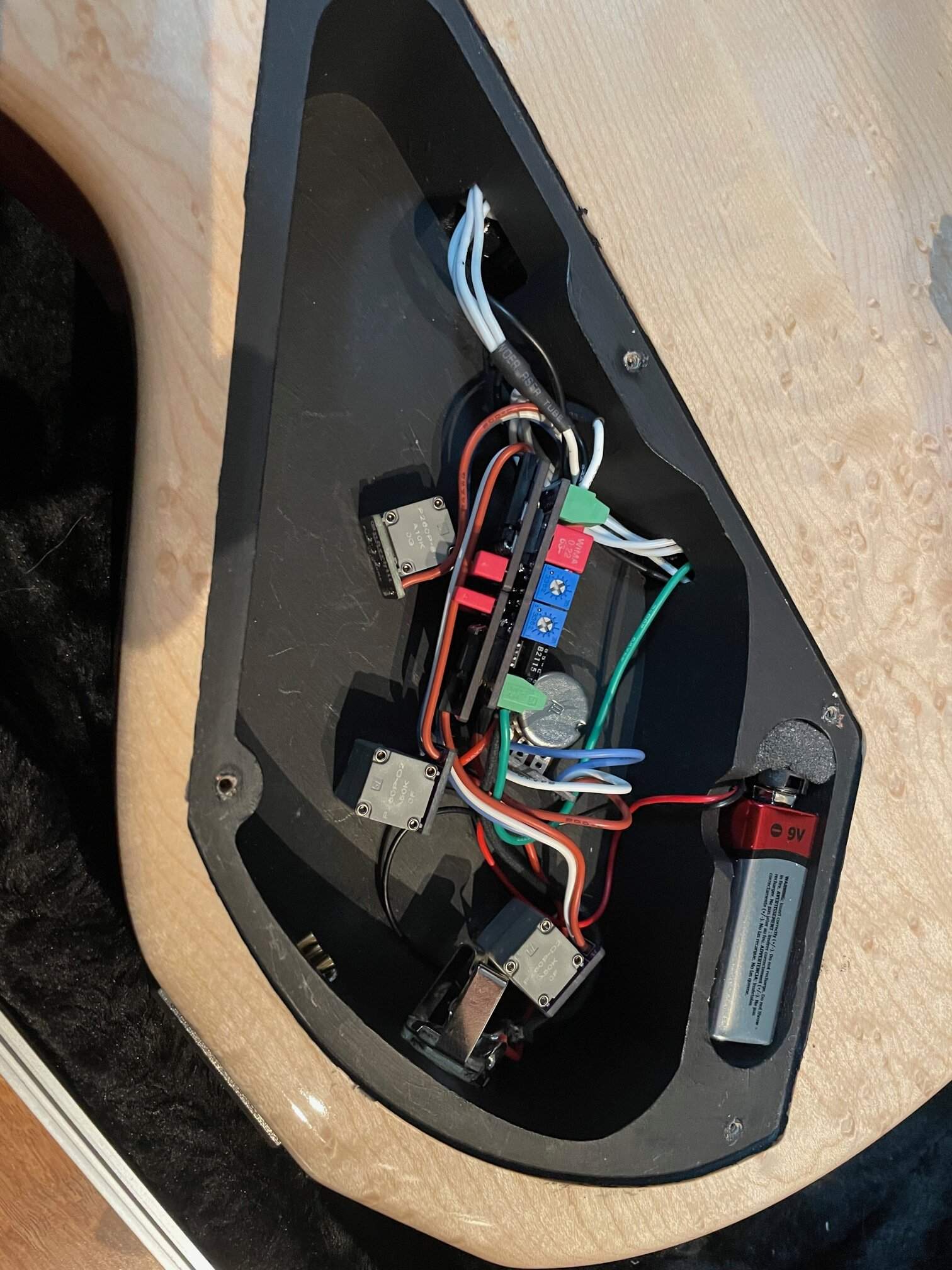
Now this is where I was most pleasantly surprised by the Underhill preamp. Where as most Wal based filter preamps on the market utilize 6mm potentiometers wired directly to the circuit boards, meaning that should a part short out, break or be in need of replacement, the dual preamp's designed by Underhill allow for an array of swappable replacements. Not only are the wiring and pots used top notch, with the latter just feeling more robust and built of the long haul, but can you easily preplace parts or swap out the filter's layout/design from bass to bass with just a few changes.Not to mention if you find yourself in a similar position like I did, you don't need to replace an entire preamp should it just be a pot that fails. Now the pot can just be swapped out and then your up and playing again in no time. This design in my opinion also allows for a huge degree in flexibility should you ever want to remove the preamp from your bass and use it in an other instrument with a different control layout. Also, by not having your pots wired straight into the circuit boards it allows you to place the preamp wherever within the control cavity which makes sense to you, instead of having the place the boards in relation to where the holes for the pots are located. Within some basses real estate can be tight and the Underhill design does away with this concern as you can see below.
Bottom Line -
What initially turned out to be an unfortunate circumstance for me with my Lusithand preamp breaking, became a blessing as it opened the doorway to me finding a much better designed and sounding solution in my opinion located right here in the US. After nearly 30 years of playing, the number of times I've come across a product that I felt really pushed or innovated the design of something already existing forward have been few and far between. However, given the few options available for purchase aftermarket for this type of product, I really can't say enought great things about not only the sound and design but the materials used as well.
That said, I do still plan on sending my original Lusithand preamp back for repair but given it's set in the box ready to ship for weeks and I still haven't sent it off since acquiring the above, that really tells me all I need to know about how pleased I've been with this product. Not to mention Tim with Underhill's customer service has been top notch every step of the way and he's made himself available for any and all question I've had has just been the icing on the cake. I really can't recommend this product enough and can honestly say his knowledge of electronics is astounding.
So in summation, if you're like me and in the market for a filter based preamp or just trying to snag that "Wal sound" at a fraction of the price take my word of it gang, this thing is IT!
Let me start off by saying I really hate doing reviews, but I feel compelled to write one on the Underhill PD-2 Filter Onboard Preamp because I was really surpised and am now a huge believer in this little bit of tech. Let me start off by saying I'm not the most knowledgable player when it comes to technology, but I do appretiate innovation and gear that just works solidly ever time. Plus, for me to personally take a moment and write a review about a new product I've come across, it'd have to be something that I felt not only sounded amazing, but filled a nitch in the bass gear market that was severly lacking and take a big step forward from a design perspective from that of any similiar product available on the market. This filter preamp easily definitely ticks all those boxes in my opinion.
First a bit of backstory, I was recently in a position where I'd aquired a new bass (a Wal Mk.2 clone) with a Lusithand preamp installed. Unfortunately, within weeks of accepting shipment, the Lusithand failed on me. It seems one of the push/pull pots which are wired directly into the circuit board just popped free of the housing and ceased working. It'd just spin freely within it's housing and not engage the filter any longer. Following this, I reached out to the owner of Lusithand in the UK where they're located and they were very nice in offering for me to send it to them directly for replacement. Unfortunately, the turnaround time to do so would leave me without a working instrument for quite some time. While I contemplated this I thought I'd do a little research and see what if any domestic builders were availible on this side of the pond currently building onboard filter preamps. That's when I first came a cross a local company called Underhill basses (https://www.underhillbass.com/) and it's owner Tim who just recently began building his own dual filter based preamps inhouse and I'm sooooo glad I did.
Sound-
While I truly love the sound of the Lusithand NFP-Special and an ACG I recently had the chance to try, I gotta give Tim over at Underhill huge props for taking his own spin on a sound of which Wal has set the standard and not only making it his own but improving upon it significantly in my opinion. I use to own an old '84 Wal mk.1 and neither the Lusithand or ACG really duplicated that rich tone I remember. The Underhill PD-2 on the other hand offers something the other two significantly lack. The two filter knobs not only seem to offer a wider sweep across their respective bands, but also contain more usuable tones as well. The PD-2 I currently have installed is also much quieter overall as well and since I picked up this bass mostly to use in recording, that's a huge bonus. This preamp through the stock pickups allows for deep dub like tones to the Wal like growl someone like Justin Chancellor of Tool is known for. Deep dub to aggressive growl and everything in between with just a simple twist of a filter knob. Plus, in the PD-2 model which I have, there are two tiny internal trim pots which all you to control the individual gain of each pickup as they're filtered by the preamp. You can dial these to balance volume or boost the filtered gain as needed. In my case, this has allowed me to take a bass with low output impedence pickups and balance it out to closely match the volume of other basses in my arsenal.
Construction-
Now this is where I was most pleasantly surprised by the Underhill preamp. Where as most Wal based filter preamps on the market utilize 6mm potentiometers wired directly to the circuit boards, meaning that should a part short out, break or be in need of replacement, the dual preamp's designed by Underhill allow for an array of swappable replacements. Not only are the wiring and pots used top notch, with the latter just feeling more robust and built of the long haul, but can you easily preplace parts or swap out the filter's layout/design from bass to bass with just a few changes.Not to mention if you find yourself in a similar position like I did, you don't need to replace an entire preamp should it just be a pot that fails. Now the pot can just be swapped out and then your up and playing again in no time. This design in my opinion also allows for a huge degree in flexibility should you ever want to remove the preamp from your bass and use it in an other instrument with a different control layout. Also, by not having your pots wired straight into the circuit boards it allows you to place the preamp wherever within the control cavity which makes sense to you, instead of having the place the boards in relation to where the holes for the pots are located. Within some basses real estate can be tight and the Underhill design does away with this concern as you can see below.
Bottom Line -
What initially turned out to be an unfortunate circumstance for me with my Lusithand preamp breaking, became a blessing as it opened the doorway to me finding a much better designed and sounding solution in my opinion located right here in the US. After nearly 30 years of playing, the number of times I've come across a product that I felt really pushed or innovated the design of something already existing forward have been few and far between. However, given the few options available for purchase aftermarket for this type of product, I really can't say enought great things about not only the sound and design but the materials used as well.
That said, I do still plan on sending my original Lusithand preamp back for repair but given it's set in the box ready to ship for weeks and I still haven't sent it off since acquiring the above, that really tells me all I need to know about how pleased I've been with this product. Not to mention Tim with Underhill's customer service has been top notch every step of the way and he's made himself available for any and all question I've had has just been the icing on the cake. I really can't recommend this product enough and can honestly say his knowledge of electronics is astounding.
So in summation, if you're like me and in the market for a filter based preamp or just trying to snag that "Wal sound" at a fraction of the price take my word of it gang, this thing is IT!