• TalkBass has been independent since 1998. Add your voice.
    Create a free account to reply to discussions, view embedded media, and browse with fewer display ads.
    Join freeLog in
    Want zero display ads or expanded classifieds tools? Compare plans.

Revolutionary bass guitar bridge - what do you think?

Interesting and original, but apart from looks, I see no advantages and a lot of drawbacks. It doesn't look easy to manufacture or install, although it looks like you already have. You'll need high-quality materials and tight tolerances if you expect it to last. So, expensive.

Mechanically, the post looks no worse than a Tune-o-matic tailpiece with the height adjustment on the bottom, but exactly how you connect that to the torpedo securely while maintaining adjustability is a question. But then, most guitar bridges are not really held together until the strings are tight. The ball end will probably chew up the end of the torpedo, I would hide it somehow. I also agree that having the ball-end hanging out in plain sight ruins the aesthetic.

It looks like Apple designed a bass bridge.

As far as the advantages of string-through, that is nonsense. String-through will add about 200 pounds (string tension) of compression on the bridge-body joint. You can easily make much more than that just by tightening the screws. It makes no difference where the compression comes from, only that the joint is tight enough. Through-body is useful when the bridge is too small to accommodate both the saddle screws and the ball ends, as is true on a Mustang for example, or many guitars. Apart from that, it is just a marketing gimmick, and has no effect on tone or sustain, except what you imagine.

In my opinion, Leo Fender's bent plate design is brilliant, and really nothing else is needed. It is cheap and easy to manufacture, easy to install, strong and fully adjustable. For different styles, you can change the shape of the plate, or replace it with a casting. Fender had a knack for boiling things down to their simplest form.
 
Last edited:
Interesting and original, but apart from looks, I see no advantages and a lot of drawbacks. It doesn't look easy to manufacture or install. You'll need high-quality materials and tight tolerances if you expect it to last. So, expensive. Mechanically, the post looks no worse than a Tune-o-matic tailpiece with the height adjustment on the bottom, but exactly how you connect that to the torpedo securely while maintaining adjustability is a question. But then, most guitar bridges are not really held together until the strings are tight. The ball end will probably chew up the end of the torpedo, I would hide it somehow. I also agree that having the ball-end hanging out in plain sight ruins the aesthetic.

It looks like Apple designed a bass bridge.

As far as the advantages of string-through, that is nonsense. String-through will add about 200 pounds (string tension) of compression on the bridge-body joint. You can easily make much more than that just by tightening the screws. It makes no difference where the compression comes from, only that the joint is tight enough. Through-body is useful when the bridge is too small to accommodate both the saddle screws and the ball ends, as is true on a Mustang for example, or many guitars. Apart from that, it is just a marketing gimmick, and has no effect on tone or sustain, except what you imagine.

In my opinion, Leo Fender's bent plate design is brilliant, and really nothing else is needed. It is cheap and easy to manufacture, easy to install, strong and fully adjustable. For different styles, you can change the shape of the plate, or replace it with a casting. Fender had a knack for boiling things down to their simplest form.

Thanks for your post. Yup it will be relatively expensive to produce. However tolerances won't be that crazy tight that it would make it super expensive either.
Yes, it is held tight when the strings are put under tension, like with most guitar bridges.

"It looks like Apple designed a bass bridge."
Thanks for the compliment!
 
That is a very good description :)

Which brings me to something I was told by a guy who hates Apple products but has a "few" of their shares. He said that "There are always people who want to waste their money on shiny things".

OP, you may be on to something ;)

Off topic, but ...

I got a MacBook in 2010, and at the time it was the best laptop on the market, no question (remember Vista?) With that and iPods, I became an Apple fan. Since then, Apple has been committing product suicide, and today I would not recommend a single Apple product to anyone for anything. I think Jony Ive has ruined every product line, software and hardware. The products today are beautiful, short-lived, unrepairable, and borderline non-functional. Tim Cook has turned the company into a scam.

I just got a Dell that blows away the new Macbooks for a fraction of the price, and even Windows 10 isn't that bad.
 
Last edited:

Attachments

  • Bass bridge concept.jpg
    Bass bridge concept.jpg
    68.8 KB · Views: 93
  • Untitled-1.jpg
    Untitled-1.jpg
    56.6 KB · Views: 66
  • Like
Reactions: Beej and Bassbeater
Thanks for your post. Yup it will be relatively expensive to produce. However tolerances won't be that crazy tight that it would make it super expensive either.
Yes, it is held tight when the strings are put under tension, like with most guitar bridges.

"It looks like Apple designed a bass bridge."
Thanks for the compliment!

You're welcome. It looks great, but rather Rube Goldberg. Mechanically, no different than a Gibson wrap-around guitar bridge, but stronger, since it has twice as many posts. It may actually have better sustain than a convention bridge, as the lack of tight coupling to the body means less damping.

That's assuming the subject of sustain has any validity at all. Sustain is almost entirely subjective. It is mostly dependant on feedback from your amp, and has nothing to do with the guitar. And what does it matter when you're playing 64th notes anyway?

I like to approach luthiery from an engineering standpoint, and from that point-of-view, luthiery is mostly BS.
 
Hupla hullahup

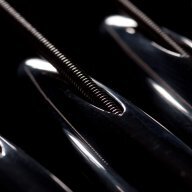
What do you think of these two?
Thanks for sharing.
The aesthetic is really cool. the "sharkfin" on the blonde bass looks like it would be hard to fit in a case because of the height. I could see it going on a custom "heavy-metal" instrument and looking good.
The "wolverine" on the black bass is interesting too. I'm concerned about overhang from the body. It seems like a protruding piece could get knocked out of position.
I see nice looking designs here. I don't know how they perform. I suggest putting them on some basses and letting local pros play them for feedback. Maybe this can help you dial in the details. I like the recurring style of the various designs.
Keep it up!
Good luck!
 
Hupla hullahup
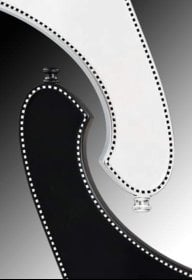
What do you think of these two?
This is looking better. Much better, 2nd on black bass is something I would have paid for design vise.
I think 1st one will be a PITA in gig bag: scratching it, collecting lint and hair, and catching on anything. But I guess it is designed for basses that are carried in hard cases by designated roadie.
But to be actually installed it has to have some mechanical merit. Some adjustability perk to stand off, or some problem solved. In short, what's it does?
 
I like the designs, the first you posted is much more developed than the other two.

From players point of view, looks to me that the string would be very tightly fit into the bridge. I for myself like the wacky feeling the classical fender bridge, where I feel there's a natural limit to how hard I can pluck the strings (before the stones start to move), forcing me to be sensitive. The other thing is that probably there's a reason the string is bent on a bridge; it's said that the more bent the string, the more the wood quality affects the sound. Whether this is true, can be tested on a prototype.

As for aesthetics, I think it's beautiful, and very much away from basses I know. Nobody would ever install this on his rickenbacker. But maybe it's time for you to design whole new bass. On the head, there could be similar tuners, maybe similar in principle to what's on Steinberger headless. Is there a market for a new bass? I personally love any design completely different, I loved my Steinberger copy when I had it (wasn't very playable though).

Last idea: I think your design tries to hide the function a bit. Why lie? I love the simplicity of classical guitar strings bridge attachment for example: the knot is basically ugly, lacking any designer's will, but it's very beautiful somehow. It's most simple, yet allowing most intricate ideas to be played. I can imagine you'd use strings with no balls, that would be fitted to the bridge with a visible screw... or something, that shows what the bridge does.
 
I think it's quite beautiful. Adjusting intonation is an occasional task at most, adjusting it from the back would be worth the minor inconvenience to me to get that clean look, don't know about others. It's a very distinct design aesthetic that wouldn't work with a lot of basses though, seems like part of a whole that would look out of place in isolation.
 
Hey guys!

I wanted to post some update on my project. It has progressed a lot since my last posts! I have ordered the first series of all the parts and am now waiting for the last parts to be delivered! If all parts fit like they should I would be ready to start taking orders!
biggrin.gif


I also made some new designs; the torpedo bridge for guitar as well as some preliminary ideas for the "Claw" bass brige for guitar. I hope to be able to progress with these bridges soon as well, and hopefully make them available. Firstly I want to finish off the torpedo bridge for bass
wink.gif


Find below a few first impressions of these new designs. More pictures can be found on facebook and Instagram (www.facebook.com/rmlinnovations and instagram.com/rmlinnovations)
smile.gif


66369993_464798690975934_2408153850373472256_n.jpg

65610932_458739788248491_5814134281278062592_n.jpg


I'm considering to visit the Guitar Summit in Mannheim, Germany. Is anyone from this Forum going? What are your experiences going there? Is it a good meet up?
 
I suggest that you should search out and directly contact high-end custom builders. Talk to Jens Ritter. Guys like that are likely to be your best customers. Your main selling point for these bridges is that they are visually stunning. Builders who are primarily building their instruments as expensive art pieces are always looking for exotic looking hardware to work with their designs. And they'll usually be willing to spend the money for exotic hardware....as long as it's beautiful and high quality, and the function is okay.

Those guys are your market. Sell your bridges to builders, rather than as an aftermarket item for retail-level bass owners. Custom hardware adds a lot of $ value to a bass, and most builders don't get into much of their own metal work.

You're trying to make the argument that your bridges have technical/functional advantages, but that's a hard sell. It's going to be tough getting guys to buy your bridge to put on their Fender, for functional reasons. A few home-customizers and kit builders might be interested, but most of them are driven by cheap price.