• TalkBass has been independent since 1998. Add your voice.
    Create a free account to reply to discussions, view embedded media, and browse with fewer display ads.
    Join freeLog in
    Want zero display ads or expanded classifieds tools? Compare plans.

Rewiring series pickup to be 4-conductor?

fourstringbliss

Supporting Member
Oct 5, 2003
12,442
6,016
56
Puyallup, WA
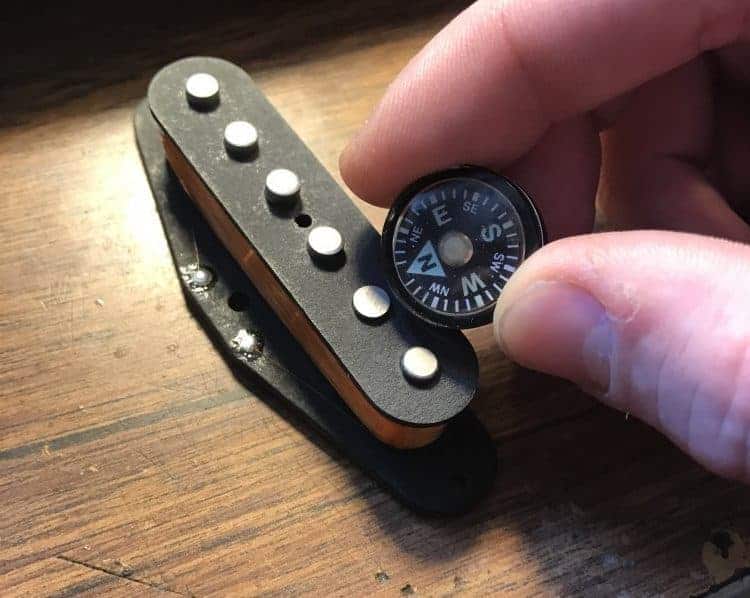
How would I wire this pickup which is wired in series to be 4-conductor, and how would I know which wire would be which? North hot, north ground, south hot, south ground? I want to wire a pair of them up as series/single/parallel (individually). The existing lead from the pickup is the clear-covered copper wire wrapped with a braided shield ground conductor.

IMG_20190707_162932.jpg


Thanks!
 
There's a couple of different ways that could be wired up on the inside....

The best thing to do if we're committed to really figuring it out and allowing it to be wired in parallel or single is to:

carefully cut the wires to each of those rear contact points...
and measure the resistance between each pair of them. The ones that have a measurable resistance measurement (non infinity) are placed on either end of a pickup coil.


Once we know where either end of each coil is, then we can figure out how to wire her up 4-conductor.

This must be done quite carefully indeed.
 
There's a couple of different ways that could be wired up on the inside....

The best thing to do if we're committed to really figuring it out and allowing it to be wired in parallel or single is to:

carefully cut the wires to each of those rear contact points...
and measure the resistance between each pair of them. The ones that have a measurable resistance measurement (non infinity) are placed on either end of a pickup coil.


Once we know where either end of each coil is, then we can figure out how to wire her up 4-conductor.

This must be done quite carefully indeed.
Hey there!

Could I just connect my multimeter probes to the solder joints without removing the wires?
 
Hey there!

Could I just connect my multimeter probes to the solder joints without removing the wires?
Hmmm. You know... let's give that a shot.

Let's number those five contacts A through E

pup.jpg


So, what's the kilo-ohms reading between:

A to B
A to C
A to D
A to E
B to C
B to D
B to E
C to D
C to E
D to E

The majority of these will read no connection(infinity ohms) or zero ohms. But several should give readings somewhere in the 1-100 KOhm range.

EDIT: To anyone reading later and tempted to toss a bit of instruction my way, I'm fully cognizant that A-E and B-D are guaranteed to read a resistance of zero. I want fourstringbliss to measure them anyway. I have lost count of the number of times I have detected errors in my measurement process by checking things that are "obvious". It pays to be thorough in measurement. ;)
 
Last edited:
  • Like
Reactions: HolmeBass
Also, I sent a support request on this to the good folks at Bartolini, but I'm not holding out a lot of hope that they're going to give me much help rewiring 12 year old custom pickups. We'll see.

If these were Nordstrand pups, though, I'd get an answer right quick.
 
  • Like
Reactions: rojo412
Here are the readings with the pickup disconnected from the preamp:

A to B 4.12
A to C 8.3
A to D 4.12
A to E
B to C 4.12
B to D
B to E 4.12
C to D 4.12
C to E 8.3
D to E 4.1

Problem is that the red and blue wires are connecting spots mucking up the readings. I need to cut those wires, huh?

From what you're seeing does it seem to you like this is a pickup that could be wired series/single/parallel? I don't want to cut anything if not. If so, I don't mind cutting those wires in the middle and then extending them by soldering more wire to the ends.
 
Last edited:
So what we know is:
C is a hot lead
A is a shielding ground and E the ground for the other coil (or the other way around, but it does not matter)
B and D are a hot lead for the E coil or the ground for the C coil. If you disconnect only the red wire you’ll find out which is which. And that is the only thing left you need to know.

Series wiring will only be possible if both coils cover the whole width. I doubt if that’s the case.
 
From what you're seeing does it seem to you like this is a pickup that could be wired series/single/parallel? I don't want to cut anything if not. If so, I don't mind cutting those wires in the middle and then extending them by soldering more wire to the ends.

It's definitely two coils in series.

C is the hot side of one of the coils. Let's call that one the First coil and the other one is the Second coil.

Between A and E, I believe one of them is the common on Second coil, and one of them is the pickup's internal shielding. They're tied together because that makes it convenient to have a single wire. You won't need to cut that blue wire for now. It's AOK as is.

The magic is B and D. One of them is First coil common, the other one is Second coil hot. Right now they're tied together by the red wire to put the pickup in series.

What we'll need to do to let you wire this pickup now is for you to determine which coil B is attached to and which coil D is attached to.

Leave the blue wire alone. Cut the only the red wire, then measure ohms again:

B to C
B to A

D to C
D to A

With those results, we can know which terminal is attached to which coil, and then get you wired up with a four-conductor pickup that you can do series, single or parallel on!
 
  • Like
Reactions: Killed_by_Death
So what we know is:
C is a hot lead
A is a shielding ground and E the ground for the other coil (or the other way around, but it does not matter)
B and D are a hot lead for the E coil or the ground for the C coil. If you disconnect only the red wire you’ll find out which is which. And that is the only thing left you need to know.

Series wiring will only be possible if both coils cover the whole width. I doubt if that’s the case.

You nailed it! :bassist: It's actually a good chance that the two coils cover the full width. Bartolini makes a lot of full width dual coils. If this pickup set is split coil, that'll eliminate the single coil option though, you're right.