• TalkBass has been independent since 1998. Add your voice.
    Create a free account to reply to discussions, view embedded media, and browse with fewer display ads.
    Join freeLog in
    Want zero display ads or expanded classifieds tools? Compare plans.

RichLite composite fretboards

My Kramer has an ebonol fret board. Do any other manufacturers/luthiers use ebonol.
The Squier VM Series Fretless Jazz and Fretless Precision have lined ebanol fingerboards. I like it on a fretless, very defined, glassy "mwah", and its jet black. It has no "grain" whatsoever, so it definitely looks synthetic though.
http://www.musiciansfriend.com/bass/squier-vintage-modified-fretless-jazz-bass

My Steinberger has a black phenolic FB, its very durable, but a little brittle and difficult to re-fret without chipping. I havent seen any pro/cons as far as refret using the Richlite or Rocklite.
 
  • Like
Reactions: gazzatriumph
Here's another one to check out. Next time I order ebony fingerboard blanks from this company in Spain I'm going to pick up a couple. They call it Blackwood Tek. Starts out life as a piece of Pine! They used to have a video that explained the manufacturing a little more, but here's the description from the website:
Has anyone used this?

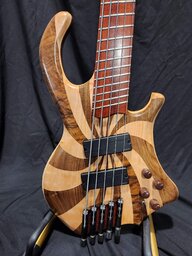
I've used it on a guitar I'm currently building. It's extremely stable, I've had no issues with planing or routing. The dust produced from sanding is very fine and (just like Ebony) can be a pain for getting trapped in the end grain of Maple, etc. Overall I like it, the only thing that would put me off using it again is that it has a strange, not-too-pleasant smell, which seemed to linger in the filter on my dust extractor for a long time after drum sanding.

7aUTDR.jpg
 
I've used it on a guitar I'm currently building. It's extremely stable, I've had no issues with planing or routing. The dust produced from sanding is very fine and (just like Ebony) can be a pain for getting trapped in the end grain of Maple, etc. Overall I like it, the only thing that would put me off using it again is that it has a strange, not-too-pleasant smell, which seemed to linger in the filter on my dust extractor for a long time after drum sanding.

Nice Guitar! That fretboard looks great in the pic. Nice, slight variations in color. Any close ups?
 
I took a shot with this stuff on a recent build and learned a lot...

First off, it's very easy to work with on shaping and cutting. I had concerns over burning it on the router or fret saw. But it cut really well.

Second, and maybe it's just my bad, but Titebond didn't work for me when attaching it to the neck. The fretboard came off!
I ended up using epoxy to finish it, but then wondered if something like SigMent binding glue would be better.

IMG_3821.JPG


Third, this stuff is TOUGH. The incident above was partially caused by the fact that the .023 fret slots were too narrow. No problems in the past with wood boards, but this stuff doesn't give. Adding a ton of pressure in the board from wide tangs, mixed with pounding the frets in furiously, likely caused the split.
- In the future, I'm using a wider blade for slots and a better glue. And I'm definitely going to try this for a fretless.

Fourth, it seems a little harder to get glossy and shiny like I'd done on other phenolic boards in the past. Again, maybe it's me, but it looked spotty when I buffed it. However, a satin/matte finish looks stellar on it.

IMG_3901.JPG

Like any phenolic, you'll see a "grain" if you don't paint it black. I've had quite a few phenolic boards and they all had grain. Personally, I like it, but if you want 100% jet black with no grain, you'll need something beyond this.

I actually have some of the "maple" stuff to try in the future, too.

IMG_3771.JPG
 
I took a shot with this stuff on a recent build and learned a lot...

First off, it's very easy to work with on shaping and cutting. I had concerns over burning it on the router or fret saw. But it cut really well.

Second, and maybe it's just my bad, but Titebond didn't work for me when attaching it to the neck. The fretboard came off!
I ended up using epoxy to finish it, but then wondered if something like SigMent binding glue would be better.

View attachment 1189330

Third, this stuff is TOUGH. The incident above was partially caused by the fact that the .023 fret slots were too narrow. No problems in the past with wood boards, but this stuff doesn't give. Adding a ton of pressure in the board from wide tangs, mixed with pounding the frets in furiously, likely caused the split.
- In the future, I'm using a wider blade for slots and a better glue. And I'm definitely going to try this for a fretless.

Fourth, it seems a little harder to get glossy and shiny like I'd done on other phenolic boards in the past. Again, maybe it's me, but it looked spotty when I buffed it. However, a satin/matte finish looks stellar on it.

View attachment 1189334
Like any phenolic, you'll see a "grain" if you don't paint it black. I've had quite a few phenolic boards and they all had grain. Personally, I like it, but if you want 100% jet black with no grain, you'll need something beyond this.

I actually have some of the "maple" stuff to try in the future, too.

View attachment 1189335
It's the glue-ability of these synthetics that gives me the most concern.
 
  • Like
Reactions: rojo412
I've used it on a guitar I'm currently building. It's extremely stable, I've had no issues with planing or routing. The dust produced from sanding is very fine and (just like Ebony) can be a pain for getting trapped in the end grain of Maple, etc. Overall I like it, the only thing that would put me off using it again is that it has a strange, not-too-pleasant smell, which seemed to linger in the filter on my dust extractor for a long time after drum sanding.

7aUTDR.jpg
Are those fret markers at 7, 9 and 15? Unusual....
 

Latest posts