• TalkBass has been independent since 1998. Add your voice.
    Create a free account to reply to discussions, view embedded media, and browse with fewer display ads.
    Join freeLog in
    Want zero display ads or expanded classifieds tools? Compare plans.

Rickenbacker Rant

I used to be a real cheerleader until I started to read of all these issues. And I did have a warranty issue that cost me quite a bit of coin. The 4003 I bought from a dealer developed some blush under the finish on the walnut wings on the headstock nine mos after I bought it. I call Ric customer service, emailed pics of the areas where the finish was failing, and they told me to send it in as it was still under warranty. I sent it to Ric at my expense. I got a call from Ric three weeks later telling me my 4003 was ready to be returned to me, and it was returned to me untouched. I called them back, sent the pics again, and complained that I would be paying for shipping to them at my expense twice. They told me that was too bad, and would not help me out with free shipping by having to ship it back again. I was persistent, and I was eventually told they'd make it up to me in the form of a credit in their parts boutique for future purchases. The finish issue was eventually fixed only to a so/so degree. Then when I wanted to buy some accessories at the boutique on a later date, there was no credit waiting for me. I was told that the original customer rep I dealt with was no longer with the company and had spoken out of turn. That's my experience with Ric customer service. Poor.

There are several models of quality control/customer service/management philosophies available today, but Ric doesn't subscribe to any of the commonly accepted schools of management. They just doesn't see the value in hiring an MBA at $150,000 year. They could certainly hire an outside consultant, but of all the privately held companies I have done business with, it's very hard for business owners to give up control and look at things differently. But things may have to change soon. Ric recently set up Guitar Center as a dealer again which tells me the backlog has shrunk significantly to the point where Ric had to look for a large volume buyer to fill in the gap. And if GC starts having to take returns of a large enough number of Rics with QC issues, they'll certainly have the clout to demand improvement.

Pretty much this. I'm not going to get into anecdotal evidence, but I could've sworn someone stole my story here. Would not reimburse for shipping to fix something they did shoddily after the initial RMA. Got a local luthier to fix the problem instead. The bass just isn't for me, and the poopie QC from the RMA was the final nail in the coffin, but I'll store it away for a while and try again later.
image-3.jpeg
 
I never even work on mine. I'm so afraid that I'm gonna screw it up so I just take it to a tech

Ah, it's not that bad. Fancy piece of wood with strings and magnets.

I've already changed out most of my pots(multiple times) and knocked off the bakelite nut and slapped a brass one on there.

Btw, shaping grooves in a brass nut using old strings takes a LONG time. (But you get pretty brass "glitter" everywhere)
 
It would take a very long(and harder to find) hex wrench than a pretty standard long-reach nutdriver if that were the case. But I agree it would be cool to include a tool.

I see no reason at all that you would need anything other than a standard allen wrench if they used that type of nut. You would have to loosen the D and A string to get them out of the way, but that is no big deal really. I used a truss rod wrench like the one in the picture on the two that I have experience with. There was no need for a long reach. If I remember right it was 1/4", I think that was the only time I have ever used that tool.
TRW_1_4.jpg


"I stand corrected, I thought they were still using the old truss rods that required you to bend the neck manually before tightening them."

Don't feel bad, Hopkins. You're only 28 years behind on your info.:) RIC switched over to the "modern" rods by 1986. Aside from a few experimentals, RIC has always used dual rods on the basses, and even with the old style "hairpin" rods, the dual system has worked fine. It's the users and untrained techs who usually bugger things up with the old rods.


I have only ever worked on two Ricks, both were late 70's or early 80's models, and that was pretty recently. Ricks just aren't that common in my area so nobody ever brings me any to work on :D
I know the, dual rods as well as the old style rods work just fine, they are just more of a pain in the rear then they need to be. There really isn't much of an advantage to a dual rod vs single rod on a 4 string, and it makes adjusting the neck more of a headache than it needs to be.
 
Yep, I don't have to loosen strings with mine bc of the nutdriver. I personally dislike loosening my strings and like them at tension while I adjust(even though final results can take overnight)

Strangely, I've also not taken much longer to adjust my trussrods than my Fenders and Fender-style necks. (I use two capos, one at each end of the fretboard to do my setups.)
 
I think I already described my Rick issues and dealing with RIC ( the company) in this thread. The lastest in issues is my action after 2.5 years needs adjusted and to get the tool from RIC is like $35+ with shipping, its $13 to ship to me 15 miles away. I go directly past there factory so you think i could just grab one, nope cant do that. So until I feel like spending $35 on a tool my rick sits in a case.
 
I think I already described my Rick issues and dealing with RIC ( the company) in this thread. The lastest in issues is my action after 2.5 years needs adjusted and to get the tool from RIC is like $35+ with shipping, its $13 to ship to me 15 miles away. I go directly past there factory so you think i could just grab one, nope cant do that. So until I feel like spending $35 on a tool my rick sits in a case.

Go on Amazon and spend 11 bucks on the very same tool like I did.
I posted a picture of mine and a link on one of these threads a while back.
 
As an Amazon Associate, TalkBass may receive commissions from qualifying purchases made via links on this site.
  • Like
Reactions: FaithNoMan
It is common for Rics to just fall apart for no reason ... here is photographic evidence ...

brokenric.jpg
broken.jpg

As a woodworker, I see these pictures and wonder what materials were used? The one on the left has clean breaks at the body wings meaning problems with the adhesive or the method of gluing. Either way, it's a preventable issue - QC's fault. The other breaks make me believe there's problems with the engineering and design. If you look at the red one on the right, where the neck pickup pocket is, you see very little material at a point where there is a lot of tension. RIC has to know about this, you'd think they would put a little R&D into it and fix it. And when I see that really light colored wood, it makes me think of wood that commonly comes from China or Taiwan. The fibers don't hold together well. It's just cheap junk that should never be used in fine furniture or musical instruments, IMHO.

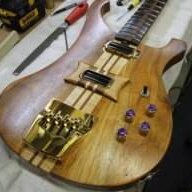
I'm building my first bass, in a RIC-style. The neck is a 5-piece laminate with hard maple predominate. I'll be incorporating carbon fiber rods into it too. But I'm still looking for additional ways to ensure something like the above doesn't happen to mine. You'd think that a guitar company, that has engineers at their disposal, would be more conscientious and thorough than someone working out of their basement shop. :oops: But maybe as long as they keep the supply low and demand high, quality can take a back seat.

 
...where the neck pickup pocket is, you see very little material at a point where there is a lot of tension. RIC has to know about this

That is an unbound "classic" model, which I believe the spacing on the neck pickup is closer to the neck by a 1/2". So the regular 4003 basses have a stronger pocket because the route is further away. But since it was ran over and you're basing build construction on that, that bass does appear weak in that area.
 
That is an unbound "classic" model, which I believe the spacing on the neck pickup is closer to the neck by a 1/2". So the regular 4003 basses have a stronger pocket because the route is further away. But since it was ran over and you're basing build construction on that, that bass does appear weak in that area.
I didn't see anything where they were run over, just that they fell apart for no reason. But that little bit of stock left after the neck cavity was routed would have me worried.
 
  • Like
Reactions: FaithNoMan