• TalkBass has been independent since 1998. Add your voice.
    Create a free account to reply to discussions, view embedded media, and browse with fewer display ads.
    Join freeLog in
    Want zero display ads or expanded classifieds tools? Compare plans.

Right hand anchoring

Hey again,
I've been watching the Sheehan lesson on Youtube, and want to be able to play as fast and fluidly as him. But, to do that, you need a good anchoring point(s) for your right hand. Incase it helps, I have two 'J' pickups, unlike Sheehan, so I can't anchor like him. So can someone please suggest a good right hand anchoring technique, and whether I should go with stationary or movable?

Thanks alot :D
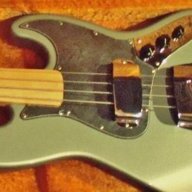
 
I'm a firm devotee of right thumb anchoring. But to do so, you do need fairly large hands, which I'm fortunate to have. On my Jaguar I use the neck pickup and I also had Jim Mouradian make me a lucite thumbrest that mounts in the pickguard screwhole near the butt of the neck. These are very easy to make (if you have the tools); basically a one-inch crescent of lucite with a hole in the middle.

I also use the side of the neck where it joins the body - you can get a nice fat, round tone here playing over the fingerboard.

If you are having trouble maintaining speed when "reaching" for the D and G strings, be sure that your right elbow moves up and away from the bass as you reach. This will not only help to avoid carpal tunnel issues by maintaining a neutral wrist position, but the movement of your elbow will help to keep your whole fluidity of motion going. Plus it keeps you on top of the strings so that your attack will be the same on the D and G strings as it is on the E and A strings, making your sound more consistent.
 
Like many, I was taught to anchor my thumb atop the pup, yet there are times when finger style moves to Slap and back. I have experimented with moving my anchoring from my thumb (rest position atop the pup) to my little finger gently pulling at the bottom of the pup as I start to Slap. Often I don't need the "Slap anchor" but there are times when it's helpful. When I first started Slapping I never used a rest but occasionally found that on a few things kept my hand very consistently in place. It wasn't so much a anchor as a "position location". With a J-Bass, there are a great many places to use for anchor or position locators.

On some setups (such as a Music Man) that requires too much Rt-Hand reach for this to be useful or comfortable and gets in the way of "palm muting". So after some time I've used much less pressure on the rest/anchor no matter the position. However in a rear pup anchor it helped a lot playing closer and closer to the bridge.

I once played a older P-Bass that had a add-on anchor for the finger(s) (@ the bottom of the pick-guard). It was designed for either playing w/ a pick or brushing w/ the thumb. It felt very odd for awhile until I got used to it and then I was pretty impressed w/ the idea.
 
I once played a older P-Bass that had a add-on anchor for the finger(s) (@ the bottom of the pick-guard). It was designed for either playing w/ a pick or brushing w/ the thumb. It felt very odd for awhile until I got used to it and then I was pretty impressed w/ the idea.

Those anchors, or tug bars, below the G string were stock, not add-ons up until the mid-'70s when they were moved to above the E string as thumb rests/anchors. Originally, it was envisioned that the electric bass would be played with the thumb. Why, I have no idea, since the whole point was to make an instrument that jazz double bassists could use as an alternative, and two-finger pizzicato is where it's at for most jazz double bassists.