• TalkBass has been independent since 1998. Add your voice.
    Create a free account to reply to discussions, view embedded media, and browse with fewer display ads.
    Join freeLog in
    Want zero display ads or expanded classifieds tools? Compare plans.

Right hand wrist angle

Hi guys!

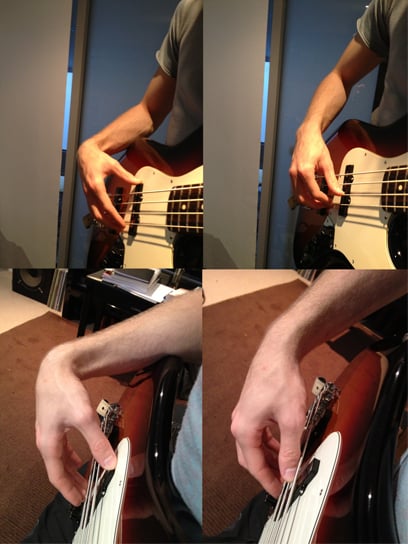
So I have a bit of a dilemma. I just started with my first real bass teacher who happens to be great. He writes music for tv and film, been in successful bands, has degrees in music, plays bass, fretless, guitar, piano, sings, etc. He's also one of the most expensive tutors in Sydney. With that in mind I went to my first lesson and got mixed advice. I have been playing bass since I started by placing my thumb on the string above the one I'm playing, like on the right in this picture. This allows me to easily pluck the stings with the fleshy part of my finger and keep my wrist from being bent - which I have read can cause injury.

My teacher said that I should be anchoring my thumb on the pickup and causing a sharp angle in my wrist to reach the G. I brought up the issue but he said it doesn't cause injury. He also said that my shoulder will tire and it's better to play his way.

This guy seems like an amazing teacher besides this one thing. What should I do? It doesn't seem like he will let me play with my thumb on the strings.
25in6t3.jpg
 
Get a new teacher ! Any teacher that forces a pupil to play in such a way, should be avoided like the plague IMO. While a lot of players rest their thumb on the pick up, it is generally accepted (your teacher being an exception) that both wrists should be as straight as possible.

Having the wrist at a severe angle will more than likely cause carpel tunnel problems later on. Just because you dont experience any problems now, does not mean that you never will. Sometimes it can take years before a problem manifests itself.

The technique you yourself use ( sometimes called the "Floating Anchor") is a very good and safe one. Here, Adam Nitty describes and endorses that technique.


It may not have caused problems for him but that doesn't necessarily mean it won't cause problems for you.

I don't know if it's relevant but it seems you have very slender wrists (A.K.A. 'girly wrists') - so do I, and I've had wrist tendon problems from playing bass guitar. I also know a professional bassist with girly wrists who's had worse problems than me resulting in surgery. Better safe than sorry - keep your wrists as straight as you can.

Incidentally the worst position that I've found for my wrists to be in is... hard to explain: Hold your hand out straight as if you're going to shake someone's hand. Now tilt your hand down towards the floor, pinky first. That wrist position is killer. If you find you're playing with your wrist bent in that way, try to find a better way because it is very bad for your tendons.
 
Hmm...when I was teaching bass, my approach was to make the student find a playing position that was comfortable. The only time I corrected someone's playing position was with a guy who anchored his thumb on the top of the body and reached down to the strings from there! Even he admitted it was tiring to play that way.

I drifted through a number of playing positions myself, but the one I've settled on is with my hand close to the top of the neck. That way I'm resting my forearm on the top of the guitar's body, and my hand can hang down, relaxed, with my thumb resting loosely on the top of the neck. My thumb will sometimes 'float' down a bit if I'm doing any fast work on the top strings.

Like this, in fact: [Invalid or Expired Link Removed]

Rather than keeping your wrist straight or bent, I would have said the most important thing is to keep it relaxed!
 
Thanks for the insight guys. I guess I'll find another teacher if playing this way is going to cause me problems down the road.

If you find this teacher to be good in other ways, you could always try explaining to him that while you respect his advice, you find that your own way is more comfortable for you. If he is any good, he will know that technique is not a "one size fits all" issue, that everyone is different, and as long as a person is comfortable with a particular technique, and it is safe, there is no problem.

If he refuses to accept this......head straight for the door.
 
james jamerson played with floating thumb. tell this to your teacher this should shut him up long term
even though what you do is anchored thumb.
i use both on my jazz. between pups i use anchorded and between neck and pup i float.
are "girly wrists" thin wrists? will i have problems too even though i play with proper technique ? :(
 
What's 'proper technique'? I didn't think there was a universally accepted 'proper' technique for bass guitar.

Yes I was talking about thin wrists. It sounds like a silly thing to consider but if you think that all the tendons and nerves for your fingers/hand have to pass through the carpal tunnel, if your wrist is narrower maybe that tunnel is narrower too, and a little inflammation could be a bigger problem.
 
What's 'proper technique'? I didn't think there was a universally accepted 'proper' technique for bass guitar.

Yes I was talking about thin wrists. It sounds like a silly thing to consider but if you think that all the tendons and nerves for your fingers/hand have to pass through the carpal tunnel, if your wrist is narrower maybe that tunnel is narrower too, and a little inflammation could be a bigger problem.

with proper technique i mean technique thats not considered a healt hazard. like straight wrists in this case
 
The major benefit of floating thumb is: muting low strings resonance, in that case the E string. Tell him that if one day you would play a 5 string or a 6 string bass, i.e muting the low B, having a good technique now would be a benefit.

I've got a teacher, a real killer, he plays wrist angled, I play floating thumb or even floating anchor. He told me I wasn't wrong, for the reason I told below, he is a little more clever than yours: if you can do all he's asking you while keeping your technique, don't worry, you are right and he is wrong: you keep your wrist in a good shape, better stamina, you won't have to face a carpal tunnel syndrome.

I raise up the shoulder to keep my wrist in a neutral position sometimes also, I mean straight in that case, and the thumb slightly open, to let all the nerves, tendons and blood canals find their way freely in my wrist when I have to play sixteenth notes grooves "a la jaco". Place the thumb where you want, but always keep the wrist straight as possible, let your wrist "breathe" .

And raising up the shoulder isn't an issue: ask volley-ball players, boxing guys, etc.... do they have issues with their shoulders?

One other important thing some times while playing, moving from the floating thumb to the floating anchor for example: if you want to change position, do it !! the best way to relax and release tension is to move our positions, ..... ask your body if you always keep the same position while sleeping, it's impossible, or you would face blood issues ;)
 
The major benefit of floating thumb is: muting low strings resonance, in that case the E string. Tell him that if one day you would play a 5 string or a 6 string bass, i.e muting the low B, having a good technique now would be a benefit.

Also, floating thumb ensures that your plucking position and stroke is consistent across strings, instead of having a different reach and angle for different strings.

I can see the argument that neither method is "better" (i.e., use what works for you), and I can see the argument(s) for why floating thumb is better, but I can't see any good argument for why anchoring is better -- at least not better enough to force a student to switch to it. I wouldn't have any objection if OP came in using anchoring, and the instructor wanted him to learn floating thumb, but the other way around doesn't make sense to me.
 
I can see the argument that neither method is "better" (i.e., use what works for you), and I can see the argument(s) for why floating thumb is better, but I can't see any good argument for why anchoring is better -- at least not better enough to force a student to switch to it. I wouldn't have any objection if OP came in using anchoring, and the instructor wanted him to learn floating thumb, but the other way around doesn't make sense to me.

Quite: even from the photos it looks like his wrist is tensed up when he's anchored and much more relaxed when the thumb's floating. I would have said that the important thing is to find a position which minimises the tension in one's hand. Any good piano teacher will tell you that your wrists should be almost "limp" when you hold your hands over the keys; in the same way your hand needs to be able to relax over the strings. If it can't, your tendons will be screaming at you after a few bars of sixteenth-notes.
 
My teacher said that I should be anchoring my thumb on the pickup and causing a sharp angle in my wrist to reach the G. I brought up the issue but he said it doesn't cause injury. He also said that my shoulder will tire and it's better to play his way.

This guy seems like an amazing teacher besides this one thing. What should I do? It doesn't seem like he will let me play with my thumb on the strings.

25in6t3.jpg

Hi, I can see your dilemma, well first off I never get involved in questioning any teachers methods, as they are usually very good reasons for what they teach.
But this part, and only this part of your teachers advice is wrong. It's not, might be, or could be, but it is plain and simply wrong.
No one introduces excesive wrist angle into a technique, wrist angle is always taken out of a technique.
The reason is a medical one. It applies to anyone that has a hand dominated use in work or leisure. From typing skills to any keyboard skills, from cycling to playing instruments etc. the advice is to minimise the wrist angles.

Simple reason is based in Anatomy and body mechanics, excess wrist angle with finger use means that the fingers being used have their movement initiated in the forearm muscle groups.
The Flexorsin these groups run through the wrist, so if the wrist is bent these Flexors are not running free, they are I fact being inhibited in there movement.
Also running through the wrists are some main nerves, one of these is the Median Nerve. So not only is the wrist bend inhibiting the Flexors, it is inhibiting the Median Nerve.

In the wrist area we have two banded muscles, the flexor retinaculum on the palm side and the extensor retinaculum on the back. When contracted, most of the tendons of these muscles are prevented from standing up like taut bowstrings around the wrist by passing under the flexor retinaculum on the palm side and the extensor retinaculum on back of the hand.
In the palm these Flexors are in sheaths that use the Carpal Tunnel to allow them to slide back and forwards with muscle contraction that move the fingers.
This is where the damage will occur...that is not might, or could, that is where the damage will occur if the wrist is over bent.

Feel free to search or look up any of the terms I have highlighted in italic, use your own judgment to decide what is correct for you.
Please tell your teacher you have used TB and got advice contrary to his, but this advice is based in medical facts.
Please ask him to read any of the posts in the medical sticky on this techniques form ( it is at the top of the page ) and if he wishes to ask any questions about why wrists should be " straight as possible " then I am always happy to share any information or advice and can be contacted here on TB or via E-mail.

What I am not here to do is to share personal vindications or endorsements of what other players do or do not do, or this person or that person has used this or that....I am just giving the medical advice and facts as we understand them today, that advice is " wrists as straight as can be, take out excess bend ".

I am sorry to take such a line in theses matters, but I have never heard of anyone being told to introduce wrist bend, never mind being told it will help them reach lower strings, this is not a modern accepted use, we as players lower the forearm onto which a straight wrist, and of course the fingers will follow as they are all one...we do not over extend the wrist to lower the fingers.
As has been said Floating Thumb will do this fine, as will any number of techniques, but always with the wrist " as straight as can be"..this will mean different things to different people depending on age, flexibility etc. but always means the same....if the wrist can be used straighter and in line...do so.

F.